


Auditory Hallucinations and the Brain's Resting-State Networks: Findings and Methodological Observations
- PMID: 27280452
- PMCID: PMC4988751
- DOI: 10.1093/schbul/sbw078
Auditory Hallucinations and the Brain's Resting-State Networks: Findings and Methodological Observations
Abstract
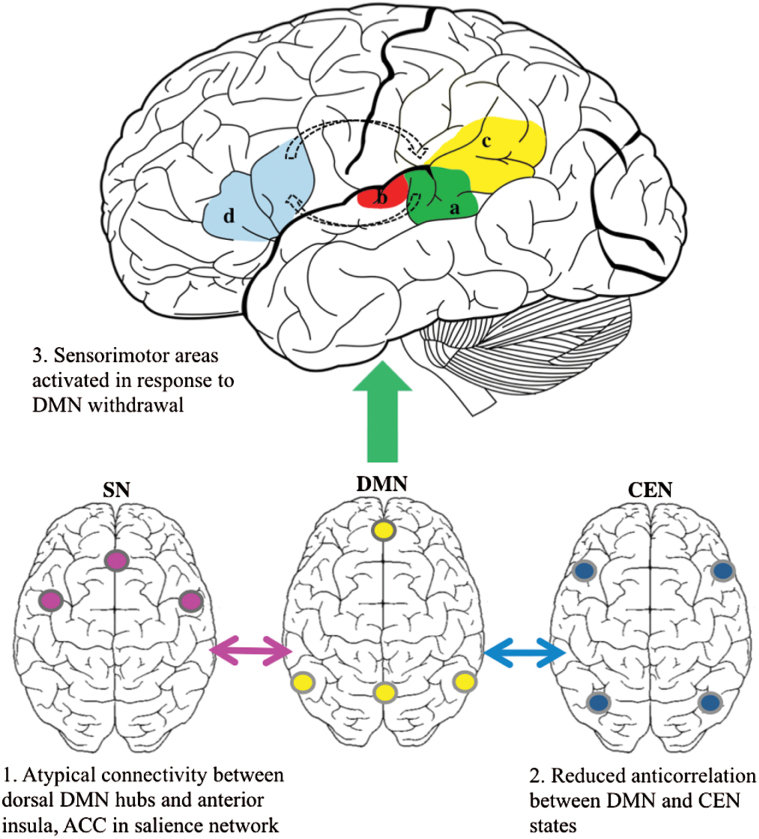
In recent years, there has been increasing interest in the potential for alterations to the brain's resting-state networks (RSNs) to explain various kinds of psychopathology. RSNs provide an intriguing new explanatory framework for hallucinations, which can occur in different modalities and population groups, but which remain poorly understood. This collaboration from the International Consortium on Hallucination Research (ICHR) reports on the evidence linking resting-state alterations to auditory hallucinations (AH) and provides a critical appraisal of the methodological approaches used in this area. In the report, we describe findings from resting connectivity fMRI in AH (in schizophrenia and nonclinical individuals) and compare them with findings from neurophysiological research, structural MRI, and research on visual hallucinations (VH). In AH, various studies show resting connectivity differences in left-hemisphere auditory and language regions, as well as atypical interaction of the default mode network and RSNs linked to cognitive control and salience. As the latter are also evident in studies of VH, this points to a domain-general mechanism for hallucinations alongside modality-specific changes to RSNs in different sensory regions. However, we also observed high methodological heterogeneity in the current literature, affecting the ability to make clear comparisons between studies. To address this, we provide some methodological recommendations and options for future research on the resting state and hallucinations.
Keywords: default mode network; fMRI; perception; psychosis; schizophrenia.
© The Author 2016. Published by Oxford University Press on behalf of the Maryland Psychiatric Research Center.
Figures
References
-
- Northoff G, Qin P. How can the brain’s resting state activity generate hallucinations? A “resting state hypothesis” of auditory verbal hallucinations. Schizophr Res. 2011;127:202–214. doi:10.1016/j.schres.2010.11.009. - PubMed
Publication types
MeSH terms
Grants and funding
LinkOut - more resources
Full Text Sources
Other Literature Sources
Medical
