


Targeted Prostate Biopsy Gleason Score Heterogeneity and Implications for Risk Stratification
- PMID: 27281263
- PMCID: PMC6754742
- DOI: 10.1097/COC.0000000000000308
Targeted Prostate Biopsy Gleason Score Heterogeneity and Implications for Risk Stratification
Abstract
Objectives: To quantify Gleason score (GS) heterogeneity within multiparametric magnetic resonance imaging (MRI)-targeted prostate biopsies and to determine impact on National Comprehensive Cancer Network (NCCN) risk stratification.
Methods: An Institutional Review Board-approved retrospective study was performed on men who underwent Artemis (MRI-transrectal-ultrasound fusion) targeted biopsy (TB) for suspected prostate cancer between 2012 and 2015. Intratarget heterogeneity was defined as a difference in GS between 2 cores within a single target in patients with ≥2 positive cores. Prostate specific antigen, maximum tumor diameter, apparent diffusion coefficient, MRI suspicion score, prostate volume, systematic biopsy (SB) GS, and T-stage were analyzed for correlation with heterogeneity. Changes in NCCN risk based on high versus low GS on TB, SB alone, and SB+TB were compared.
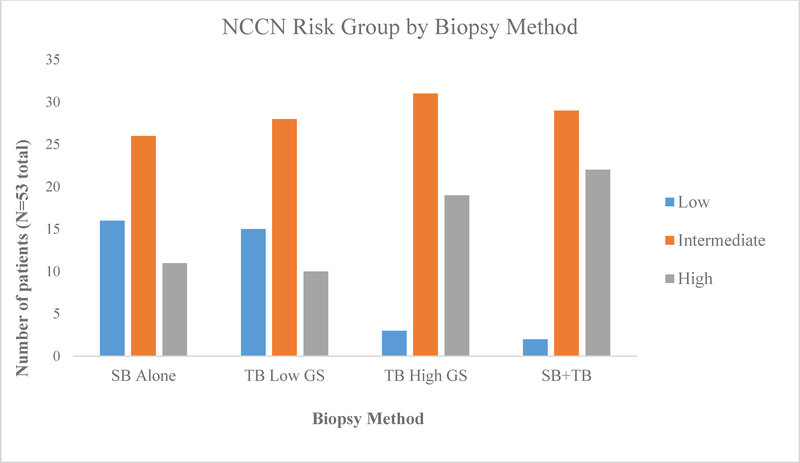
Results: Fifty-three patients underwent TB of 73 suspected lesions. Seventy percent (51/73) had ≥2 positive cores, thus meeting inclusion criteria for heterogeneity analysis. Fifty-five percent (28/51) of qualifying targets showed GS heterogeneity. None of the evaluated factors showed a significant relationship with heterogeneity. NCCN low-risk, intermediate-risk, and high-risk groups were 30%, 49%, and 21%, respectively, with SB alone. Adding low GS TB to SB resulted in 17%, 55%, 28% in each risk group, while using high GS+SB resulted in 4%, 54%, and 42%. Overall, the addition of TB resulted in higher NCCN risk groups in 38% of cases.
Conclusions: Over half of multiparametric MRI-defined targets demonstrated GS heterogeneity. The addition of high GS from TB leads to risk inflation compared with using SB alone. Further research is needed on how to integrate these findings into current risk stratification models and clinical practice.
Conflict of interest statement
Figures
References
-
- Washington SL, Bonham M, Whitson JM, Cowan JE, Carroll PR. Transrectal ultrasonography-guided biopsy does not reliably identify dominant cancer location in men with low-risk prostate cancer. BJU international. 2012;110(1):50–5. - PubMed
-
- Fernandes ET, Sundaram CP, Long R, Soltani M, Ercole CJ. Biopsy Gleason score: how does it correlate with the final pathological diagnosis in prostate cancer? British journal of urology. 1997;79(4):615–7. - PubMed
Publication types
MeSH terms
Grants and funding
LinkOut - more resources
Full Text Sources
Other Literature Sources
Medical
