Metabolic and Kidney Diseases in the Setting of Climate Change, Water Shortage, and Survival Factors
- PMID: 27283495
- PMCID: PMC4978060
- DOI: 10.1681/ASN.2015121314
Metabolic and Kidney Diseases in the Setting of Climate Change, Water Shortage, and Survival Factors
Abstract
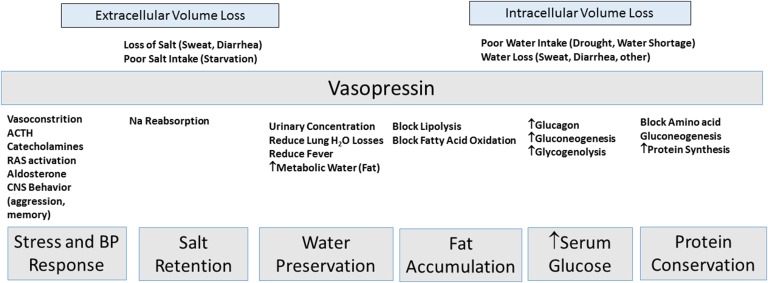
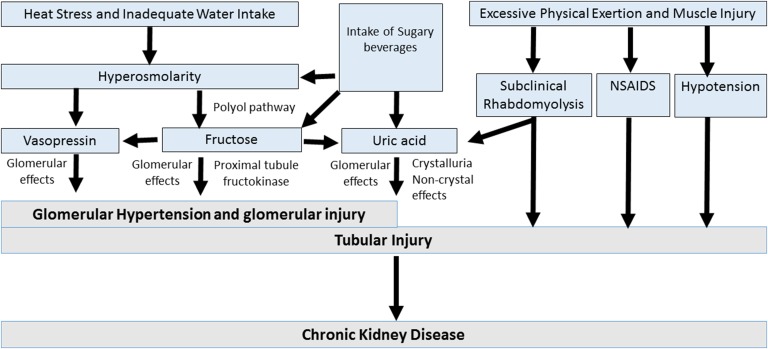
Climate change (global warming) is leading to an increase in heat extremes and coupled with increasing water shortage, provides a perfect storm for a new era of environmental crises and potentially, new diseases. We use a comparative physiologic approach to show that one of the primary mechanisms by which animals protect themselves against water shortage is to increase fat mass as a means for providing metabolic water. Strong evidence suggests that certain hormones (vasopressin), foods (fructose), and metabolic products (uric acid) function as survival signals to help reduce water loss and store fat (which also provides a source of metabolic water). These mechanisms are intricately linked with each other and stimulated by dehydration and hyperosmolarity. Although these mechanisms were protective in the setting of low sugar and low salt intake in our past, today, the combination of diets high in fructose and salty foods, increasing temperatures, and decreasing available water places these survival signals in overdrive and may be accelerating the obesity and diabetes epidemics. The recent discovery of multiple epidemics of CKD occurring in agricultural workers in hot and humid environments may represent harbingers of the detrimental consequences of the combination of climate change and overactivation of survival pathways.
Keywords: chronic kidney disease; metabolism; obesity; osmolality; vasopressin.
Copyright © 2016 by the American Society of Nephrology.
Figures

References
-
- NASA: Global Temperatures. Earth Observatory. Available at: http://earthobservatory.nasa.gov/Features/WorldOfChange/decadaltemp.php. Accessed April 20, 2016
-
- Hansen J, Ruedy R, Sato M, Lo K: Global surface temperature change. Rev Geophys 48: RG4004, 2010
-
- Fischer EM, Knutti R: Anthropogenic contribution to global occurrence of heavy precipitation and high temperature extremes. Nat Clim Chang 5: 560–565, 2015
-
- Kummu M, Ward PJ, de Moel H, Varis O: Is physical water scarcity a new phenomenon? Global assessment of water shortage over the last two millennia. Environ Res Lett 5: 1–10, 2010
-
- Vörösmarty CJ, Green P, Salisbury J, Lammers RB: Global water resources: Vulnerability from climate change and population growth. Science 289: 284–288, 2000 - PubMed
Publication types
MeSH terms
Substances
Grants and funding
LinkOut - more resources
Full Text Sources
Other Literature Sources
Medical
Miscellaneous