. 2016 Jul 1;121(1):299-311.
doi: 10.1152/japplphysiol.01077.2015. Epub 2016 Jun 9.

Effects of aging on mitochondrial function in skeletal muscle of American American Quarter Horses

Affiliations

Effects of aging on mitochondrial function in skeletal muscle of American American Quarter Horses

Chengcheng Li et al. J Appl Physiol (1985). .

Abstract

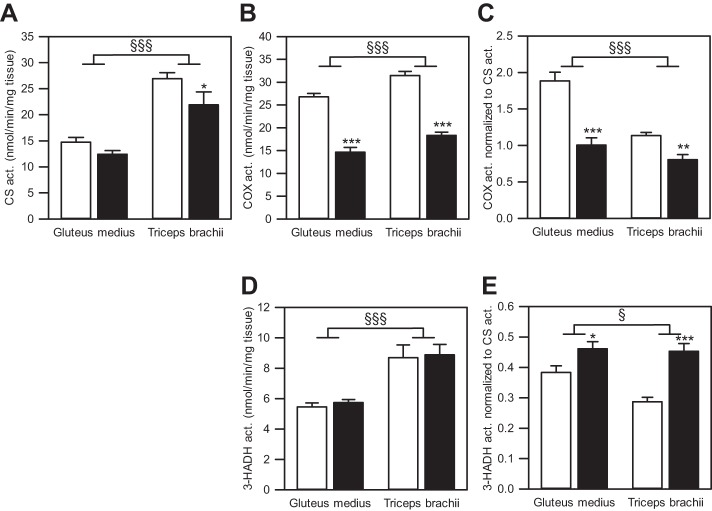
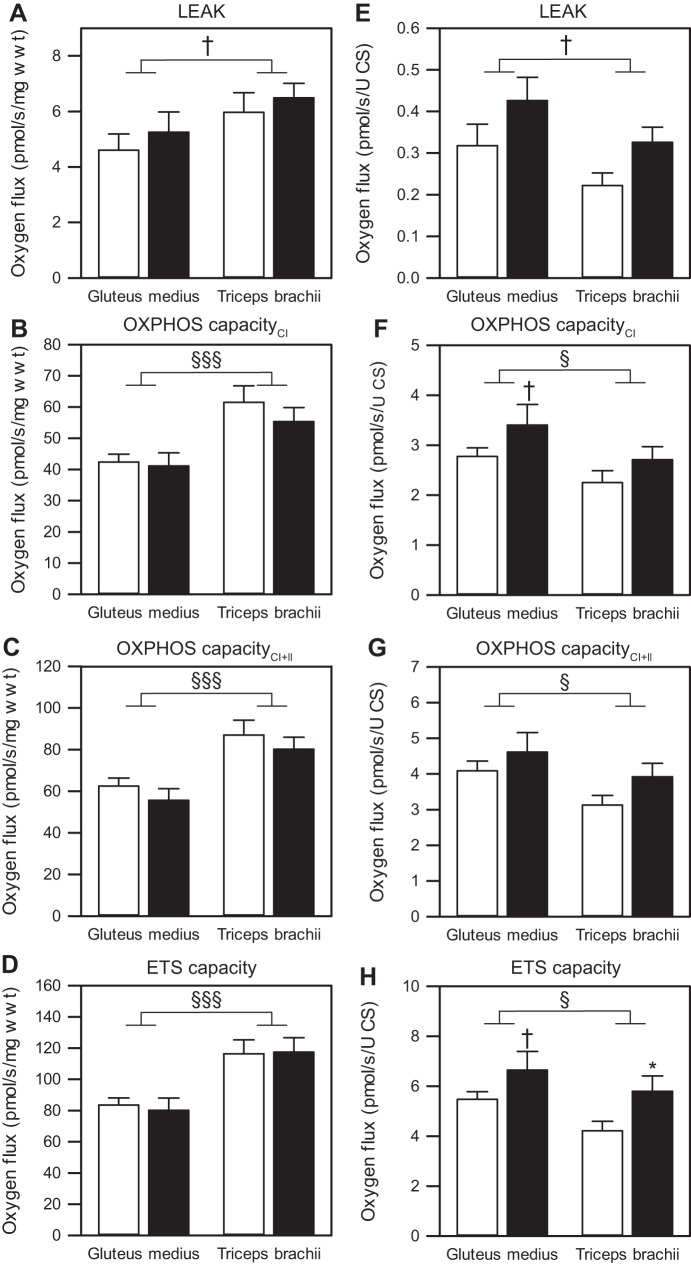
Skeletal muscle function, aerobic capacity, and mitochondrial (Mt) function have been found to decline with age in humans and rodents. However, not much is known about age-related changes in Mt function in equine skeletal muscle. Here, we compared fiber-type composition and Mt function in gluteus medius and triceps brachii muscle between young (age 1.8 ± 0.1 yr, n = 24) and aged (age 17-25 yr, n = 10) American Quarter Horses. The percentage of myosin heavy chain (MHC) IIX was lower in aged compared with young muscles (gluteus, P = 0.092; triceps, P = 0.012), while the percentages of MHC I (gluteus; P < 0.001) and MHC IIA (triceps; P = 0.023) were increased. Mass-specific Mt density, indicated by citrate synthase activity, was unaffected by age in gluteus, but decreased in aged triceps (P = 0.023). Cytochrome-c oxidase (COX) activity per milligram tissue and per Mt unit decreased with age in gluteus (P < 0.001 for both) and triceps (P < 0.001 and P = 0.003, respectively). Activity of 3-hydroxyacyl-CoA dehydrogenase per milligram tissue was unaffected by age, but increased per Mt unit in aged gluteus and triceps (P = 0.023 and P < 0.001, respectively). Mt respiration of permeabilized muscle fibers per milligram tissue was unaffected by age in both muscles. Main effects of age appeared when respiration was normalized to Mt content, with increases in LEAK, oxidative phosphorylation capacity, and electron transport system capacity (P = 0.038, P = 0.045, and P = 0.007, respectively), independent of muscle. In conclusion, equine skeletal muscle aging was accompanied by a shift in fiber-type composition, decrease in Mt density and COX activity, but preserved Mt respiratory function.

Keywords: 3-hydroxyacyl-CoA dehydrogenase; citrate synthase; cytochrome-c oxidase; high-resolution respirometry; myosin heavy chain isoform.


Figures

Fig. 1.
Fig. 1.
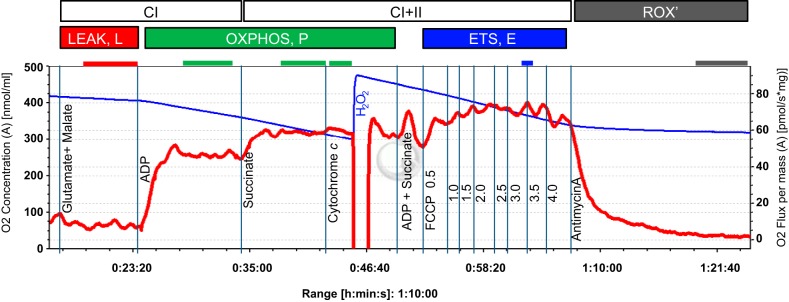
Respirometric protocol with permeabilized fibers from American Quarter Horse gluteus medius muscle. Shown is a typical trace of oxygen consumption after permeabilized fiber preparation with glutamate/malate and succinate substrate combinations to support electron flow through complex I (CI) and complex II (CII), respectively, of the mitochondrial electron transport system (ETS), and its activation by ADP. Cytochrome c was added as a quality control (see text for details), FCCP to induce uncoupling and evaluate ETS capacity, and antimycin A (inhibitor of complex III of the ETS) to evaluate residual oxygen consumption (ROX). The blue line represents the oxygen concentration (nmol/ml), the red line the muscle mass-specific O2 flux (pmol O2·s−1·mg wet wt−1; negative slope of the blue line normalized to tissue weight). Marked sections correspond to steady-state fluxes at different coupling states (L, P, and E; see text for explanations).
Fig. 2.
Fig. 2.
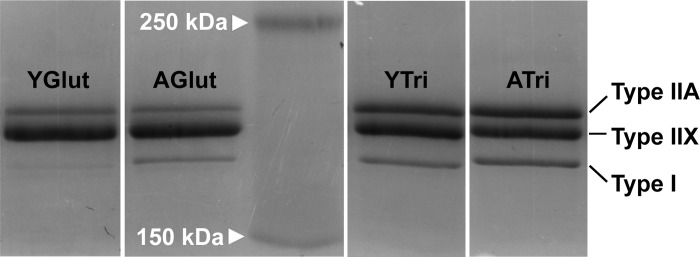
Representative SDS polyacrylamide gel stained with Coomassie blue following electrophoretic separation. Bands shown are MHC isoforms type I, type IIA, and type IIX, in gluteus muscle from young (YGlut) and aged (AGlut), and triceps muscle from young (YTri) and aged (ATri) American Quarter Horses. The middle lane shows the molecular mass markers at 250 and 150 kDa.
Fig. 3.
Fig. 3.
Enzyme activities in muscle tissue homogenates from gluteus medius and triceps brachii from young and aged American Quarter Horses. A: activity of citrate synthase (CS) per milligram tissue of gluteus medius and triceps brachii from young (n = 24 for gluteus, n = 11 for triceps) and aged (n = 9 for gluteus, n = 10 for triceps) horses. BE: activity of cytochrome-c oxidase (COX; B and C) and 3-hydroxyacyl-CoA dehydrogenase (3-HADH; D and E) normalized to milligram tissue (B and D) and to CS activity (C and E) in gluteus medius and triceps brachii from young (n = 23–24 for gluteus, n = 11–12 for triceps) and aged (n = 9–10 for gluteus, n = 9–10 for triceps) horses. Values are means ± SE. Open bars represent young horses; solid bars, aged horses. Young vs. aged: *P < 0.05, **P < 0.01, ***P < 0.001. Gluteus vs. triceps: §P < 0.05, §§§P < 0.001.
Fig. 4.
Fig. 4.
Mitochondrial respiration of permeabilized skeletal muscle fibers from gluteus medius and triceps brachii. Mass-specific O2 flux (pmol O2·s−1·mg wet wt−1; AD) and O2 flux normalized to CS activity (pmol·s−1·unit CS−1; EH), respectively, with LEAK respiration (A and E), OXPHOS capacityCI (B and F), OXPHOS capacityCI+II (C and G), and maximal ETS capacity (D and H) are shown. Values are means ± SE; n = 17–18 (young-gluteus), 12 (young-triceps), 9 (aged-gluteus), and 9 (aged-triceps). Open bars represent young horses; solid bars, aged horses. Young vs. aged: †P < 0.1, *P < 0.05. Gluteus vs. triceps: †P < 0.1, §P < 0.05, §§§P < 0.001.
Fig. 5.
Fig. 5.
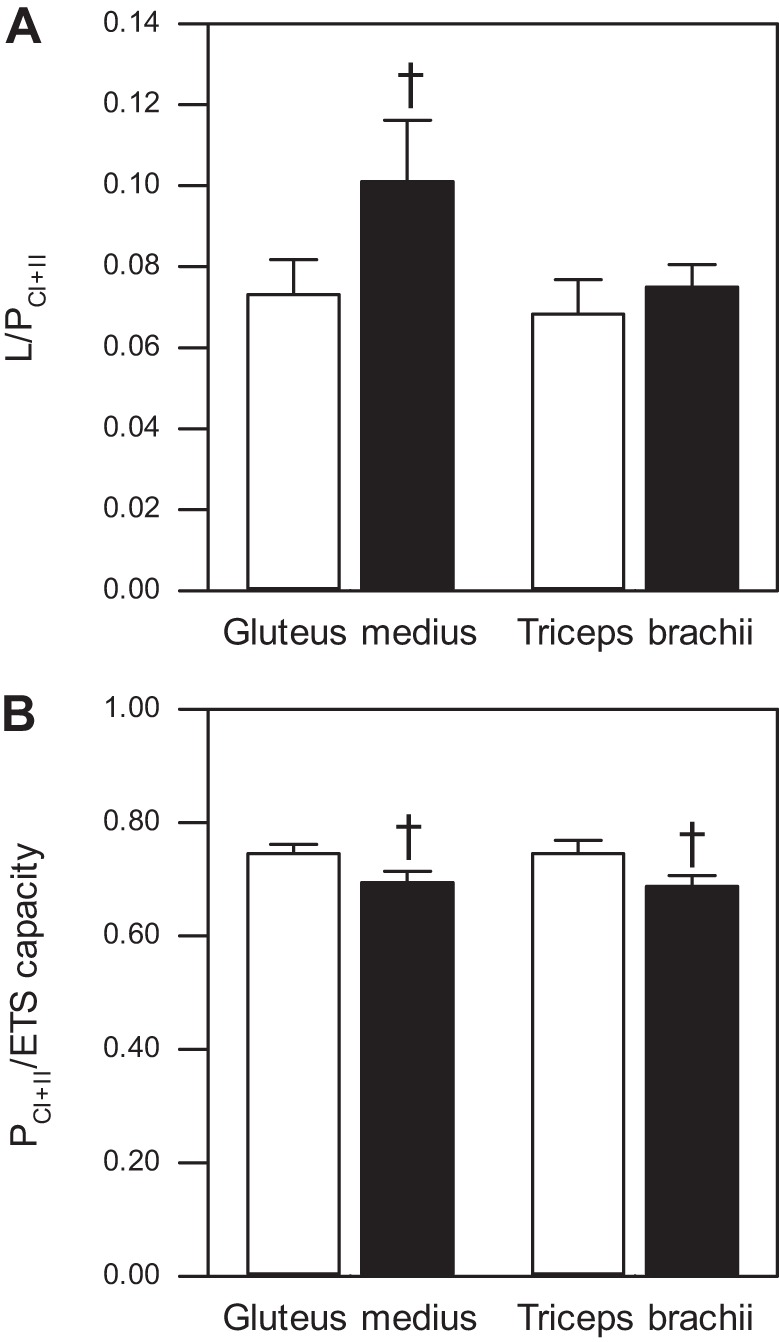
Mitochondrial coupling control ratios of permeabilized skeletal muscle fibers from gluteus medius and triceps brachii. A: L/P coupling control ratio (LEAK/PCI+II) of gluteus medius and triceps brachii from young (n = 18 for gluteus, n = 12 for triceps) and aged (n = 9 for gluteus, n = 8 for triceps) American Quarter Horses. B: P/E coupling control ratio (PCI+II/ETS capacity) of gluteus medius and triceps brachii from young (n = 18 for gluteus, n = 12 for triceps) and aged (n = 9 for gluteus, n = 9 for triceps) American Quarter Horses. Values are means ± SE. Open bars represent young horses; solid bars, aged horses. Young vs. aged: †P < 0.1.

References

    1. Amara CE, Shankland EG, Jubrias SA, Marcinek DJ, Kushmerick MJ, Conley KE. Mild mitochondrial uncoupling impacts cellular aging in human muscles in vivo. Proc Natl Acad Sci U S A 104: 1057–1062, 2007. - PMC - PubMed
    1. Andersen JL. Muscle fibre type adaptation in the elderly human muscle. Scand J Med Sci Sports 13: 40–47, 2003. - PubMed
    1. Anderson EJ, Neufer PD. Type II skeletal myofibers possess unique properties that potentiate mitochondrial H2O2 generation. Am J Physiol Cell Physiol 290: C844–C851, 2006. - PubMed
    1. Anton SD, Woods AJ, Ashizawa T, Barb D, Buford TW, Carter CS, Clark DJ, Cohen RA, Corbett DB, Cruz-Almeida Y, Dotson V, Ebner N, Efron PA, Fillingim RB, Foster TC, Gundermann DM, Joseph AM, Karabetian C, Leeuwenburgh C, Manini TM, Marsiske M, Mankowski RT, Mutchie HL, Perri MG, Ranka S, Rashidi P, Sandesara B, Scarpace PJ, Sibille KT, Solberg LM, Someya S, Uphold C, Wohlgemuth S, Wu SS, Pahor M. Successful aging: advancing the science of physical independence in older adults. Ageing Res Rev 24: 304–327, 2015. - PMC - PubMed
    1. Barrey E, Valette JP, Jouglin M, Blouin C, Langlois B. Heritability of percentage of fast myosin heavy chains in skeletal muscles and relationship with performance. Equine Vet J Suppl 30: 289–292, 1999. - PubMed

Substances