Review
. 2016 Jun 10;352(6291):aad9926.
doi: 10.1126/science.aad9926.

Transcriptional termination in mammals: Stopping the RNA polymerase II juggernaut

Affiliations
Review

Transcriptional termination in mammals: Stopping the RNA polymerase II juggernaut

Nick J Proudfoot. Science. .

Abstract

Terminating transcription is a highly intricate process for mammalian protein-coding genes. First, the chromatin template slows down transcription at the gene end. Then, the transcript is cleaved at the poly(A) signal to release the messenger RNA. The remaining transcript is selectively unraveled and degraded. This induces critical conformational changes in the heart of the enzyme that trigger termination. Termination can also occur at variable positions along the gene and so prevent aberrant transcript formation or intentionally make different transcripts. These may form multiple messenger RNAs with altered regulatory properties or encode different proteins. Finally, termination can be perturbed to achieve particular cellular needs or blocked in cancer or virally infected cells. In such cases, failure to terminate transcription can spell disaster for the cell.


Figures

Fig. 1
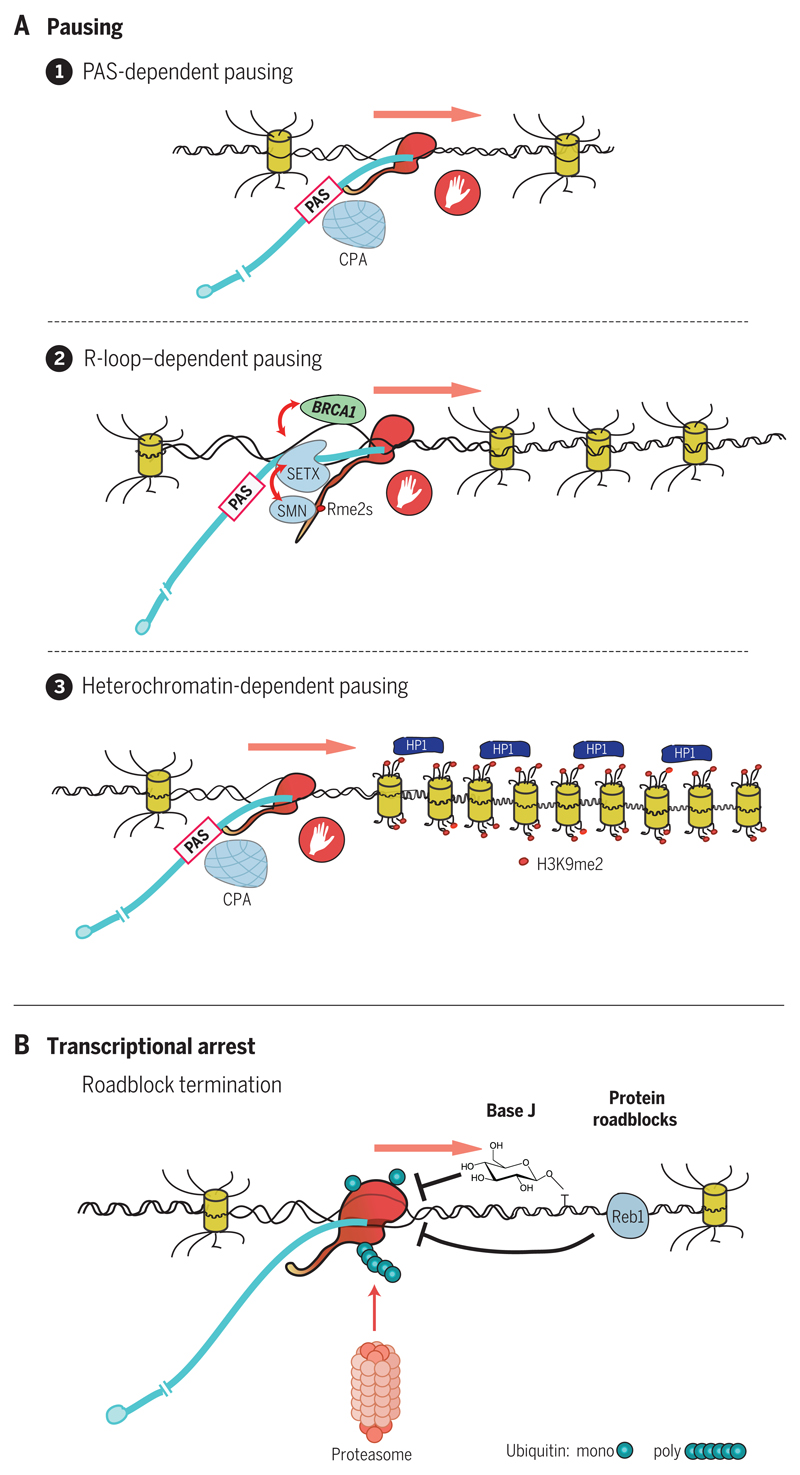
Fig. 1. Pausing or arresting Pol II.
(A) Three different types of Pol II pausing induced by CPA recognition of the PAS, R-loop formation, and heterochromatin patches. Elongating Pol II (red) is shown transcribing the DNA template, with extruded, capped RNA transcript (blue) indicated. Nucleosomes are depicted by yellow barrels, with histone N-terminal tails indicated. Pol II CTD is shown as an extended tail. Red dots on the CTD and histone tails denote methylation. The hand denotes Pol II pausing. (B) Pol II arrested by base J or Reb1 DNA binding protein. Pol II is then ubiquitinated and degraded by the proteasome.
Fig. 2
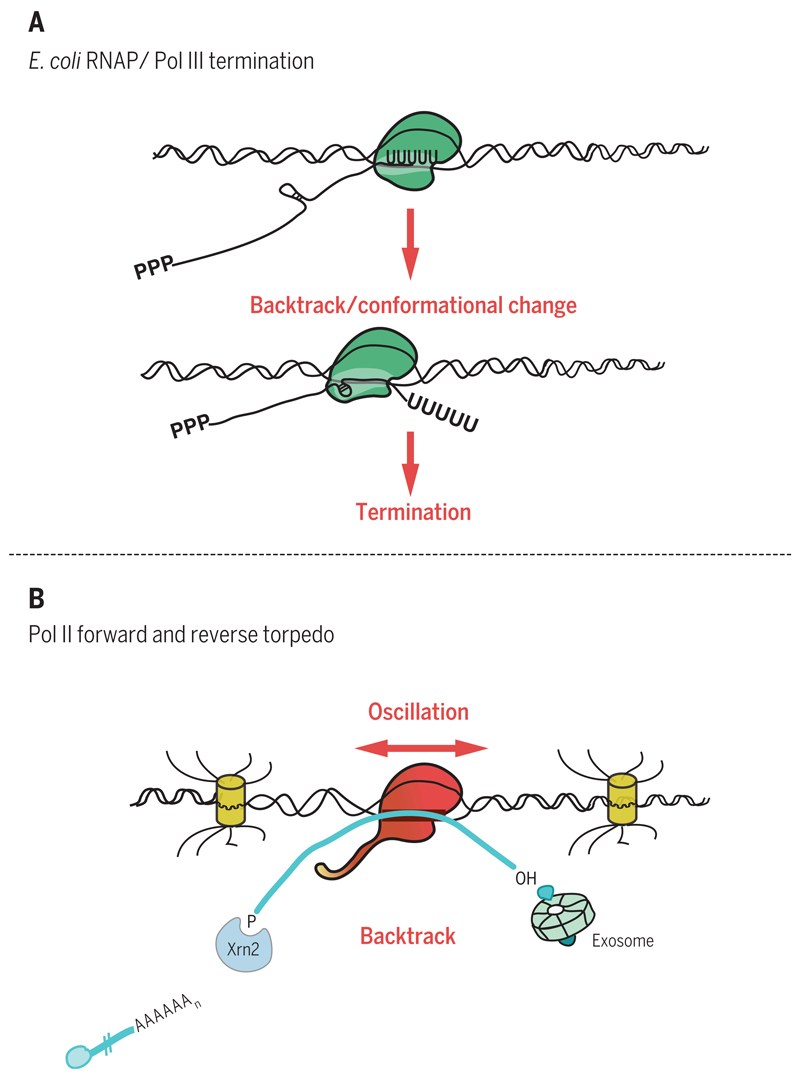
Fig. 2. Pol II backtracking.
(A) Bacterial RNA polymerase or Pol III terminates at an oligo(U) transcript, which pauses polymerase and promotes backtracking. An upstream RNA hairpin is forced into polymerase active site, inducing a conformational change that results in termination. (B) Pol II moves forward to synthesize or backward to extrude transcript (oscillation). Forward transcript, once cleaved at PAS to release mRNA, is then degraded by Xrn2. Backtracked transcript is degraded by the exosome. Removal of RNA up to Pol II (forward or reverse torpedo) induces termination.
Fig. 3
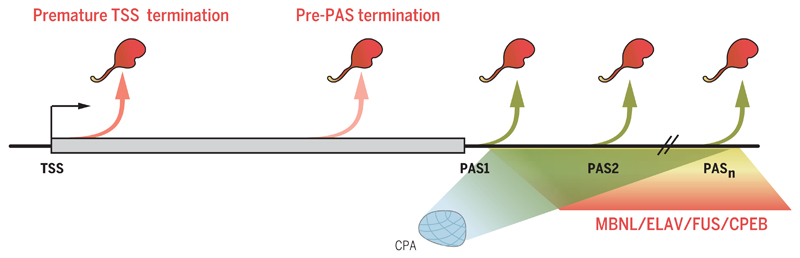
Fig. 3. Pol II alternative 3′-end formation.
Diagram depicting early release of Pol II prior to PAS or alternative PAS selection at gene 3′ ends. This later process is mediated by competitive association of CPA versus other RNA binding factors with alternative PAS.
Fig. 4
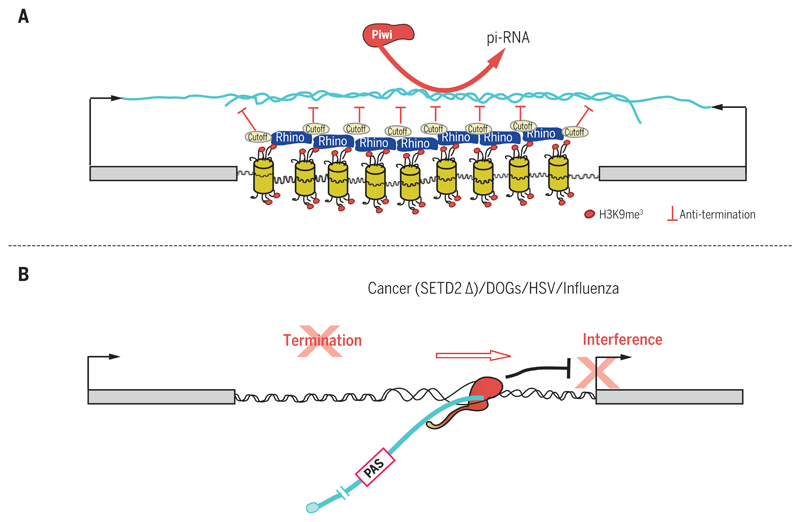
Fig. 4. Regulated or misregulated Pol II termination.
(A) Primary piRNA clusters in Drosophila are often positioned between convergent genes. dsRNA induces heterochromatic histone tail modification (H3K9me3). This in turn recruits the HP1-like factor Rhino together with Cutoff, an anti-terminator that promotes readthrough transcription. (B) Inactivation of termination by cancer mutation (SETD2 mutation), osmotic stress, or viral infection all induce Pol II read-through and interference with downstream gene expression.

References

    1. Platt T. Transcription termination and the regulation of gene expression. Annu Rev Biochem. 1986;55:339–372. doi: 10.1146/annurev.bi.55.070186.002011. - DOI - PubMed
    1. Epshtein V, Cardinale CJ, Ruckenstein AE, Borukhov S, Nudler E. An allosteric path to transcription termination. Mol Cell. 2007;28:991–1001. doi: 10.1016/j.molcel.2007.10.011. - DOI - PubMed
    1. Richardson JP. Preventing the synthesis of unused transcripts by Rho factor. Cell. 1991;64:1047–1049. doi: 10.1016/0092-8674(91)90257-Y. - DOI - PubMed
    1. Epshtein V, Dutta D, Wade J, Nudler E. An allosteric mechanism of Rho-dependent transcription termination. Nature. 2010;463:245–249. doi: 10.1038/nature08669. - DOI - PMC - PubMed
    1. Henkin TM, Yanofsky C. Regulation by transcription attenuation in bacteria: How RNA provides instructions for transcription termination/antitermination decisions. BioEssays. 2002;24:700–707. doi: 10.1002/bies.10125. - DOI - PubMed

Publication types

MeSH terms