Review
. 2016 Sep;7(5):294-316.
doi: 10.1002/wcs.1397. Epub 2016 Jun 10.

Primate cognition: attention, episodic memory, prospective memory, self-control, and metacognition as examples of cognitive control in nonhuman primates

Affiliations
Review

Primate cognition: attention, episodic memory, prospective memory, self-control, and metacognition as examples of cognitive control in nonhuman primates

Michael J Beran et al. Wiley Interdiscip Rev Cogn Sci. 2016 Sep.

Abstract

Primate Cognition is the study of cognitive processes, which represent internal mental processes involved in discriminations, decisions, and behaviors of humans and other primate species. Cognitive control involves executive and regulatory processes that allocate attention, manipulate and evaluate available information (and, when necessary, seek additional information), remember past experiences to plan future behaviors, and deal with distraction and impulsivity when they are threats to goal achievement. Areas of research that relate to cognitive control as it is assessed across species include executive attention, episodic memory, prospective memory, metacognition, and self-control. Executive attention refers to the ability to control what sensory stimuli one attends to and how one regulates responses to those stimuli, especially in cases of conflict. Episodic memory refers to memory for personally experienced, autobiographical events. Prospective memory refers to the formation and implementation of future-intended actions, such as remembering what needs to be done later. Metacognition consists of control and monitoring processes that allow individuals to assess what information they have and what information they still need, and then if necessary to seek information. Self-control is a regulatory process whereby individuals forego more immediate or easier to obtain rewards for more delayed or harder to obtain rewards that are objectively more valuable. The behavioral complexity shown by nonhuman primates when given tests to assess these capacities indicates psychological continuities with human cognitive control capacities. However, more research is needed to clarify the proper interpretation of these behaviors with regard to possible cognitive constructs that may underlie such behaviors. WIREs Cogn Sci 2016, 7:294-316. doi: 10.1002/wcs.1397 For further resources related to this article, please visit the WIREs website.


Conflict of interest statement

All authors declare that they have no conflicts of interest in preparing this article.

Figures
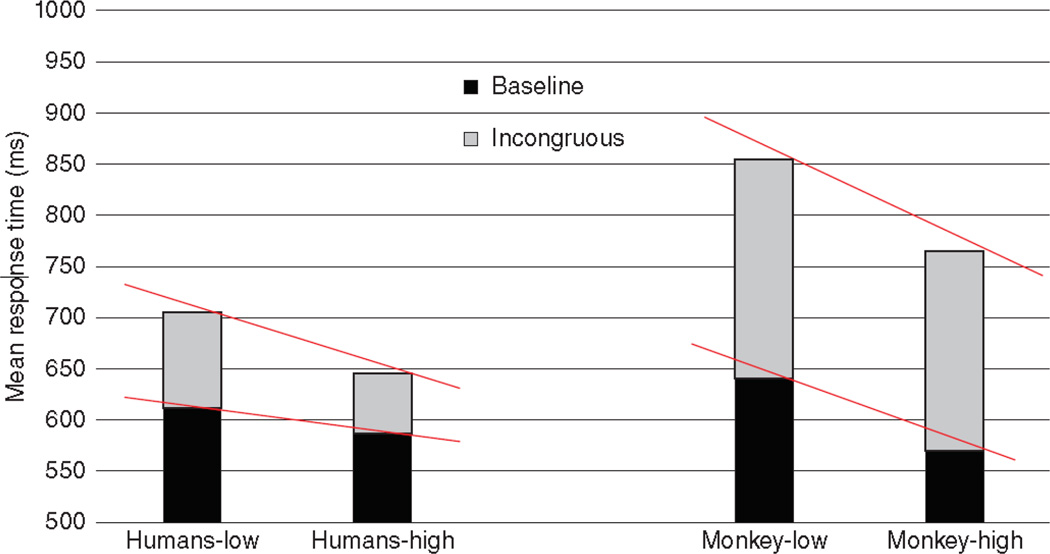
Figure 1
Figure 1
Mean response time for humans and monkeys under low-incentive and high-incentive conditions. The red bars show the Stroop-like interference (longer response times on incongruous than baseline trials). The diagonal lines highlight the finding that, although incentive improved performance overall, it reduced Stroop interference for humans but not for monkeys. From “The Stroop effect at 80: The competition between stimulus control and cognitive control,” by DA Washburn, Journal of the Experimental Analysis of Behavior, 105: 3–13. Copyright 2016 by Wiley. Reprinted with permission.
Figure 2
Figure 2
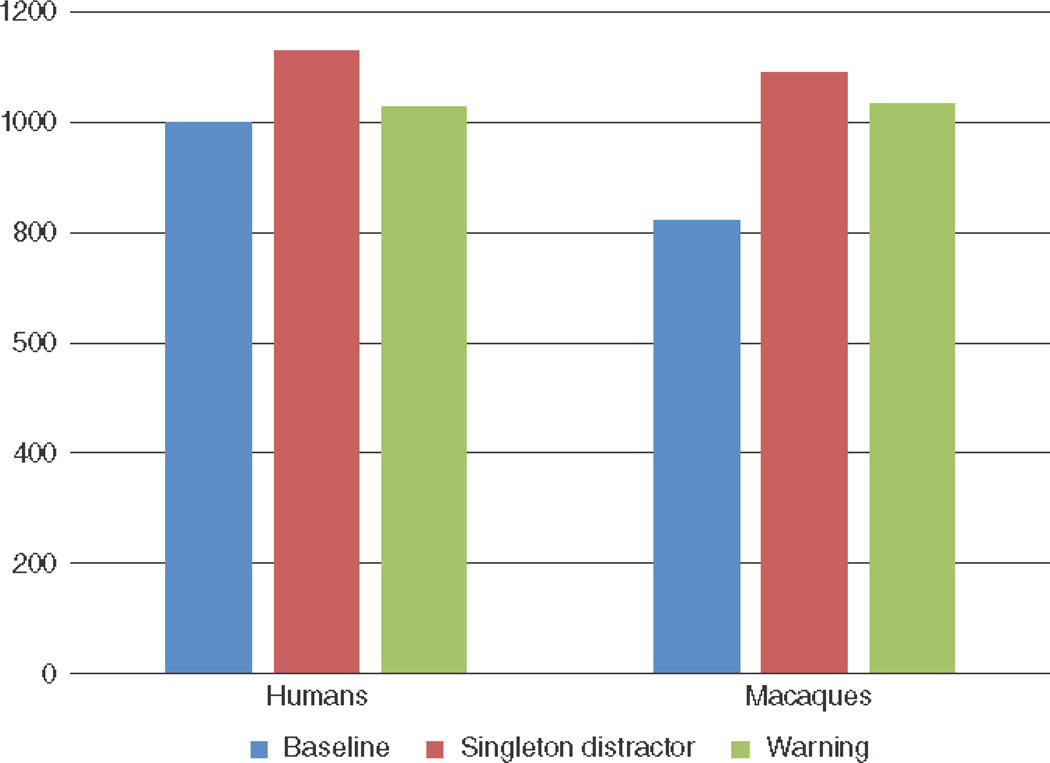
Mean response time on a visual search task for undergraduate participants and rhesus monkeys, averaged across set sizes (5- to 30-letter arrays). For both species, response times were significantly longer when a non-target stimulus appeared in a unique color (singleton distractor). Humans but not the monkeys performed significantly faster if this pop-out distractor was preceded by warning information informing the participant of exactly what stimuli would appear in the search array. Data are from Washburn and Taglialatela.
Figure 3
Figure 3
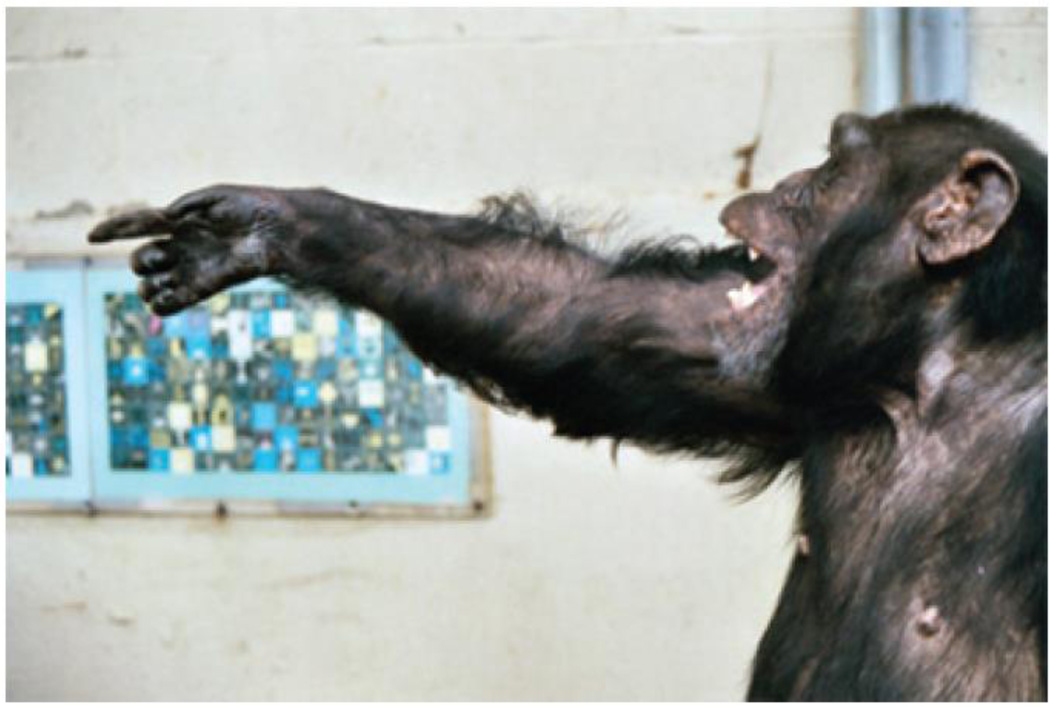
After touching the lexigram on her keyboard (visible in background) corresponding to the type of object hidden, Panzee points toward the location of the object. Photograph by Charles R. Menzel.
Figure 4
Figure 4
Panzee’s recovery order of 10 bags of food by memory on a sample trial. Diamond indicates subject’s position in tower; the line emanating from this point traces through hidden items in the order Panzee directed an uninformed person to them. Size of circle denotes almond quantity, open circles almonds without shells, closed circles almonds with shells. Hatches on the perimeter represent 1-meter increments. On this trial, all 10 hidden items were recovered and there were no unsuccessful searches. Reprinted from Animal Behaviour, 84, Sayers K, Menzel CR, “Memory and foraging theory: chimpanzee utilization of optimality heuristics in the rank-order recovery of hidden foods”, 795–803, 2012, with permission from Elsevier.
Figure 5
Figure 5
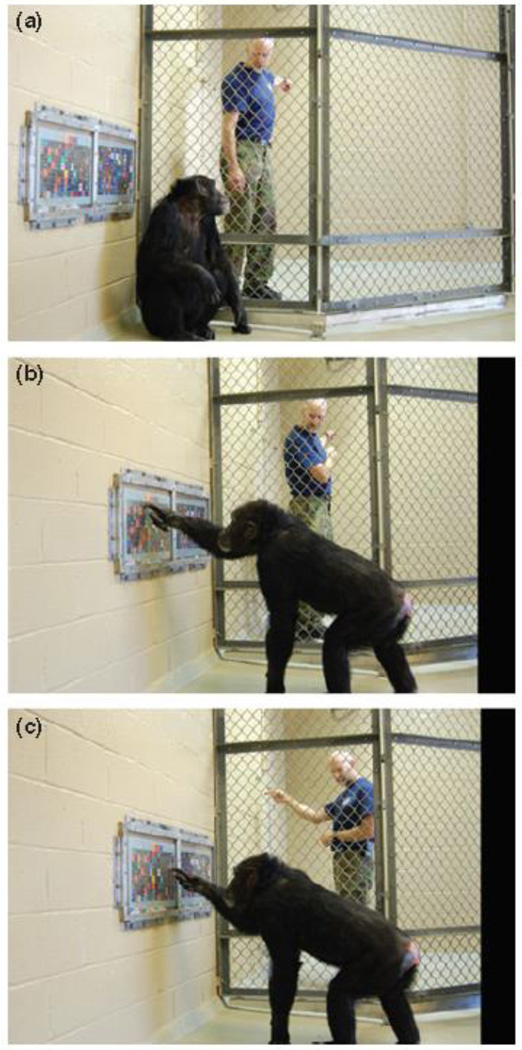
Caregiver (J) with Panzee (P) indoors. a) J points manually to the west and says “what’s out there?” Unknown to J, but known to P, peanuts lie beyond the cinder block wall of the building in the direction in which J is pointing. b) P responds to J’s query by touching the PEANUT lexigram on her keyboard. c) J now points to the south. M&M candies lie beyond the wall in that direction. P responds by touching the M&M lexigram on her keyboard. Photographs by Charles R. Menzel from .
Figure 6
Figure 6
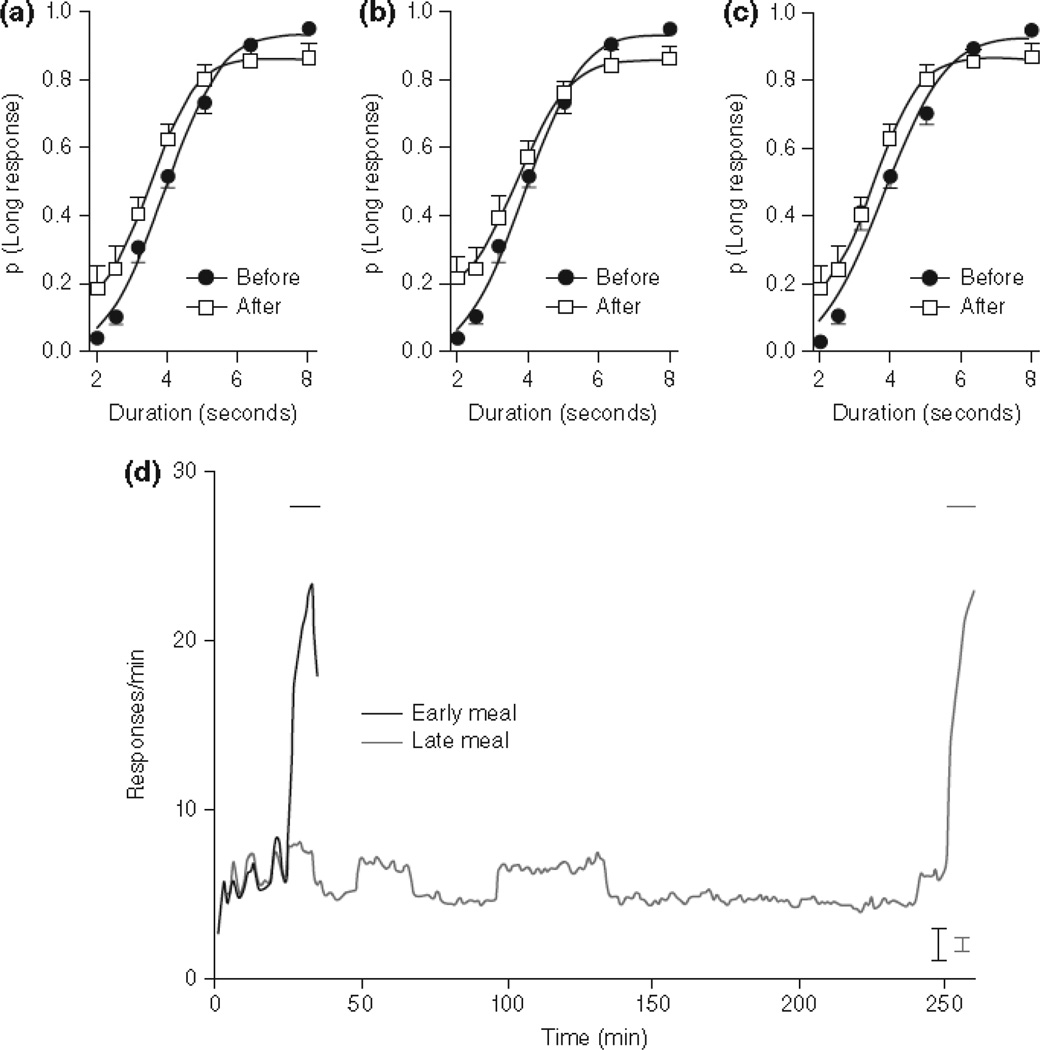
Testing rats in a prospective memory test. Anticipation of early (A) and late (B) meals severely disrupted performance in an ongoing task (an auditory discrimination) after the event, relative to excellent performance at an earlier time point. (C) When event and time were dissociated (using data from 25–34 min, with and without the event), performance was severely disrupted by the event. (D) Rats anticipated the arrival of the meal, as shown by the increase in food-trough responses when the event provided information that the meal could be obtained soon; the meal could be obtained early or late (beginning at 35 or 260 min, respectively), which was randomly determined on each day. Horizontal lines indicate the last 10-min before the meal when the event was presented. From “Event-based prospective memory in the rat” by Wilson AG, Pizzo MJ, Crystal JD, Current Biology, 23, 1089–1093. Copyright 2013 by Elsevier Press. Reprinted with permission.
Figure 7
Figure 7
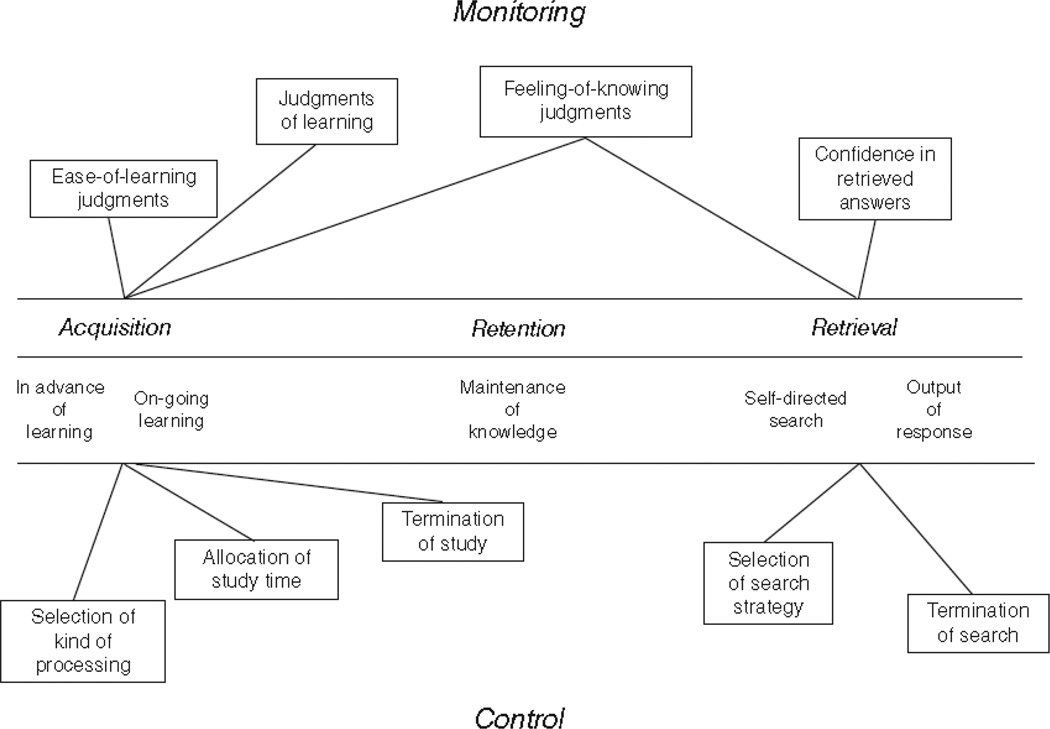
A theoretical framework for research on metacognition, showing examples of process-monitoring capacities above and process-control capacities below. From “Metamemory: A theoretical framework and new findings,” by T. O. Nelson and L. Narens, The Psychology of Learning and Motivation, 26, p. 129. Copyright 1990 by Academic Press. Reprinted with permission.
Figure 8
Figure 8
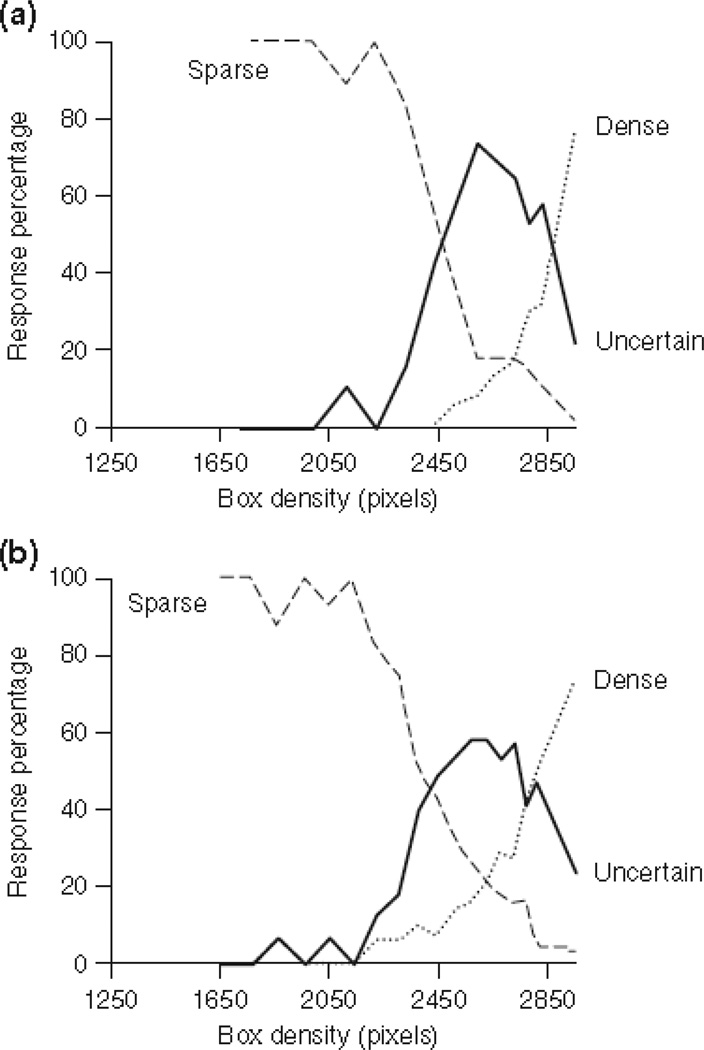
A. Performance by a monkey in a Sparse-Dense discrimination. The horizontal axis indicates the density of the trial. The Dense response was correct for 2,950-pixel trials—these trials are represented by the rightmost data point for each curve. All trials with fewer pixels deserved the Sparse response. The solid line represents the percentage of trials receiving the uncertainty response at each trial level. The percentages of trials ending with the Sparse response (dashed line) or Dense response (dotted line) are also shown. B. The performance of humans in the Sparse-Dense discrimination, depicted in the same way. To equate discrimination performance across subjects, the data were normalized to place each subject's discrimination crossover at a pixel density of about 2,700. From “The comparative psychology of uncertainty monitoring and metacognition,” by J. D. Smith, W. E. Shields, and D. A. Washburn, Behavioral and Brain Sciences, 26, p. 322. Copyright 2003 by the Cambridge University Press. Reprinted with permission.
Figure 9
Figure 9
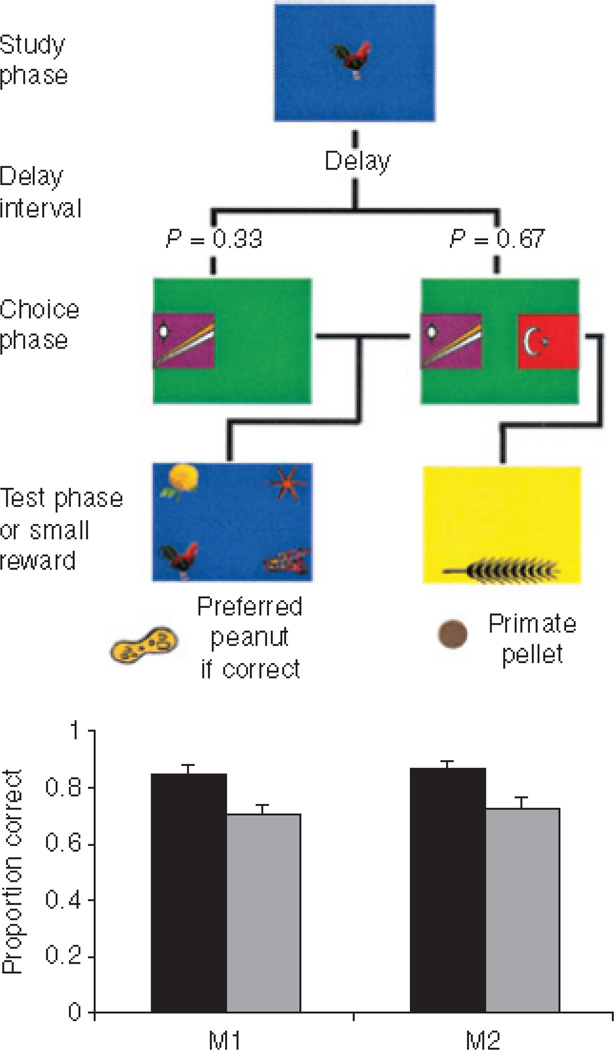
The metamemory task of Hampton. The top panel outlines the procedure. Each colored panel represents what monkeys saw on a touch-sensitive computer monitor at a given stage in a trial. At the start of each trial, monkeys studied a randomly selected image. A delay period followed over which monkeys often forgot the studied image. In two-thirds of trials, animals chose between taking a memory test (Right, left-hand stimulus) and declining the test (Right, right-hand stimulus). In one-third of trials, monkeys were forced to take the test (Left). Better accuracy on chosen than on forced tests indicates that monkeys know when they remember and decline tests when they have forgotten, if given the option. The bottom panel shows the results. Dark bars represent accuracy on tests the monkeys chose to take. Light bars represent performance on trials where the animals were not given the choice of declining tests. Monkeys were more accurate on tests they chose to take than those they were forced to take. From “Rhesus monkeys know when they remember,” by RR Hampton, Proceedings of the National Academy of Sciences, 98: 5359–5362. Copyright 2001 by HighWire Press. Reprinted with permission.
Figure 10
Figure 10
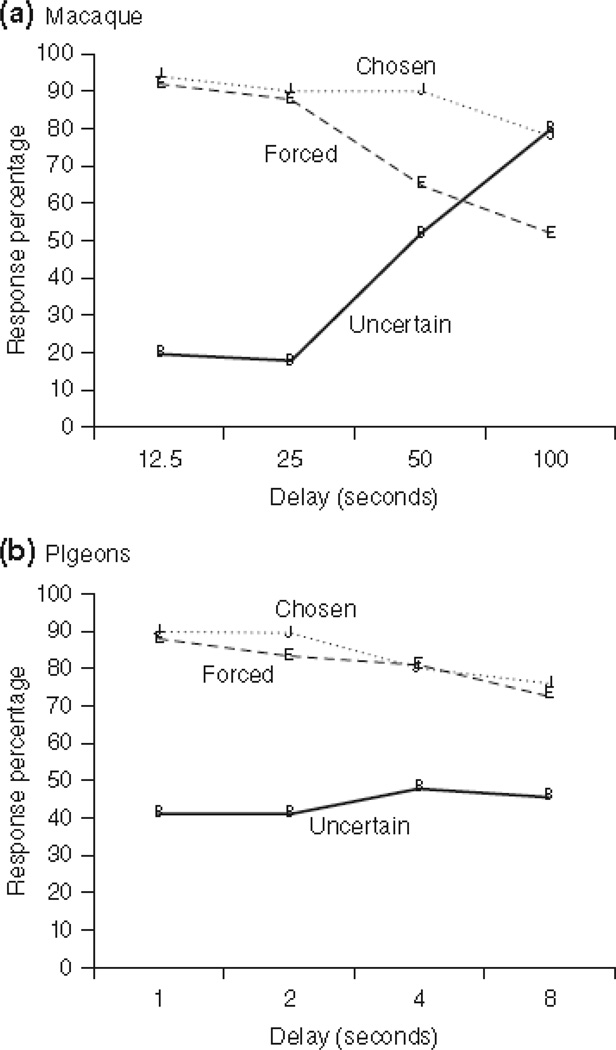
A. Memory performance by a macaque in the delayed matching-to-sample task of Hampton (2001). The horizontal axis indicates the length of the retention interval before matching could occur. The percentage of trials that received the uncertainty response is shown (solid line). The percentages correct of memory tests completed are also shown, on occasions when the memory test was mandatory (dashed line) or optional and voluntarily selected by the macaque (dotted line). B. Memory performance by a pigeon in the delayed matching-to-sample task of Inman and Shettleworth (1999). From “Animal metacognition: A tale of two comparative psychologies,” by J. D. Smith, J. J. Couchman, & M. J. Beran, Journal of Comparative Psychology, 128, p. 115. Copyright 2014 by the American Psychological Association. Reprinted with permission.
Figure 11
Figure 11
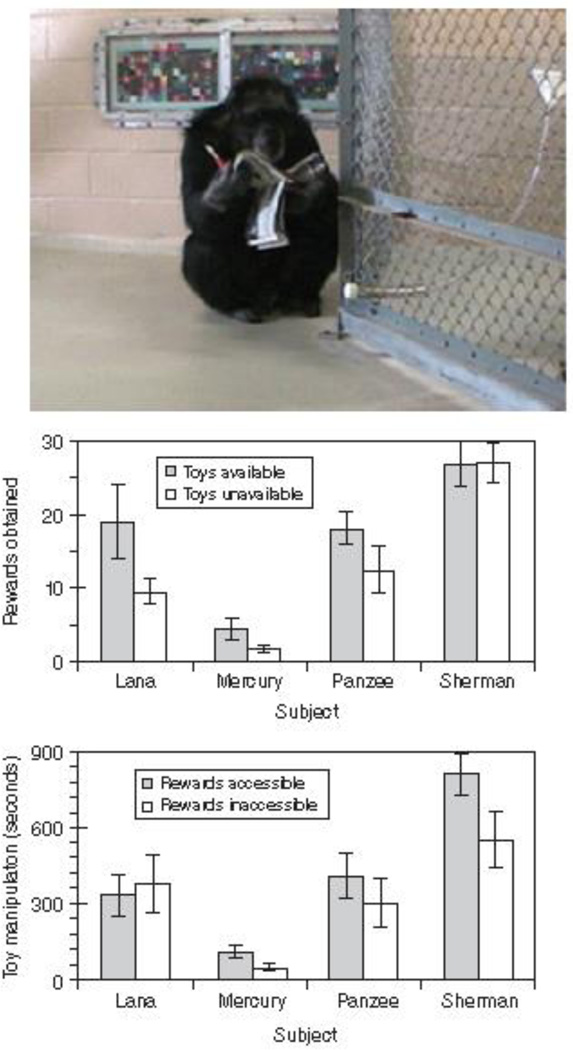
The top panel shows chimpanzee Sherman with items he could use for self-distraction during an accumulation self-control test. An automated dispenser delivered food items, one-at-a-time, into the tube that projected into his enclosure. Food items would continue to accumulate as long as Sherman did not take the tube and eat the items. The middle panel shows that three of four chimpanzees obtained more food items when they had toys to act as distractions than when they did not. However, this result is the not the critical one to showing self-distraction, because it may have been that simply having toys made chimpanzees play with the more, and thus wait longer. The bottom panel shows the crucial result. Three chimpanzees showed a statistically greater level of item manipulation when rewards were accessible (i.e., they had to self-impose the continued delay of eating those items) than when rewards were inaccessible and delay was imposed by the experimenters. This meant that having toys available was not the key factor in whether chimpanzees interacted with those toys. The key factor was whether the chimpanzees had to maintain self-control in the face of temptation or did not. These data are reported in Evans and Beran (2007).

References

    1. Davidson MC, Amso D, Anderson LC, Diamond A. Development of cognitive control and executive functions from 4 to 13 years: Evidence from manipulations of memory, inhibition, and task switching. Neuropsychologia. 2006;44:2037–2078. - PMC - PubMed
    1. Posner MI, Snyder CRR. Attention and cognitive control. In: Solso R, editor. Information processing and cognition: The Loyola Symposium. Hillsdale, NJ: Lawrence Erlbaum; 1975. pp. 55–85.
    1. Nelson TO, editor. Metacognition: Core readings. Needham Heights, MA: Allyn & Bacon; 1992.
    1. Schneider W, Shiffrin RM. Controlled and automatic human information processing: I. Detection, search, and attention. Psychological Review. 1977;84:1–66.
    1. Klein SB, Robertson TE, Delton AW. Facing the future: Memory as an evolved system for planning future acts. Memory and Cognition. 2010;38:13–22. - PMC - PubMed

LinkOut - more resources