Review
. 2016 Aug;125(2):399-411.
doi: 10.1097/ALN.0000000000001195.

Immune Modulation by Volatile Anesthetics

Affiliations
Review

Immune Modulation by Volatile Anesthetics

Lindsay M Stollings et al. Anesthesiology. 2016 Aug.

Abstract

Volatile general anesthetics continue to be an important part of clinical anesthesia worldwide. The impact of volatile anesthetics on the immune system has been investigated at both mechanistic and clinical levels, but previous studies have returned conflicting findings due to varied protocols, experimental environments, and subject species. While many of these studies have focused on the immunosuppressive effects of volatile anesthetics, compelling evidence also exists for immunoactivation. Depending on the clinical conditions, immunosuppression and activation due to volatile anesthetics can be either detrimental or beneficial. This review provides a balanced perspective on the anesthetic modulation of innate and adaptive immune responses as well as indirect effectors of immunity. Potential mechanisms of immunomodulation by volatile anesthetics are also discussed. A clearer understanding of these issues will pave the way for clinical guidelines that better account for the impact of volatile anesthetics on the immune system, with the ultimate goal of improving perioperative management.


Conflict of interest statement

The authors disclose no conflicts of interest.

Figures
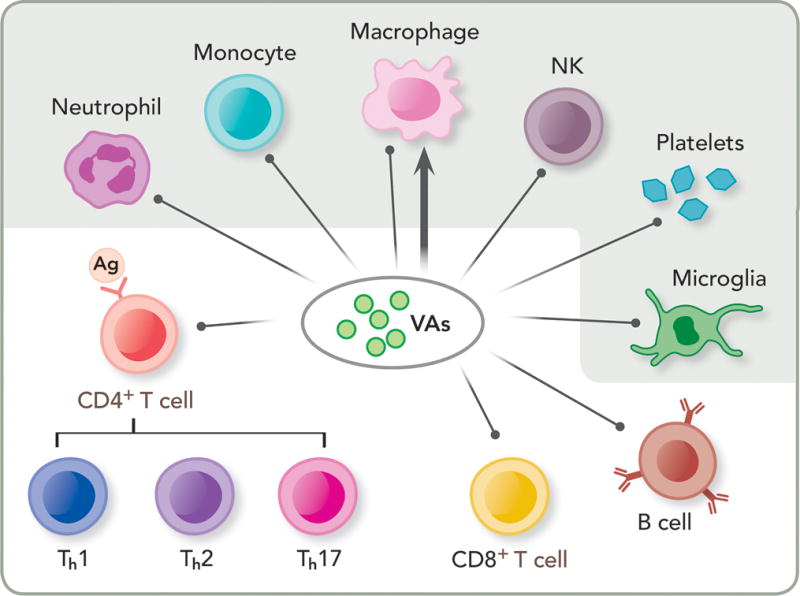
Figure 1
Figure 1. Direct immune modulations by volatile anesthetics (VAs)
Depicted here are immune cells responsible for the innate (shaded) and adaptive (un-shaded) immunity. VAs have been shown to suppress innate immunity by impairing or suppressing neutrophil adhesion, monocytes, macrophages and natural killer cells (NK), and affecting resident cells in tissues, such as platelets and microglial cells. VAs also suppress adaptive immunity by decreasing lymphocyte proliferation, such as CD4+ and CD8+ T cells as well as B cells. Note that VAs can have both inhibition (shown as a line with a dot) and potentiation (shown as a line with an arrowhead) effects on macrophages, depending on the site of infection or inflammation. Ag: antigen; Th1, Th2, Th17: T helper cell type 1, 2, 17, respectively.
Figure 2
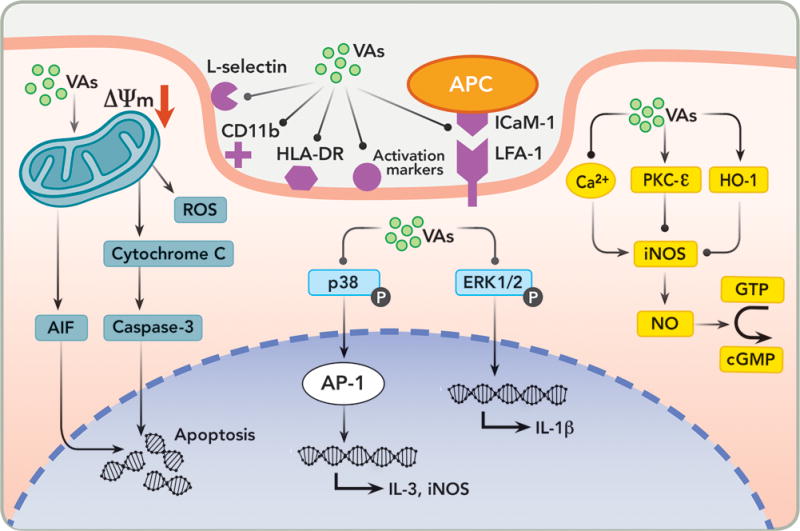
Figure 2. Potential mechanisms involved in the immunomodulation by volatile anesthetics (VAs)
Depicted here are schematic representations of major immunomodulation pathways affected by VAs. The thick solid line shows the cytoplasmic membrane and the dashed line marks the nuclear membrane. The pink shaded areas are cytoplasmic and extracellular space, and the light purple shaded area is the cell nucleus. Lines with arrowheads and dots at the end represent “activation” and “inhibition”, respectively. ΔΨm = mitochondrial membrane potential; AIF = apoptosis inducing factor; ROS = reactive oxygen species; APC = antigen-presenting cell; HLA = human leukocyte antigen; DR = antigen D related; LFA-1 = lymphocyte function-associated antigen 1; ICAM-1 = intercellular adhesion molecule; AP-1 = activator protein 1; iNOS = inducible nitric oxide synthase; ERK = extracellular signal-regulated kinases; PKC = protein kinase C; HO-1 = heme oxygenase 1; GTP = guanosine triphosphate; cGMP = cyclic 3′,5′-guanosine monophosphate; and NO = nitric oxide.

References

    1. Satpathy AT, Wu X, Albring JC, Murphy KM. Re(de)fining the dendritic cell lineage. Nat Immunol. 2012;13:1145–54. - PMC - PubMed
    1. Iwasaki A, Medzhitov R. Control of adaptive immunity by the innate immune system. Nat Immunol. 2015;16:343–53. - PMC - PubMed
    1. Forman SA, Miller KW. Anesthetic sites and allosteric mechanisms of action on Cys-loop ligand-gated ion channels. Can J Anaesth. 2011;58:191–205. - PMC - PubMed
    1. Franks NP. General anaesthesia: from molecular targets to neuronal pathways of sleep and arousal. Nat Rev Neurosci. 2008;9:370–86. - PubMed
    1. Hemmings HC, Jr, Akabas MH, Goldstein PA, Trudell JR, Orser BA, Harrison NL. Emerging molecular mechanisms of general anesthetic action. Trends Pharmacol Sci. 2005;26:503–10. - PubMed

MeSH terms

Substances