


Prognosis of Mucosal, Uveal, Acral, Nonacral Cutaneous, and Unknown Primary Melanoma From the Time of First Metastasis
- PMID: 27286787
- PMCID: PMC4943393
- DOI: 10.1634/theoncologist.2015-0522
Prognosis of Mucosal, Uveal, Acral, Nonacral Cutaneous, and Unknown Primary Melanoma From the Time of First Metastasis
Abstract
Background: Subtypes of melanoma, such as mucosal, uveal, and acral, are believed to result in worse prognoses than nonacral cutaneous melanoma. After a diagnosis of distant metastatic disease, however, the overall survival of patients with mucosal, uveal, acral, nonacral cutaneous, and unknown primary melanoma has not been directly compared.
Materials and methods: We conducted a single-center, retrospective analysis of 3,454 patients with melanoma diagnosed with distant metastases from 2000 to 2013, identified from a prospectively maintained database. We examined melanoma subtype, date of diagnosis of distant metastases, age at diagnosis of metastasis, gender, and site of melanoma metastases.
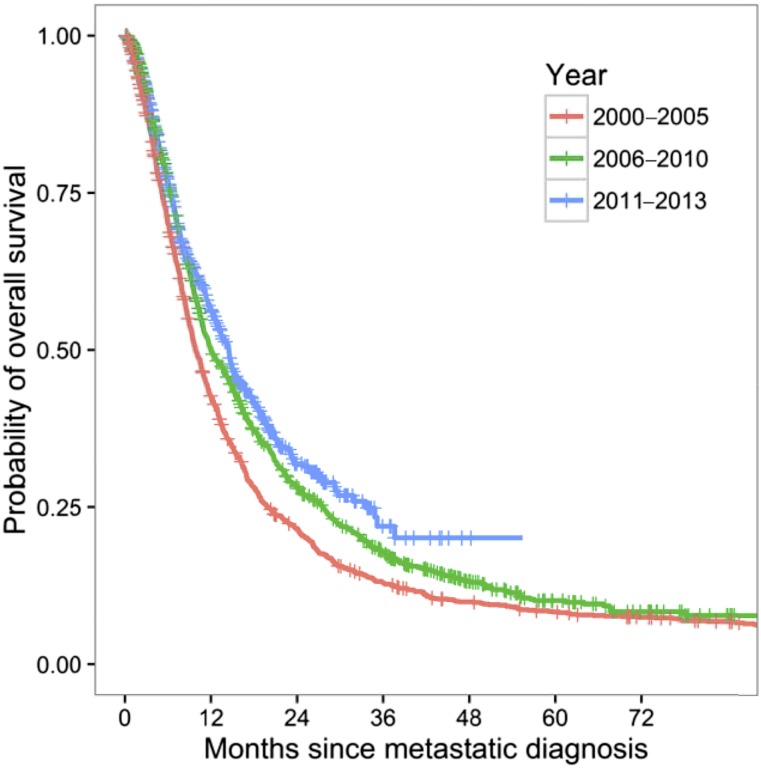
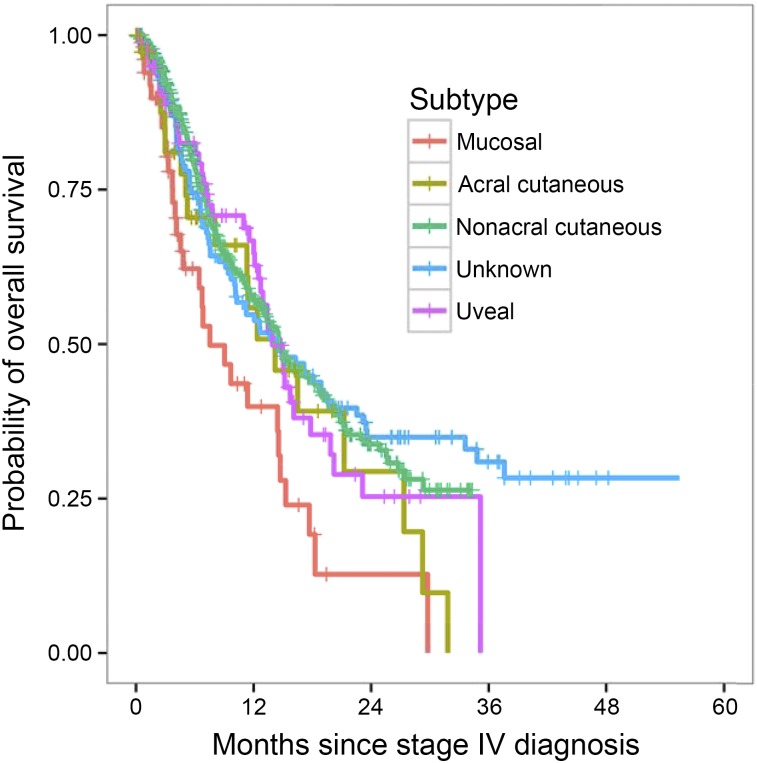
Results: Of the 3,454 patients (237 with mucosal, 286 with uveal, 2,292 with nonacral cutaneous, 105 with acral cutaneous, and 534 with unknown primary melanoma), 2,594 died. The median follow-up was 46.1 months. The median overall survival for those with mucosal, uveal, acral, nonacral cutaneous, and unknown primary melanoma was 9.1, 13.4, 11.4, 11.7, and 10.4 months, respectively. Patients with uveal melanoma, cutaneous melanoma (acral and nonacral), and unknown primary melanoma had similar survival, but patients with mucosal melanoma had worse survival. Patients diagnosed with metastatic melanoma in 2006-2010 and 2011-2013 had better overall survival than patients diagnosed in 2000-2005. In a multivariate model, patients with mucosal melanoma had inferior overall survival compared with patients with the other four subtypes.
Conclusion: Additional research and advocacy are needed for patients with mucosal melanoma because of their shorter overall survival in the metastatic setting. Despite distinct tumor biology, the survival was similar for those with metastatic uveal melanoma, acral, nonacral cutaneous, and unknown primary melanoma.
Implications for practice: Uveal, acral, and mucosal melanoma are assumed to result in a worse prognosis than nonacral cutaneous melanoma or unknown primary melanoma. No studies, however, have been conducted assessing the overall survival of patients with these melanoma subtypes starting at the time of distant metastatic disease. The present study found that patients with uveal, acral, nonacral cutaneous, and unknown primary melanoma have similar overall survival after distant metastases have been diagnosed. These findings provide information for oncologists to reconsider previously held assumptions and appropriately counsel patients. Patients with mucosal melanoma have worse overall survival and are thus a group in need of specific research and advocacy.
Keywords: Acral cutaneous melanoma; Mucosal melanoma; Nonacral cutaneous melanoma; Prognosis; Unknown primary melanoma; Uveal melanoma.
©AlphaMed Press.
Conflict of interest statement
Disclosures of potential conflicts of interest may be found at the end of this article.
Figures

References
-
- McLaughlin CC, Wu XC, Jemal A, et al. Incidence of noncutaneous melanomas in the U.S. Cancer. 2005;103:1000–1007. - PubMed
-
- Chang AE, Karnell LH, Menck HR. The National Cancer Data Base report on cutaneous and noncutaneous melanoma: A summary of 84,836 cases from the past decade. Cancer. 1998;83:1664–1678. - PubMed
-
- Curtin JA, Fridlyand J, Kageshita T, et al. Distinct sets of genetic alterations in melanoma. N Engl J Med. 2005;353:2135–2147. - PubMed
-
- Curtin JA, Busam K, Pinkel D, et al. Somatic activation of KIT in distinct subtypes of melanoma. J Clin Oncol. 2006;24:4340–4346. - PubMed
Publication types
MeSH terms
Grants and funding
LinkOut - more resources
Full Text Sources
Other Literature Sources
Medical
