


Making patient values visible in healthcare: a systematic review of tools to assess patient treatment priorities and preferences in the context of multimorbidity
- PMID: 27288377
- PMCID: PMC4908882
- DOI: 10.1136/bmjopen-2015-010903
Making patient values visible in healthcare: a systematic review of tools to assess patient treatment priorities and preferences in the context of multimorbidity
Abstract
Objectives: To identify studies of existing instruments available for clinicians to record overall patient preferences and priorities for care, suitable for use in routine primary care practice in patients with multimorbidity. To examine the data for all identified tools with respect to validity, acceptability and effect on health outcomes.
Design: Systematic Review.
Data sources: MEDLINE, EMBASE and Cochrane databases, each with a predefined search strategy.
Eligibility criteria: Citations were included if they reported a tool used to record patient priorities or preferences for treatment, and quantitative or qualitative results following administration of the tool.
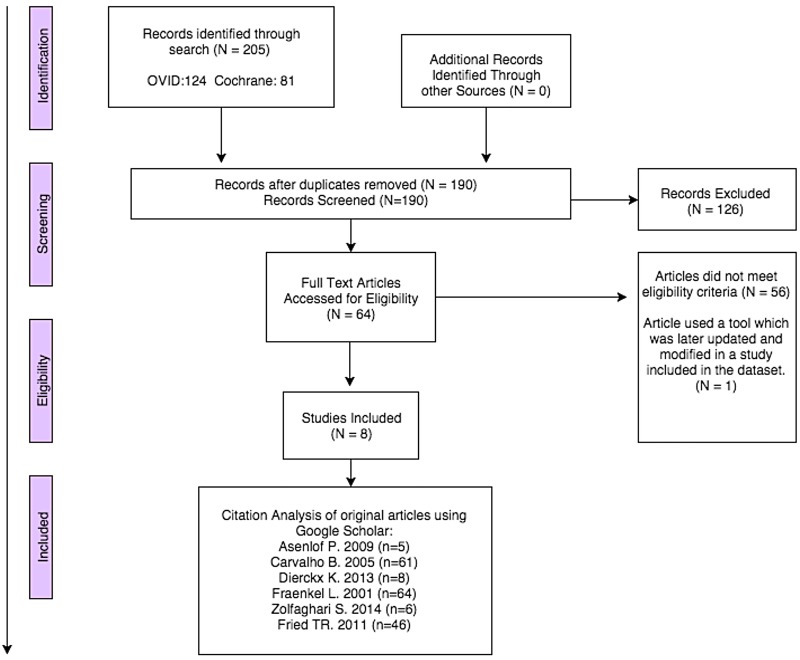
Results: Our search identified 189 potential studies of which 6 original studies and 2 discussion papers were included after screening for relevance. 5 of 6 studies (83%) were of cross-sectional design and of moderate quality. All studies reported on the usability of a tool in order to elicit patient preferences. No studies reported on changes to patient-specific healthcare outcomes as a consequence of recording preferences and priorities. 1 of 6 studies reported on eliciting patient preference in the context of multimorbidity. No studies incorporated patient preferences into an electronic medical record.
Conclusions: Given the importance of eliciting patient priorities and preferences in providing patient-centred care in the context of multimorbidity and polypharmacy, we found surprisingly few relevant tools. Some aspects of the tools used for single-disease contexts may also be useful in the context of multimorbidity. There is an urgent need to develop ways to make patient priorities explicitly visible in the clinical record and medical decision-making and to test the effect on patient-relevant outcomes.
Keywords: GERIATRIC MEDICINE; PRIMARY CARE; REHABILITATION MEDICINE.
Published by the BMJ Publishing Group Limited. For permission to use (where not already granted under a licence) please go to http://www.bmj.com/company/products-services/rights-and-licensing/
Figures
References
-
- Organization WH. Micronutrient deficiencies. Battling iron deficiency anaemia. World Health Organisation, 2003. http://www.who.int/nut/ida.htm (updated 9 Apr 2003; cited 25 July 2003).
-
- Starfield B. Primary care: balancing health needs, services, and technology. New York: Oxford University Press, 1998.
-
- Stewart M, Brown JB, Weston WW et al. . Patient-centred medicine: transforming the clinical method. United Kingdom: Radcliffe Medical Press, 2003.
Publication types
MeSH terms
LinkOut - more resources
Full Text Sources
Other Literature Sources
