Review
. 2016 Dec 2:226:20-39.
doi: 10.1016/j.virusres.2016.05.023. Epub 2016 Jun 8.

Evolution, antigenicity and pathogenicity of global porcine epidemic diarrhea virus strains

Affiliations
Review

Evolution, antigenicity and pathogenicity of global porcine epidemic diarrhea virus strains

Chun-Ming Lin et al. Virus Res. .

Abstract

Emerging and re-emerging coronaviruses cause morbidity and mortality in human and animal populations, resulting in serious public and animal health threats and economic losses. The ongoing outbreak of a highly contagious and deadly porcine epidemic diarrhea virus (PEDV) in Asia, the Americas and Europe is one example. Genomic sequence analyses of PEDV variants have revealed important insights into the evolution of PEDV. However, the antigenic variations among different PEDV strains are less explored, although they may contribute to the failure of PEDV vaccines in Asian countries. In addition, the evolution of PEDV results in variants with distinct genetic features and virulence differences; thus PEDV can serve as a model to explore the molecular mechanisms of coronavirus evolution and pathogenesis. In this article, we review the evolution, antigenic relationships and pathologic features of PEDV strains. This information and review of researches will aid in the development of strategies for control and prevention of PED.

Keywords: Antigenicity; Coronavirus; Cross-protection; Cross-reactivity; Evolution; Pathogenicity; Porcine epidemic diarrhea; Porcine epidemic diarrhea virus.


Figures

Fig. 1
Fig. 1
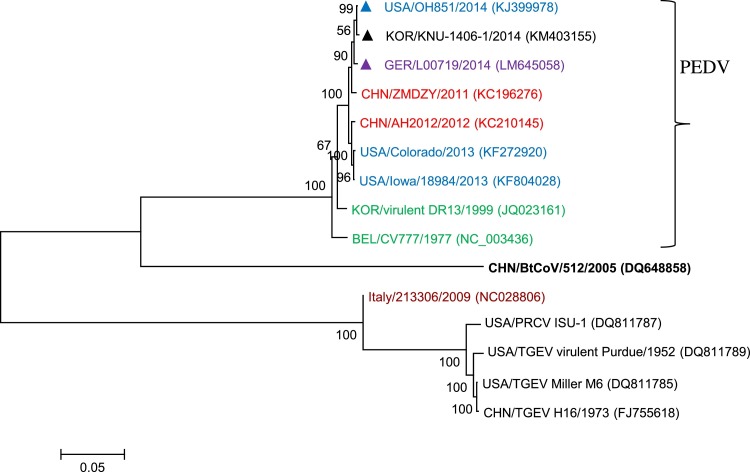
Phylogenetic tree of the complete genomes of PEDV strains and closely related alphacoronaviruses. Classical and the emerging PEDV strains, a bat alphacoronavirus (in bold), the recombinant porcine enteric coronavirus between TGEV and PEDV (in brown), three TGEV strains and one PRCV strain were included to generate a Maximum Likelihood phylogenetic tree using General Time Reversible nucleotide substitution model and supported with a bootstrap test of 1000 replicates in MEGA 6.06 software (Tamura et al., 2013). The number on each branch indicates the bootstrap value. The scale represents the nucleotide substitutions per site. Classical PEDV strains are in green. Emerging US, Chinese and European PEDV strains are in blue, red, and purple, respectively. Emerging S INDEL PEDV strains are labeled with a solid triangle in front of the strain name.
Fig. 2
Fig. 2
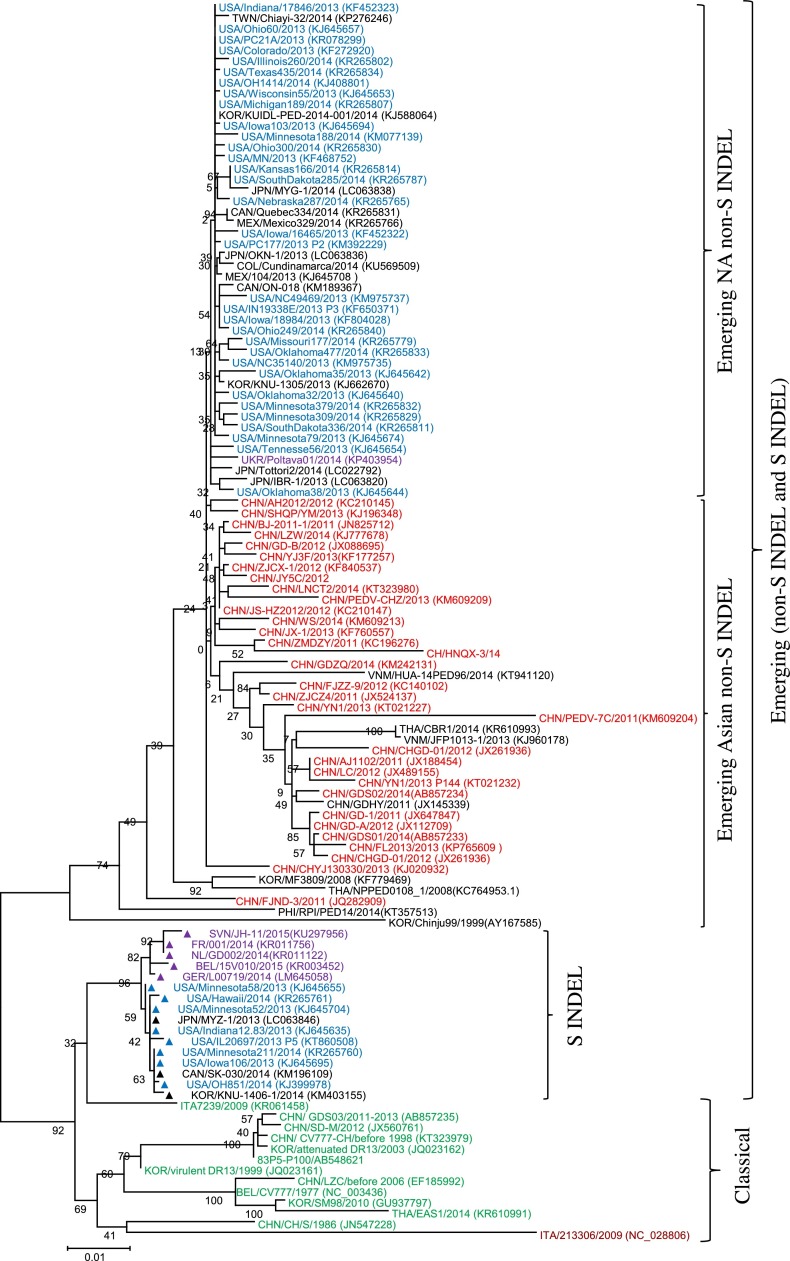
Phylogenetic tree of the genomes of PEDV strains, excluding the UTRs. A Maximum Likelihood phylogenetic tree was constructed using General Time Reversible nucleotide substitution model and supported with a bootstrap test of 1000 replicates in MEGA 6.06 software (Tamura et al., 2013). The number on each branch indicates the bootstrap value. The scale represents the nucleotide substitutions per site. Each PEDV strain is indicated in the following format: Country origin (three letter code: BEL, Belgium; CAN, Canada; CHN, China; COL, Columbia; FRA, France; GER, Germany; JPN, Japan; KOR, Korea; MEX, Mexico; SVN, Slovenia; THA, Thailand; UKR, Ukraine; USA, the United States; VNM, Vietnam)/strain name/year of sample collection (Genbank accession number) followed by passage (P) number for tissue culture-adapted strains. Classical PEDV strains are in green. Emerging US, Chinese and European PEDV strains are in blue, red, and purple, respectively. Emerging S INDEL PEDV strains are labeled with a solid triangle in front of the strain name.
Fig. 3
Fig. 3
Phylogenetic tree of the S proteins of PEDV strains. A Maximum Likelihood phylogenetic tree was constructed using Jones-Taylor-Thornton (JTT) model and supported with a bootstrap test of 1000 replicates in MEGA 6.06 software (Tamura et al., 2013). The number on each branch indicates the bootstrap value. The scale represents the nucleotide substitutions per site. Each PEDV strain is indicated in the following format: Country or area origin (three letter code: BEL, Belgium; CAN, Canada; CHN, China; COL, Columbia; FRA, France; GER, Germany; JPN, Japan; KOR, Korea; MEX, Mexico; PHI, Philippine; SVN, Slovenia; THA, Thailand; TWN, Taiwan; UKR, Ukraine; USA, the United States; VNM, Vietnam)/strain name/year of sample collection (Genbank accession number) followed by passage (P) number for tissue culture-adapted strains. Classical PEDV strains are in green. Emerging US, Chinese and European PEDV strains are in blue, red, and purple, respectively. Emerging S INDEL PEDV strains are labeled with a solid triangle in front of the strain name. The recombinant porcine enteric coronavirus between TGEV and PEDV is in brown.
Fig. 4
Fig. 4
Antigenic map generated using cross-reactive PEDV and TGEV CCIF serum antibody titers presented in Table 1. The relative position of strains, including the prototype PEDV CV777 (black diamond), highly virulent PEDV PC22A (red triangle), S INDEL PEDV Iowa106 (orange hexagon), S 197del PEDV PC177 (green trapezoid), TGEV Miller (purple circle) and TGEV Purdue (blue circle) was adjusted such that the distances between strains in the map represent the corresponding ratios between homologous and heterologous antibody titers. The original data (Table 1) was published in our previous study (Lin et al., 2014). This antigenic map was constructed using webserver (http://sysbio.cvm.msstate.edu/AntigenMap) established by Cai et al., 2010.

References

    1. Akimkin V., Beer M., Blome S., Hanke D., Hoper D., Jenckel M., Pohlmann A. New chimeric porcine coronavirus in swine feces, Germany, 2012. Emerg. Infect. Dis. 2016;22:1314–1315. - PMC - PubMed
    1. Alonso C., Goede D.P., Morrison R.B., Davies P.R., Rovira A., Marthaler D.G., Torremorell M. Evidence of infectivity of airborne porcine epidemic diarrhea virus and detection of airborne viral RNA at long distances from infected herds. Vet. Res. 2014;45:73. - PMC - PubMed
    1. Annamalai T., Saif L.J., Lu Z., Jung K. Age-dependent variation in innate immune responses to porcine epidemic diarrhea virus infection in suckling versus weaned pigs. Vet. Immunol. Immunopathol. 2015;168:193–202. - PMC - PubMed
    1. Beall A., Yount B., Lin C.M., Hou Y., Wang Q., Saif L., Baric R. Characterization of a pathogenic full-Length cDNA clone and transmission model for porcine epidemic diarrhea virus strain PC22A. mBio. 2016:7. - PMC - PubMed
    1. Boniotti M.B., Papetti A., Lavazza A., Alborali G., Sozzi E., Chiapponi C., Faccini S., Bonilauri P., Cordioli P., Marthaler D. Porcine epidemic diarrhea virus and discovery of a recombinant swine enteric Coronavirus, Italy. Emerg. Infect. Dis. 2016;22:83–87. - PMC - PubMed

Publication types

MeSH terms