


Assessing Adherence to Antiretroviral Therapy in a Rural Paediatric Cohort in KwaZulu-Natal, South Africa
- PMID: 27289369
- PMCID: PMC5071125
- DOI: 10.1007/s10461-016-1419-5
Assessing Adherence to Antiretroviral Therapy in a Rural Paediatric Cohort in KwaZulu-Natal, South Africa
Abstract
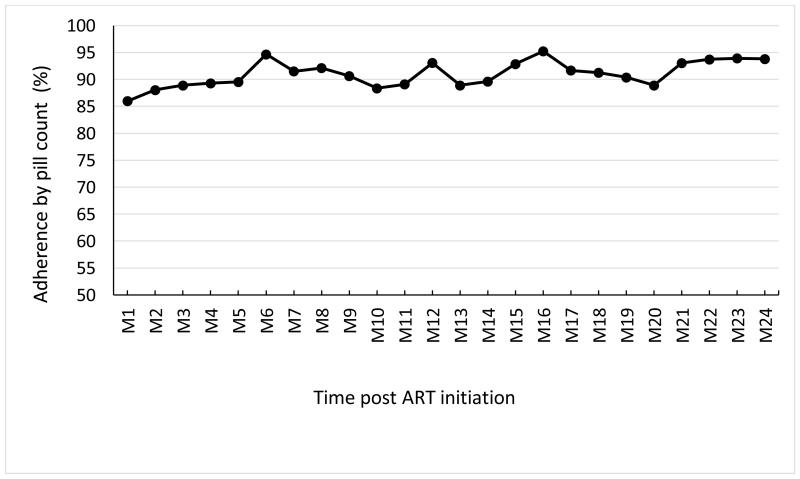
Achieving optimal adherence to ARV's in a rural paediatric population is challenging. Monitoring adherence by frequent viral load assay is not always feasible or sustainable in rural communities. A relatively cheaper, reliable, valid and sustainable measure of adherence for children is required for routine management. This study retrospectively assessed adherence outcomes using monthly pill count and viral load data, including reasons reported for non-adherence, in a paediatric cohort in rural KwaZulu-Natal, South Africa. Between 2008 and 2013, 78 children, mean age of 7.1 years, were enrolled in the CAPRISA 052 AIDS Treatment Programme. Monthly treatment adherence by pill count was categorized as either high (≥95 %) or low (<95 %). Overall median monthly adherence to treatment by pill count was 87.8 % at month 6, 88.9 % at month 12 and 90.8 % at month 24. However, the proportion of children with an undetectable viral load (<400 copies/ml) was 84.0 % (63/74), 86.6 % (58/67), and 84.5 % (49/58) at the three time points respectively. Agreement between pill count and viral load showed that only 33.9, 36. 3 and 30.6 % of children were truly adherent by pill count at months 6, 12 and 24 respectively. In conclusion, this treatment programme demonstrated that adherence of >95 % by pill count is not an ideal indicator of virological suppression in children aged 6 months to 13 years. Viral load assessment remains the gold standard for assessing treatment success in this age group.
Keywords: ARVs; Adherence; Children; Paediatric; Rural.
Figures


References
-
- World Health Orginization [Accessed on August 27, 2015];Global summary of the AIDS epidemic. 2014 Available from: http://www.who.int/hiv/data/epi_core_july2015.png.
-
- UNAIDS [Accessed on August 27, 2015];Fact sheet: 2014 statistics. Available from: http://www.unaids.org/sites/default/files/media_asset/20150714_FS_DG6_Re....
-
- UNAIDS [Accessed on June 30];South Africa HIV and AIDS estimates 2013. 2015 Available from: http://www.unaids.org/en/regionscountries/countries/southafrica/
-
- World Health Organization [Accessed on June 11, 2014];Global update on the Health Sector Response to HIV. 2014
-
- South African National Department of Health . National consolidated guidelines for the prevention of mother-to-cild transmission of HIV(PMTC) and the management of HIV in children, adolescents and adults. Pretoria: 2014.
MeSH terms
Substances
Grants and funding
LinkOut - more resources
Full Text Sources
Other Literature Sources
Medical
