


Antibiotics for otitis media with effusion in children
- PMID: 27290722
- PMCID: PMC7117560
- DOI: 10.1002/14651858.CD009163.pub3
Antibiotics for otitis media with effusion in children
Abstract
Background: Otitis media with effusion (OME) is characterised by an accumulation of fluid in the middle ear behind an intact tympanic membrane, without the symptoms or signs of acute infection. Since most cases of OME will resolve spontaneously, only children with persistent middle ear effusion and associated hearing loss potentially require treatment. Previous Cochrane reviews have focused on the effectiveness of ventilation tube insertion, adenoidectomy, nasal autoinflation, antihistamines, decongestants and corticosteroids in OME. This review, focusing on the effectiveness of antibiotics in children with OME, is an update of a Cochrane review published in 2012.
Objectives: To assess the benefits and harms of oral antibiotics in children up to 18 years with OME.
Search methods: The Cochrane ENT Information Specialist searched the ENT Trials Register; Central Register of Controlled Trials (CENTRAL 2016, Issue 3); PubMed; Ovid EMBASE; CINAHL; Web of Science; ClinicalTrials.gov; ICTRP and additional sources for published and unpublished trials. The date of the search was 14 April 2016.
Selection criteria: Randomised controlled trials comparing oral antibiotics with placebo, no treatment or therapy of unproven effectiveness in children with OME.
Data collection and analysis: We used the standard methodological procedures expected by Cochrane.
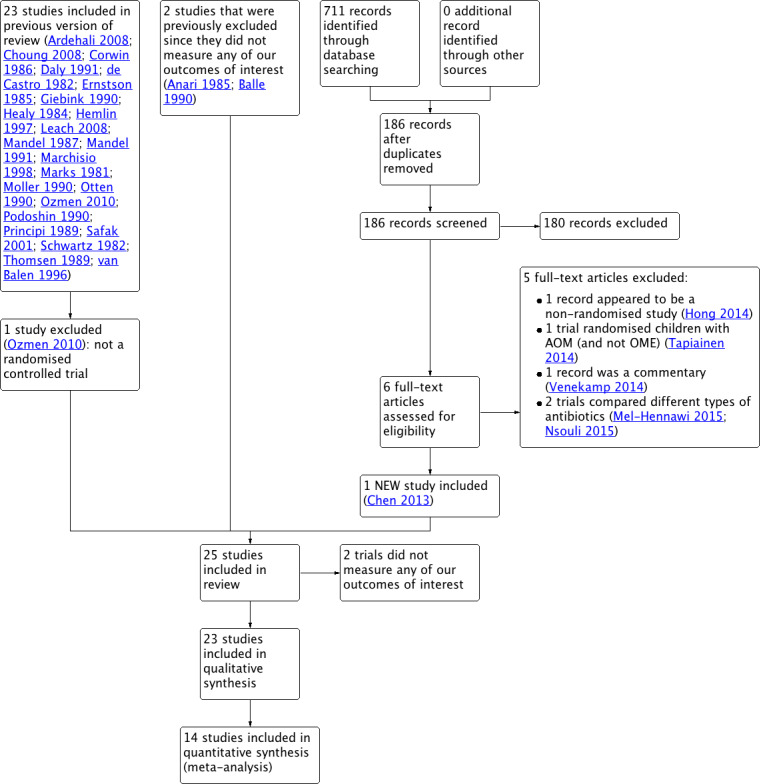
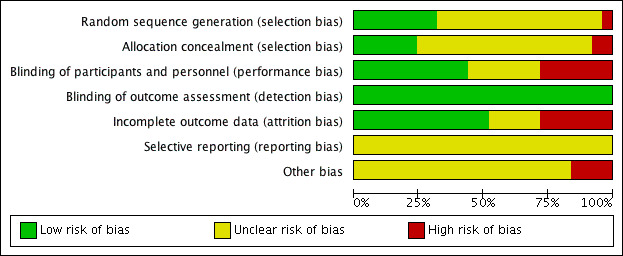
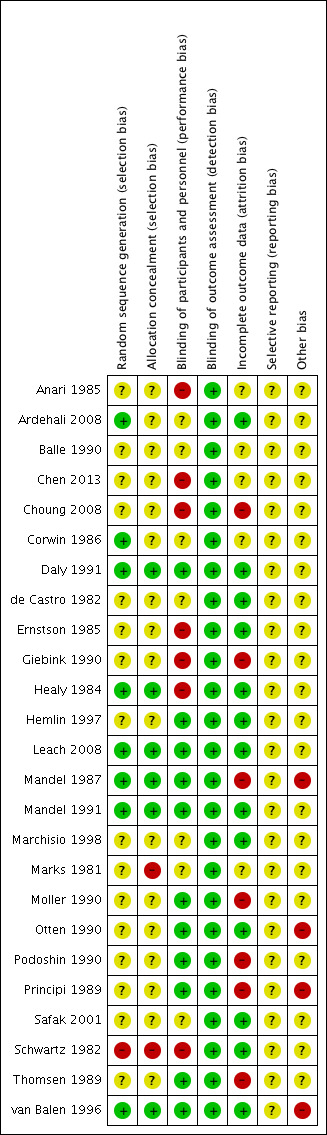
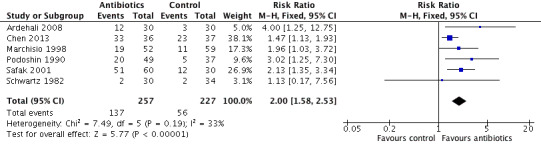
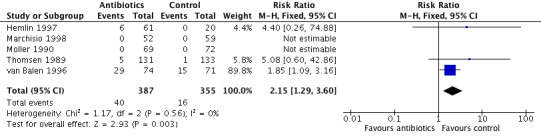
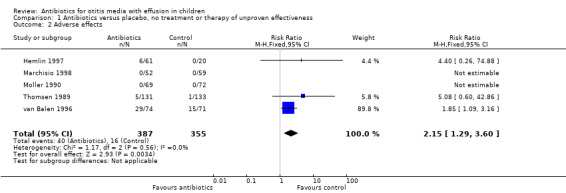
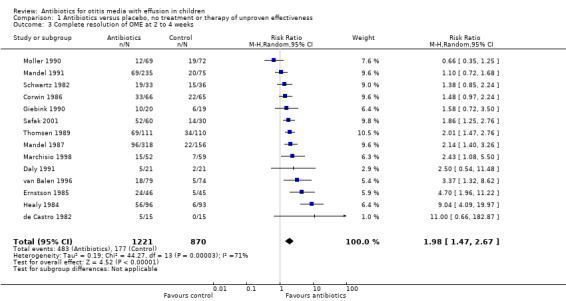
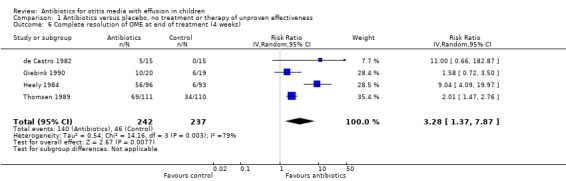
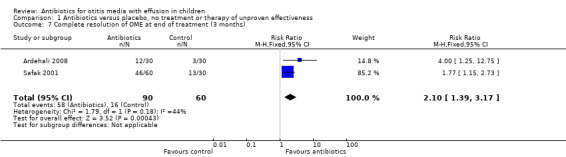
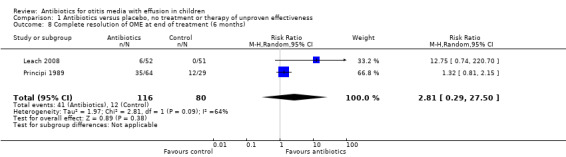
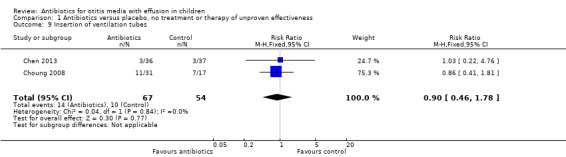
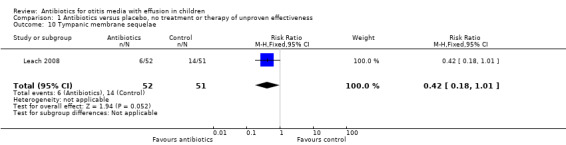
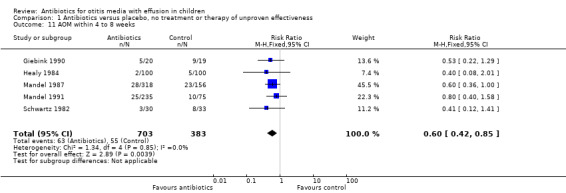
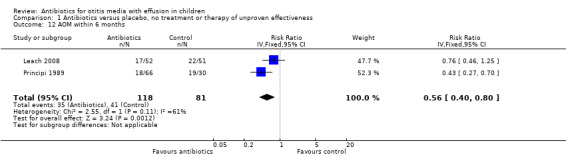
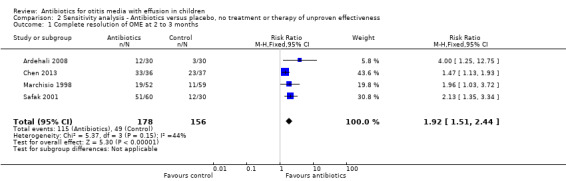
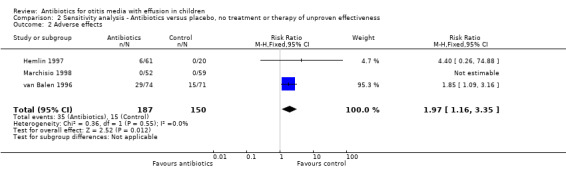
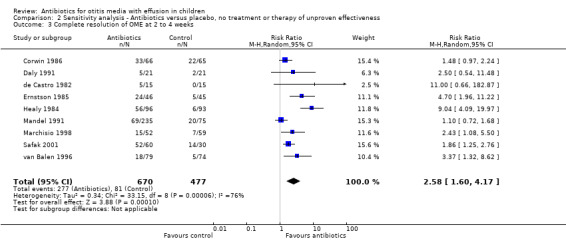
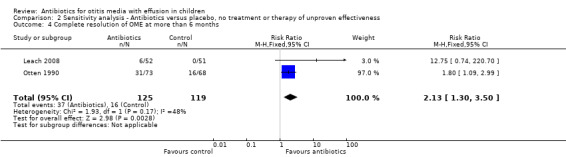
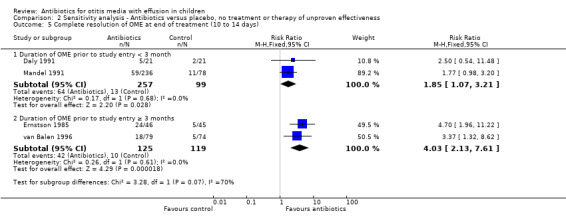
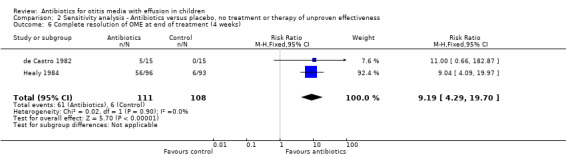
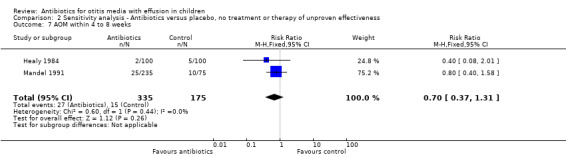
Main results: Twenty-five trials (3663 children) were eligible for inclusion. Two trials did not report on any of the outcomes of interest, leaving 23 trials (3258 children) covering a range of antibiotics, participants, outcome measures and time points for evaluation. Overall, we assessed most studies as being at low to moderate risk of bias.We found moderate quality evidence (six trials including 484 children) that children treated with oral antibiotics are more likely to have complete resolution at two to three months post-randomisation (primary outcome) than those allocated to the control treatment (risk ratio (RR) 2.00, 95% confidence interval (CI) 1.58 to 2.53; number needed to treat to benefit (NNTB) 5). However, there is evidence (albeit of low quality; five trials, 742 children) indicating that children treated with oral antibiotics are more likely to experience diarrhoea, vomiting or skin rash (primary outcome) than those allocated to control treatment (RR 2.15, 95% CI 1.29 to 3.60; number needed to treat to harm (NNTH) 20).In respect of the secondary outcome of complete resolution at any time point, we found low to moderate quality evidence from five meta-analyses, including between two and 14 trials, of a beneficial effect of antibiotics, with a NNTB ranging from 3 to 7. Time periods ranged from 10 to 14 days to six months.In terms of other secondary outcomes, only two trials (849 children) reported on hearing levels at two to four weeks and found conflicting results. None of the trials reported data on speech, language and cognitive development or quality of life. Low quality evidence did not show that oral antibiotics were associated with a decrease in the rate of ventilation tube insertion (two trials, 121 children) or in tympanic membrane sequelae (one trial, 103 children), while low quality evidence indicated that children treated with antibiotics were less likely to have acute otitis media episodes within four to eight weeks (five trials, 1086 children; NNTB 18) and within six months post-randomisation (two trials, 199 children; NNTB 5). It should, however, be noted that the beneficial effect of oral antibiotics on acute otitis media episodes within four to eight weeks was no longer significant when we excluded studies with high risk of bias.
Authors' conclusions: This review presents evidence of both benefits and harms associated with the use of oral antibiotics to treat children up to 16 years with OME. Although evidence indicates that oral antibiotics are associated with an increased chance of complete resolution of OME at various time points, we also found evidence that these children are more likely to experience diarrhoea, vomiting or skin rash. The impact of antibiotics on short-term hearing is uncertain and low quality evidence did not show that oral antibiotics were associated with fewer ventilation tube insertions. Furthermore, we found no data on the impact of antibiotics on other important outcomes such as speech, language and cognitive development or quality of life.Even in situations where clear and relevant benefits of oral antibiotics have been demonstrated, these must always be carefully balanced against adverse effects and the emergence of bacterial resistance. This has specifically been linked to the widespread use of antibiotics for common conditions such as otitis media.
Conflict of interest statement
AGMS has received an honorarium from GlaxoSmithKline for participating in educational activities and workshops related to pneumococcal vaccination and otitis media. She has received funds from GlaxoSmithKline for research on microbial pathogens in acute tympanostomy tube otorrhoea.
AGMS and MJB are Co‐ordinating Editors of Cochrane ENT, but had no role in the editorial process for this review.
RPV is an Editor for the Cochrane Acute Respiratory Infections Group and Cochrane ENT, but had no role in the editorial process for this review.
TMAvD, AGMS and RPV were involved in research on microbial pathogens in acute tympanostomy tube otorrhoea, partly funded by GlaxoSmithKline.
Figures



Update of
-
Antibiotics for otitis media with effusion in children.Cochrane Database Syst Rev. 2012 Sep 12;(9):CD009163. doi: 10.1002/14651858.CD009163.pub2. Cochrane Database Syst Rev. 2012. Update in: Cochrane Database Syst Rev. 2016 Jun 12;(6):CD009163. doi: 10.1002/14651858.CD009163.pub3. PMID: 22972136 Updated.
References
References to studies included in this review
Anari 1985 {published data only}
-
- Anari M, Cederberg A, Ernstson S. The effect of cefaclor on the nasopharyngeal flora in children with chronic OME. Acta Oto‐Laryngologica. Supplement 1985;424:13‐6. - PubMed
Ardehali 2008 {published data only}
-
- Ardehali MM, Seraj JM, Asiabar MK, Adibi H. The possible role of gastroesophageal reflux disease in children suffering from chronic otitis media with effusion. Acta Medica Iranica 2008;46(1):33‐7.
Balle 1990 {published data only}
-
- Balle VH, Stangerup SE, Sederberg Olsen J, Thomsen J, Vejlsgaard R. Amoxicillin/clavulanate treatment in secretory otitis media. Bacteriological findings in the nasopharynx. Acta Oto‐Laryngologica 1990;110(3‐4):274‐8. - PubMed
Chen 2013 {published data only}
-
- Chen K, Wu X, Jiang G, Du J, Jiang H. Low dose macrolide administration for long term is effective for otitis media with effusion in children. Auris Nasus Larynx 2013;40(1):46‐50. - PubMed
Choung 2008 {published data only}
Corwin 1986 {published data only}
-
- Corwin MJ, Weiner LB, Daniels D. Efficacy of oral antibiotics for the treatment of persistent otitis media with effusion. International Journal of Pediatric Otorhinolaryngology 1986;11(2):109‐12. - PubMed
-
- Corwin MJ, Weiner LB, Daniels DA. Effects of oral antibiotics on the outcome of serous otitis media. Pediatric Research 1982;16:238A.
Daly 1991 {published data only}
-
- Daly K, Giebink GS, Batalden PB, Anderson RS, Le CT, Lindgren B. Resolution of otitis media with effusion with the use of a stepped treatment regimen of trimethoprim‐sulfamethoxazole and prednisone. Pediatric Infectious Disease Journal 1991;10(7):500‐6. - PubMed
de Castro 1982 {published data only}
-
- Castro FJ, Jaeger RW, Martin L, Temeck JW, Tournour B. Serous otitis media. A double‐blind trial with sulfisoxazole. Missouri Medicine 1982;79(9):629‐30. - PubMed
Ernstson 1985 {published data only}
-
- Ernstson S, Anari M. Cefaclor in the treatment of otitis media with effusion. Acta Oto‐Laryngologica. Supplement 1985;424:17‐21. - PubMed
Giebink 1990 {published data only}
-
- Giebink GS, Batalden PB, Le CT, Lassman FM, Buran DJ, Seltz AE. A controlled trial comparing three treatments for chronic otitis media with effusion. Pediatric Infectious Disease Journal 1990;9(1):33‐40. - PubMed
Healy 1984 {published data only}
-
- Healy GB. Antimicrobial therapy of chronic otitis media with effusion. International Journal of Pediatric Otorhinolaryngology 1984;8(1):13‐7. - PubMed
Hemlin 1997 {published data only}
-
- Hemlin C, Carenfelt C, Papatziamos G. Single dose of betamethasone in combined medical treatment of secretory otitis media. Annals of Otology, Rhinology and Laryngology 1997;106(5):359‐63. - PubMed
Leach 2008 {published data only}
-
- Leach AJ, Morris PS, Mathews JD, Chronic Otitis Media Intervention Trial ‐ One (COMIT1) group. Compared to placebo, long‐term antibiotics resolve otitis media with effusion (OME) and prevent acute otitis media with perforation (AOMwiP) in a high‐risk population: a randomized controlled trial. BMC Pediatrics 2008;8:23. - PMC - PubMed
Mandel 1987 {published data only}
-
- Mandel EM, Rockette HE, Bluestone CD, Paradise JL, Nozza RJ. Efficacy of amoxicillin with and without decongestant‐antihistamine for otitis media with effusion in children. Results of a double‐blind, randomized trial. New England Journal of Medicine 1987;316(8):432‐7. - PubMed
Mandel 1991 {published data only}
-
- Mandel EM, Rockette HE, Paradise JL, Bluestone CD, Nozza RJ. Comparative efficacy of erythromycin‐sulfisoxazole, cefaclor, amoxicillin or placebo for otitis media with effusion in children. Pediatric Infectious Disease Journal 1991;10(12):899‐906. - PubMed
Marchisio 1998 {published data only}
-
- Marchisio P, Principi N, Passali D, Salpietro DC, Boschi G, Chetri G, et al. Epidemiology and treatment of otitis media with effusion in children in the first year of primary school. Acta Oto‐Laryngologica 1998;118(4):557‐62. - PubMed
Marks 1981 {published data only}
-
- Marks NJ, Mills RP, Shaheen OH. A controlled trial of co‐trimoxazole therapy in serous otitis media. Journal of Laryngology and Otology 1981;95(10):1003‐10. - PubMed
-
- Marks NJ, Mills RP, Shaheen OH. Cotrimoxazole in the treatment of serous otitis. A follow‐up report. Journal of Laryngology and Otology 1983;97(3):213‐5. - PubMed
Moller 1990 {published data only}
-
- Moller P, Dingsor G. Otitis media with effusion: can erythromycin reduce the need for ventilating tubes?. Journal of Laryngology and Otology 1990;104(3):200‐2. - PubMed
Otten 1990 {published data only}
-
- Otten FW, Grote JJ. Otitis media with effusion and chronic upper respiratory tract infection in children: a randomized, placebo‐controlled clinical study. Laryngoscope 1990;100(6):627‐33. - PubMed
Podoshin 1990 {published data only}
-
- Podoshin L, Fradis M, Ben David Y, Faraggi D. The efficacy of oral steroids in the treatment of persistent otitis media with effusion. Archives of Otolaryngology ‐ Head and Neck Surgery 1990;116(12):1404‐6. - PubMed
Principi 1989 {published data only}
-
- Principi N, Marchisio P, Massironi E, Grasso RM, Filiberti G. Prophylaxis of recurrent acute otitis media and middle‐ear effusion. Comparison of amoxicillin with sulfamethoxazole and trimethoprim. American Journal of Diseases of Children 1989;143(12):1414‐8. - PubMed
Safak 2001 {published data only}
-
- Safak MA, Kilic R, Haberal I, Gocmen H, Ozeri C. A comparative study of azithromycin and pseudoephedrine hydrochloride for otitis media with effusion in children. Acta Oto‐Laryngologica 2001;121(8):925‐9. - PubMed
Schwartz 1982 {published data only}
-
- Schwartz RH, Rodriguez WJ. Trimethoprim‐sulfamethoxazole treatment of persistent otitis media with effusion. Pediatric Infectious Disease Journal 1982;1(5):333‐5. - PubMed
Thomsen 1989 {published data only}
-
- Thomsen J, Sederberg Olsen J, Balle V, Vejlsgaard R, Stangerup SE, Bondesson G. Antibiotic treatment of children with secretory otitis media. A randomized, double‐blind, placebo‐controlled study. Archives of Otolaryngology ‐ Head and Neck Surgery 1989;115(4):447‐51. - PubMed
-
- Thomsen J, Sederberg‐Olsen J, Stangerup SE, Balle V, Vejlsgaard R. Long‐term antibiotic treatment of children with secretory otitis media: a double‐blind placebo‐controlled study. Acta Oto‐Laryngologica. Supplement 1988;449:49‐50. - PubMed
van Balen 1996 {published data only}
-
- Balen FA, Melker RA, Touw‐Otten FW. Double‐blind randomised trial of co‐amoxiclav versus placebo for persistent otitis media with effusion in general practice. Lancet 1996;348(9029):713‐6. - PubMed
References to studies excluded from this review
Balle 1998 {published data only}
-
- Balle V, Sederberg Olsen J, Thomsen J, Hartzen S. Treatment of children with secretory otitis media (SOM) with amoxicillin and clavulanic acid (Spektramox) or penicillin‐V (Primcillin). Bacteriological findings in the nasopharynx before and after treatment. International Journal of Pediatric Otorhinolaryngology 1998;45(1):77‐82. - PubMed
Berman 1987 {published data only}
-
- Berman S, Grose K, Zerbe GO. Medical management of chronic middle‐ear effusion. Results of a clinical trial of prednisone combined with sulfamethoxazole and trimethoprim. American Journal of Diseases of Children 1987;141(6):690‐4. - PubMed
Berman 1990 {published data only}
-
- Berman S, Grose K, Nuss R, Huber‐Navin C, Roark R, Gabbard SA, et al. Management of chronic middle ear effusion with prednisone combined with trimethoprim‐sulfamethoxazole. Pediatric Infectious Disease Journal 1990;9(8):533‐8. - PubMed
Bojanovic 1999 {published data only}
-
- Bojanovic M, Stankovic M, Dinic M, Milisavljevic L, Zivkovic E, Stefanov A. Treatment of children with secretory otitis media (SOM) with antihistamine and mucolytic or antibiotic (amoxicillin and clavulanic acid). XXII Annual Meeting of the Politzer Society: Otology 2000 ‐ Achievements and Perspectives, Zurich, Switzerland, 15‐19 August, 1999. 1999; Vol. 28:Abstract No. A14‐3.
Cantekin 1991 {published data only}
-
- Cantekin EI, McGuire TW, Griffith TL. Antimicrobial therapy for otitis media with effusion ('secretory' otitis media). JAMA 1991;266(23):3309‐17. - PubMed
Chan 1988 {published data only}
-
- Chan KH, Mandel EM, Rockette HE, Bluestone CD, Bass LW, Blatter MM, et al. A comparative study of amoxicillin‐clavulanate and amoxicillin. Treatment of otitis media with effusion. Archives of Otolaryngology ‐ Head and Neck Surgery 1988;114(2):142‐6. - PubMed
Combs 2004 {published data only}
-
- Combs JT. The effect of montelukast sodium on the duration of effusion of otitis media. Clinical Pediatrics 2004;43(6):529‐33. - PubMed
Donaldson 1990 {published data only}
-
- Donaldson JD, Martin GF, Maltby CC, Seywerd EB. The efficacy of pulse‐dosed antibiotic therapy in the management of persistent otitis media with effusion. Journal of Otolaryngology 1990;19(3):175‐8. - PubMed
Eiden 1997 {published data only}
-
- Eiden P. Antibiotic therapy for otitis media infection with effusion in children can make surgery unnecessary. Deutsche Apotheker Zeitung 1997;137(8):41‐2.
Ernstson 1985a {published data only}
-
- Ernstson S, Sundberg L. Erythromycin in the treatment of otitis media with effusion: timing and long‐term effects. Current Therapeutic Research, Clinical and Experimental 1985;38(6):918‐21.
Fontanel 1998 {published data only}
-
- Fontanel JP. Role of ciprofloxacin in the treatment of chronic otitis media. Presse Medicale 1998;27(29):1506‐8. - PubMed
Fujita 1994 {published data only}
-
- Fujita A, Kurata K, Takahashi H, Takagita S. Clinical efficacy of clarithromycin treatment of refractory otitis media with effusion. Practica Otologica 1994;87(9):1287‐91.
Gates 1986 {published data only}
-
- Gates GA, Wachtendorf C, Holt GR, Hearne EM. Medical treatment of chronic otitis media with effusion (secretory otitis media). Otolaryngology ‐ Head and Neck Surgery 1986;94(3):350‐4. - PubMed
Goodey 1975 {published data only}
-
- Goodey RJ, Bowers M. Antibiotic treatment of secretory otitis media assessed by impedence audiometry. New Zealand Medical Journal 1975;82(548):187‐8. - PubMed
Heary 1990 {published data only}
-
- Heary C, Hokanson J, Ury H, Chang C, Coplan B, Hall M. Lack of efficacy of short‐term prednisolone, trimethoprim‐sulfamethoxazole, alone or combined, in persistent otitis media with effusion: season of entry as a possible determinant of outcome. American Journal of Diseases of Childhood 1990;144(4):420.
Hong 2014 {published data only}
-
- Hong HR, Kim TS, Chung JW. Long‐term follow‐up of otitis media with effusion in children: comparisons between a ventilation tube group and a non‐ventilation tube group. International Journal of Pediatric Otorhinolaryngology 2014;78(6):938‐43. - PubMed
Howie 1971 {published data only}
-
- Howie VM, Ploussard JH. Bacterial etiology and antimicrobial treatment of exudative otitis media: relation of antibiotic therapy to relapses. Southern Medical Journal 1971;64(2):233‐9. - PubMed
Hozawa 2001 {published data only}
-
- Hozawa T. Evidence‐based macrolide therapy for children with serous otitis media. Japanese Journal of Antibiotics 2001;54(Suppl C):30‐2. - PubMed
Karlidag 2002 {published data only}
-
- Karlidag T, Kaygusuz I, Gok U, Yalcin S, Keles E, Ozturk L. The efficacy of combining antibiotic treatment with topical intranasal steroid administration in the treatment of chronic otitis media with effusion. Kulak Burun Bogaz Ihtis Derg 2002;9(4):257‐62. - PubMed
Mandel 1996 {published data only}
-
- Mandel EM, Casselbrant ML, Kurs Lasky M, Bluestone CD. Efficacy of ceftibuten compared with amoxicillin for otitis media with effusion in infants and children. Pediatric Infectious Disease Journal 1996;15(5):409‐14. - PubMed
Mandel 2002 {published data only}
-
- Mandel EM, Casselbrant ML, Rockette HE, Fireman P, Kurs‐Lasky M, Bluestone CD. Systemic steroid for chronic otitis media with effusion in children. Pediatrics 2002;110(6):1071‐80. - PubMed
Margas 2004 {published data only}
-
- Margas K, Mourtzouhos C, Assimakopoulos A, Anagnostopoulos M. Treatment of otitis media with effusion (OME): antibiotics vs. antihistamines ‐ our experience. 8th International Conference on Pediatric Otorhinolaryngology (ESPO), Athens, Greece, 16‐19 May 2004. International Journal of Pediatric Otorhinolaryngology 2004. 2004; Vol. 68(5):644, Abstract No. O.1.36.
Mel‐Hennawi 2015 {published data only}
-
- Mel‐Hennawi D, Ahmed MR. Outcome evaluation of clarithromycin, metronidazole and lansoprazole regimens in Helicobacter pylori positive or negative children with resistant otitis media with effusion. Journal of Laryngology and Otology 2015;129(11):1069‐72. - PubMed
Nsouli 2015 {published data only}
-
- Nsouli SM. The efficacy of a macrolide antibiotic clarithromycin for the treatment of serous otitis media in atopic children. American College of Allergy, Asthma and Immunology Annual Scientific Meeting 2015. 2015:A53.
Ortega 2005 {published data only}
-
- Ortega del Alamo P, Rivera RT, Sanz FR. The effect of AM3 in the resolution of otitis media with effusion (OME) in paediatric patients. Acta Otorrinolaringologica Espanola 2005;56(1):1‐5. - PubMed
Ozmen 2010 {published data only}
-
- Ozmen OA, Genc A, Ozmen S, Kayikci EMK, Sarac S, Sennaroglu L, et al. Successive medical treatment versus watchful waiting in chronic otitis media with effusion. Journal of International Advanced Otology 2010;6(1):11‐7.
Pestalozza 1992 {published data only}
-
- Pestalozza G, Cioce C, Facchini M. Azithromycin in upper respiratory tract infections: a clinical trial in children with otitis media. Scandinavian Journal of Infectious Diseases. Supplementum 1992;83:22‐5. - PubMed
Puhakka 1985 {published data only}
-
- Puhakka H, Haapaniemi J, Tuohimaa P, Ruuskanen O, Eskola J. Peroral prednisolone in the treatment of middle‐ear effusion in children: a double‐blind study. Auris, Nasus, Larynx 1985;12(Suppl 1):S268‐71. - PubMed
Rosenfeld 1995 {published data only}
-
- Rosenfeld RM. Nonsurgical management of surgical otitis media with effusion. Journal of Laryngology and Otology 1995;109(9):811‐6. - PubMed
Roydhouse 1991 {published data only}
-
- Roydhouse N. Antibiotic treatment of otitis media with effusion. New Zealand Medical Journal 1991;104(919):380‐2. - PubMed
Schloss 1988 {published data only}
-
- Schloss MD, Dempsey EE, Rishikof E, Sorga S, Grace MGA. Double blind study comparing erythromycin‐sulfisoxazole (Pediazole) TID to placebo in chronic otitis media with effusion. Proceedings of the Fourth International Symposium on Recent Advances in Otitis Media. 1988:261‐3.
Schwartz 1980 {published data only}
-
- Schwartz RH, Puglese J, Schwartz DM. Use of a short course of prednisone for treating middle ear effusion. A double‐blind crossover study. Annals of Otology, Rhinology and Laryngology 1980;89(3 (Pt 2)):296‐300. - PubMed
Schwartz 1982a {published data only}
Sundberg 1984 {published data only}
-
- Sundberg L. Antibiotic treatment of secretory otitis media. Acta Oto‐Laryngologica. Supplement 1984;407:26‐9. - PubMed
Tapiainen 2014 {published data only}
-
- Tapiainen T, Kujala T, Renko M, Koivunen P, Kontiokari T, Kristo A, et al. Effect of antimicrobial treatment of acute otitis media on the daily disappearance of middle ear effusion: a placebo‐controlled trial. Journal of the American Medical Association Pediatrics 2014;168(7):635‐41. - PubMed
Thomsen 1997 {published data only}
-
- Thomsen J, Sederberg OJ, Balle V, Hartzen S. Antibiotic treatment of children with secretory otitis media. Amoxicillin‐clavulanate is superior to penicillin V in a double‐blind randomized study. Archives of Otolaryngology ‐ Head and Neck Surgery 1997;123(7):695‐9. - PubMed
Tracy 1998 {published data only}
-
- Tracy JM, Demain JG, Hoffman KM, Goetz DW. Intranasal beclomethasone as an adjunct to treatment of chronic middle ear effusion. Annals of Allergy, Asthma and Immunology 1998;80(2):198‐206. - PubMed
Unlu 2005 {published data only}
-
- Unlu Y, Haberal Y, Emyr H, Ozdek A, Gocmen H, Kaptan ZK, et al. The comparison of different antibiotics and the effect of mucolitics in treatment of otitis media with effusion. XVIII IFOS World Congress, Rome, Italy, 25‐30 June, 2005. 2005.
Varsano 1985 {published data only}
-
- Varsano I, Volovitz B, Mimouni F. Sulfisoxazole prophylaxis of middle ear effusion and recurrent acute otitis media. American Journal of Diseases of Children 1985;139(6):632‐5. - PubMed
Venekamp 2014 {published data only}
-
- Venekamp RP, Schilder AG. Antibiotic treatment in otitis media reduces middle ear effusion duration. Journal of Pediatrics 2014;165(3):641‐2. - PubMed
Yin 2002 {published data only}
-
- Yin TF, Tang QL, Xie DH, Lu YD. Efficacy of cefaclor in treating children with secretory otitis media. Shanghai Medicine 2002;23(2):65‐6.
Zocconi 1994 {published data only}
-
- Zocconi E. Antibiotics and oral steroids in the treatment of otitis media with effusion. Pediatria Medica e Chirurgica 1994;16(3):273‐5. - PubMed
Additional references
AAFP 2004
-
- Neff MJ. AAP, AAFP, AAO‐HNS release guideline on diagnosis and management of otitis media with effusion. American Family Physician 2004;69:2929‐31. - PubMed
Boonacker 2014
Browning 2010
Casselbrant 2003
-
- Casselbrant ML, Mandel EM. Epidemiology. In: Rosenfeld RM, Bluestone CD editor(s). Evidence‐based Otitis Media. 2nd Edition. Hamilton, ON: BC Decker, 2003:149‐53.
Costelloe 2010
-
- Costelloe C, Metcalfe C, Lovering A, Mant D, Hay AD. Effect of antibiotic prescribing in primary care on antimicrobial resistance in individual patients: systematic review and meta‐analysis. BMJ 2010;340:c2096. - PubMed
ECDC 2011
-
- European Centre for Disease Prevention and Control. Antimicrobial Resistance Surveillance in Europe 2010. Annual Report of the European Antimicrobial Resistance Surveillance Network (EARS‐Net). Stockholm: ECDC, 2011.
Gates 2002
-
- Gates GA, Klein JO, Lim DJ, Mogi G, Ogra PL, Pararella MM, et al. Recent advances in otitis media, 1: Definitions, terminology, and classification of otitis media. Annals of Otology, Rhinology and Laryngology 2002;111:8‐18. - PubMed
Gillies 2015
Gouma 2011
-
- Gouma P, Mallis A, Daniilidis V, Gouveris H, Armenakis N, Naxakis S. Behavioral trends in young children with conductive hearing loss: a case‐control study. European Archives of Otorhinolaryngology 2011;268(1):63‐6. - PubMed
Griffin 2011
Handbook 2011
-
- Higgins JPT, Green S (editors). Cochrane Handbook for Systematic Reviews of Interventions Version 5.1.0 [updated March 2011]. The Cochrane Collaboration, 2011. Available from www.cochrane‐handbook.org.
Laxminarayan 2013
-
- Laxminarayan R, Duse A, Wattal C, Zaidi AK, Wertheim HF, Sumpradit N, et al. Antibiotic resistance‐the need for global solutions. Lancet Infectious Diseases 2013;13(12):1057‐98. - PubMed
Mandel 2004
-
- Mandel EM, Casselbrant ML. Antibiotics for otitis media. Minerva Pediatrica 2004;56(5):481‐95. - PubMed
Perera 2013
Pignataro 1996
-
- Pignataro O, Pignataro LD, Gallus G, Calori G, Cordaro CI. Otitis media with effusion and S carboxymethylcysteine and/or its lysine salt: a critical overview. International Journal of Pediatric Otorhinolaryngology 1996;35:231‐41. - PubMed
Poetker 2005
-
- Poetker DM, Lindstrom DR, Edmiston CE, Krepel CJ, Link TR, Kerschner JE. Microbiology of middle ear effusions from 292 patients undergoing tympanostomy tube placement for middle ear disease. International Journal of Pediatric Otorhinolaryngology 2005;69(6):799‐804. - PubMed
Roberts 2004
-
- Roberts JE, Rosenfeld RM, Zeisel SA. Otitis media and speech and language: a meta‐analysis of prospective studies. Pediatrics 2004;113(3 Pt 1):e238‐48. - PubMed
Rosenfeld 2003
-
- Rosenfeld RM, Kay D. Natural history of untreated otitis media. In: Rosenfeld RM, Bluestone CD editor(s). Evidence‐based Otitis Media. 2nd Edition. BC Decker: Hamilton, ON, 2003:186‐94.
Rosenfeld 2004
-
- Rosenfeld RM. Otitis media with effusion. In: Alper CM, Bluestone CD, Casselbrant ML, Dohar JE, Mandel EM editor(s). Advanced Therapy of Otitis Media. 2nd Edition. Hamilton, ON: BC Decker, 2004:175‐9.
Rovers 2004
-
- Rovers MM, Schilder AG, Zielhuis GA, Rosenfeld RM. Otitis media. Lancet 2004;363:465‐73. - PubMed
Sabo 2003
-
- Sabo DL, Paradise JL, Kurs‐Lasky M, Smith CG. Hearing levels in infants and young children in relation to testing technique, age group, and the presence or absence of middle‐ear effusion. Ear and Hearing 2003;24:38‐47. - PubMed
Shekelle 2002
Simpson 2011
Teele 1989
-
- Teele DW, Klein JO, Rosner B. Epidemiology of otitis media during first seven years of life in children in greater Boston: a prospective, cohort study. Journal of Infectious Diseases 1989;160:83‐94. - PubMed
References to other published versions of this review
van Zon 2011
-
- Zon A, Schilder AGM, Heijden GJ. Antibiotics for otitis media with effusion in children. Cochrane Database of Systematic Reviews 2011, Issue 6. [DOI: 10.1002/14651858.CD009163] - DOI
Publication types
MeSH terms
Substances
Grants and funding
LinkOut - more resources
Full Text Sources
Other Literature Sources
Medical
Research Materials
Miscellaneous
