Identification of intraocular inflammatory mediators in patients with endophthalmitis
- PMID: 27293374
- PMCID: PMC4890595
Identification of intraocular inflammatory mediators in patients with endophthalmitis
Abstract
Purpose: Endophthalmitis is mediated by inflammatory cytokines. We employed a quantitative antibody array, which profiles protein expression and function in a high-throughput manner, to identify inflammatory mediators in the infectious aqueous and vitreous humor from patients with endophthalmitis.
Methods: In this prospective study, aqueous humor (AH) and vitreous humor (VH) samples were obtained from 30 patients with endophthalmitis and were collected during anterior chamber paracentesis and vitrectomy. Control samples were obtained from 32 healthy donors. We examined the expression of 20 inflammatory mediators in AH and VH using a quantitative antibody protein array. Hierarchical cluster analysis based on the expression of the quantified cytokines was applied to identify the specificity of endophthalmitis disease. Validation analysis using enzyme-linked immunosorbent assay (ELISA) was performed to confirm the expression of the cytokines identified in the AH and VH samples.
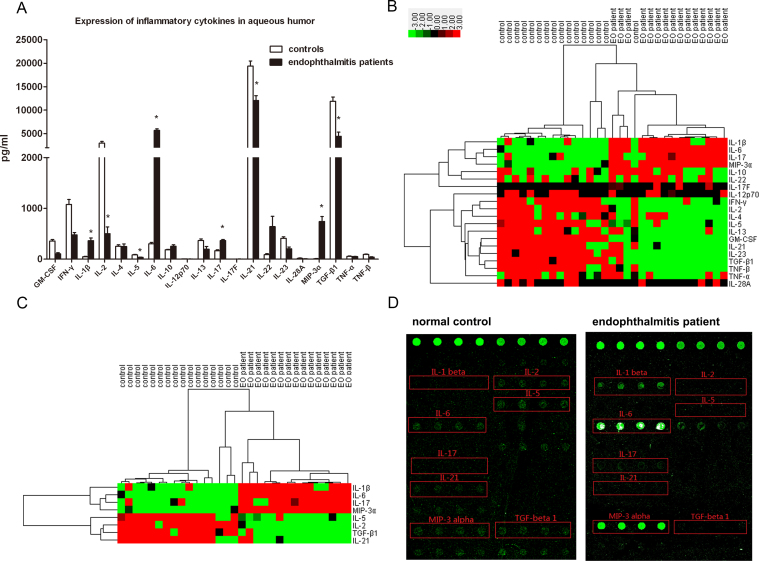
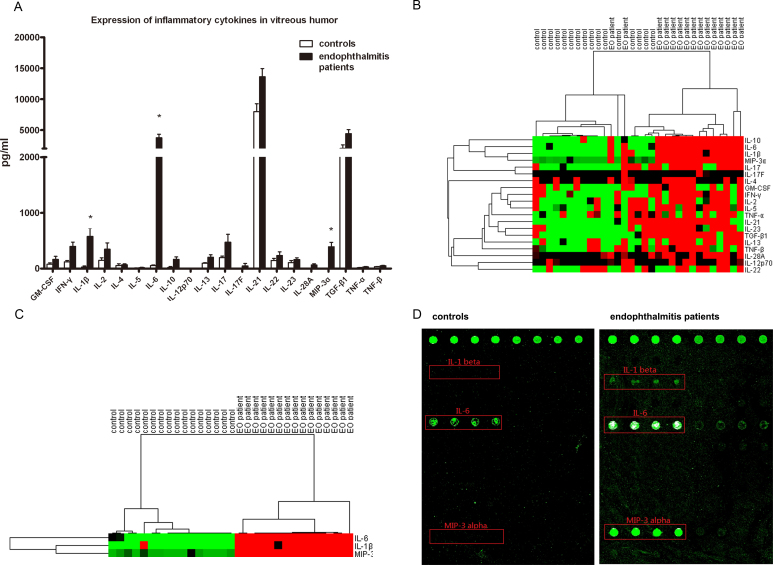
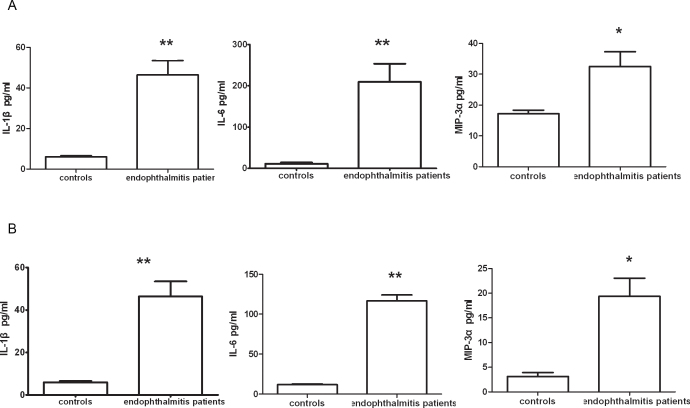
Results: Our results demonstrated elevated expression of interleukin (IL)-1β, IL-6, and macrophage inflammatory protein (MIP)-3α in AH or VH from patients with endophthalmitis. The concentration of IL-17 was upregulated in AH from the patients. The expression of IL-2, IL-5, IL-21, and transforming growth factor (TGF)-β1 was downregulated in AH from the patients. The cluster analysis demonstrated that the cytokine profile expression in AH or VH significantly differed between the patients with endophthalmitis and the healthy controls. Confirmation with ELISA validated the increase in IL-1β, IL-6, and MIP-3α in the AH and VH samples from the patients with endophthalmitis.
Conclusions: Increased expression of IL-1β, IL-6, IL-17, and MIP-3α and decreased expression of IL-2, IL-5, IL-21, and TGF-β in the AH and VH suggests an abnormal cytokine profile in patients with endophthalmitis. Knowledge of this will aid in the diagnosis of infectious endophthalmitis.
Figures
References
-
- Callegan MC, Engelbert M, Parke DW, 2nd, Jett BD, Gilmore MS. Bacterial endophthalmitis: epidemiology, therapeutics, and bacterium-host interactions. Clin Microbiol Rev. 2002;15:111–24. http://www.ncbi.nlm.nih.gov/entrez/query.fcgi?cmd=Retrieve&db=PubMed&lis... - PMC - PubMed
-
- Essex RW, Yi Q, Charles PG, Allen PJ. Post-traumatic endophthalmitis. Ophthalmology. 2004;111:2015–22. http://www.ncbi.nlm.nih.gov/entrez/query.fcgi?cmd=Retrieve&db=PubMed&lis... - PubMed
-
- Jonas JB, Knorr HL, Budde WM. Prognostic factors in ocular injuries caused by intraocular or retrobulbar foreign bodies. Ophthalmology. 2000;107:823–8. http://www.ncbi.nlm.nih.gov/entrez/query.fcgi?cmd=Retrieve&db=PubMed&lis... - PubMed
-
- Meredith TA. Posttraumatic endophthalmitis. Arch Ophthalmol. 1999;117:520–1. http://www.ncbi.nlm.nih.gov/entrez/query.fcgi?cmd=Retrieve&db=PubMed&lis... - PubMed
-
- Carifi G. Bacterial post-traumatic endophthalmitis. Surv Ophthalmol. Vol 57. United States2012. p. 85–6; author reply 6–8. - PubMed
Publication types
MeSH terms
Substances
LinkOut - more resources
Full Text Sources