


Heat tolerance during embryonic development has not diverged among populations of a widespread species (Sceloporus undulatus)
- PMID: 27293602
- PMCID: PMC4806623
- DOI: 10.1093/conphys/cot018
Heat tolerance during embryonic development has not diverged among populations of a widespread species (Sceloporus undulatus)
Abstract
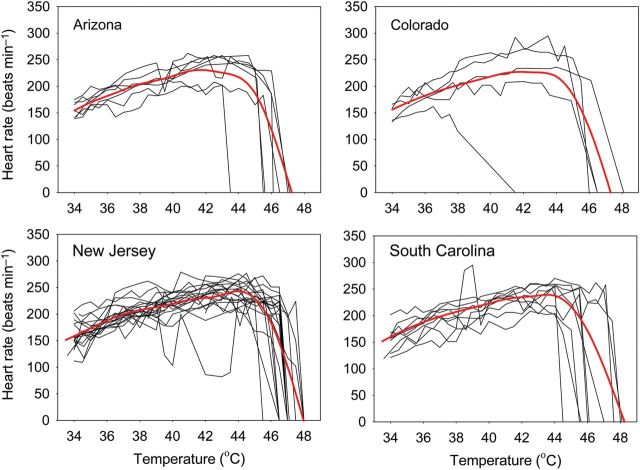
The frequency and magnitude of heat waves have increased in recent decades, imposing additional stresses on organisms in extreme environments. Most reptilian embryos are regularly exposed to thermal stress because they develop in shallow, warm soils for weeks to months. We studied cardiac performance during warming to infer lethal temperatures for embryonic lizards in the Sceloporus undulatus complex. Embryos from four populations throughout the geographical range (New Jersey, South Carolina, Colorado, and Arizona) were warmed at a rate observed in natural nests. Embryos from all populations exhibited a similar pattern of thermal sensitivity, as follows: heart rate rose between 34 and 41°C, remained stable between 41 and 44°C, and dropped sharply between 44 and 47°C. No embryos recovered from cardiac arrest, indicating that the upper lethal temperature was ≤47°C. Despite the putative selective pressures, the thermal limit to cardiac performance seems to have been conserved during the evolution of this species.
Keywords: Critical thermal maximum; embryo; heart rate; survival; temperature; thermal tolerance.
Figures
References
-
- Andrews RM, Mathies T, Warner DA. (2000) Effect of incubation temperature on morphology, growth, and survival of juvenile Sceloporus undulatus. Herpetol Monogr 14: 420–431.
-
- Angilletta MJ, Winters RS, Dunham AE. (2000) Thermal effects on the energetics of lizard embryos: Implications for hatchling phenotypes. Ecology 81: 2957–2968.
-
- Angilletta MJ, Hill T, Robson MA. (2002a) Is physiological performance optimized by thermoregulatory behavior?: A case study of the eastern fence lizard, Sceloporus undulatus. J Therm Biol 27: 199–204.
-
- Angilletta MJ, Niewiarowski PH, Navas CA. (2002b) The evolution of thermal physiology in ectotherms. J Therm Biol 27: 249–268.
-
- Angilletta MJ, Niewiarowski PH, Dunham AE, Leache AD, Porter WP. (2004) Bergmann's clines in ectotherms: illustrating a life-history perspective with sceloporine lizards. Am Nat 164: E168–E183. - PubMed
LinkOut - more resources
Full Text Sources
Other Literature Sources
