


Body condition and habitat use by Hermann's tortoises in burnt and intact habitats
- PMID: 27293640
- PMCID: PMC4732473
- DOI: 10.1093/conphys/cou019
Body condition and habitat use by Hermann's tortoises in burnt and intact habitats
Abstract
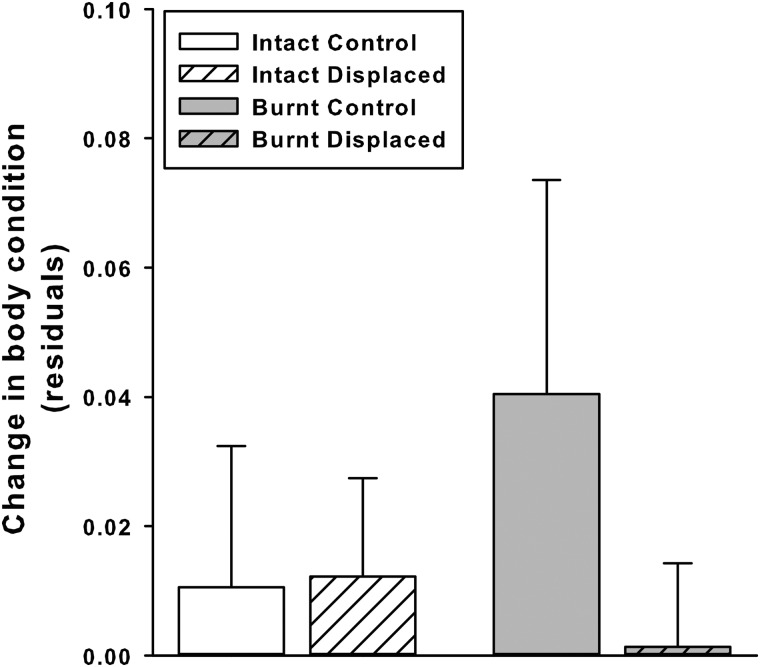
In Mediterranean regions, fires threaten terrestrial tortoises. Nevertheless, varying proportions of adults survive fire; these surviving individuals can play a central role for population recovery. The regions devastated by fire often include important habitat of Hermann's tortoises (Testudo hermanni hermanni), so assessing the ability of survivors to persist is essential for conserving the species. Body-condition indices provide an integrative estimate of how well individuals cope with environmental variations and impacts, including fires. Between 2002 and 2009, we monitored Hermann's tortoises in intact and burnt habitats in southeastern France. In summer 2003, a strong fire ravaged half of the surveyed zone, providing an opportunity to compare body condition of tortoises between intact and burnt areas over time. Six years later, the impact of fire on vegetation was still marked; large trees were abundant in the intact area, whereas open shrub vegetation prevailed in the burnt area. In both areas, the mean body condition of tortoises fluctuated over time; however, there were no differences between the two areas. A radio-tracking experiment demonstrated that individuals from each area were residents, and not vagrants commuting between areas. We also assessed changes in body condition and microhabitat use in radio-tracked individuals. We found no significant differences between the tortoises living in the burnt and intact areas, despite subtle differences in habitat use.
In conclusion: (i) surviving tortoises in an area ravaged by fire can maintain their body condition like individuals living in an intact area, and thus, individuals from burnt areas should not be translocated to supposedly better areas; and (ii) depopulated burnt areas are likely to be appropriate for population-augmentation programmes.
Keywords: Fire mortality; Mediterranean region; Testudo hermanni; habitat; reptiles.
Figures




References
-
- Attum O, Kramer A, Baha El Din SM. (2013) Thermal utility of desert vegetation for the Egyptian tortoise and its conservation implications. J Arid Environ 96: 73–79.
-
- Ballouard JM, Caron S, Lafon T, Servant L, Devaux B, Bonnet X. (2013) Fibrocement slabs as useful tools to monitor juvenile reptiles: a study in a tortoise species. Amph Rept 34: 1–10.
-
- Barje F, Slimani T, El Mouden EH, Lagarde F, Bonnet X, Ben Kaddour RK. (2005) Shrewd shrikes and spiny shrubs: a calamity for hatchling Moorish tortoise. Amph Rept 26: 113–115.
-
- Bertolero A, Cheylan M, Hailey A, Livoreil B, Willemsen RE. (2011) Testudo hermanni (Gmelin 1789) Hermann's Tortoise. In Rhodin AGJ, van Pritchard PCH, Dijk PP, Saumure RA, Buhlmann KA, Iverson JB, Mittermeier RA, eds, Conservation Biology of Freshwater Turtles and Tortoises: A Compilation Project of the IUCN/SSC Tortoise and Freshwater Turtle Specialist Group. Chelonian Research Monographs 5: 059.1–059.20, doi:10.3854/crm.5.059. hermanni.v1.2011, http://www.iucn-tftsg.org/cbftt/ Anders G.J. Rhodin Chelonian Research Foundation, 168 Goodrich Street, Lunenburg, MA 01462, USA.
-
- Bonnet X, Naulleau G, Shine R, Lourdais O. (1999) What is the appropriate timescale for measuring costs of reproduction in a capital breeder such as the aspic viper? Evol Ecol 13: 485–497.
LinkOut - more resources
Full Text Sources
Other Literature Sources
