Neuroendocrine carcinoma of the esophagus: clinical characteristics and prognostic evaluation of 49 cases with surgical resection
- PMID: 27293844
- PMCID: PMC4886019
- DOI: 10.21037/jtd.2016.04.21
Neuroendocrine carcinoma of the esophagus: clinical characteristics and prognostic evaluation of 49 cases with surgical resection
Abstract
Background: The clinicopathological features and optimum treatment of esophageal neuroendocrine carcinoma (NEC) are hardly known due to its rarity. Therefore, we conducted a retrospective study to analyze the clinical characteristics and prognosis of patients with surgically resected esophageal NEC.
Methods: We collected clinicopathological data on consecutive limited disease stage esophageal NEC patients who underwent esophagectomy with regional lymphadenectomy in West China Hospital from January 2007 to December 2013.
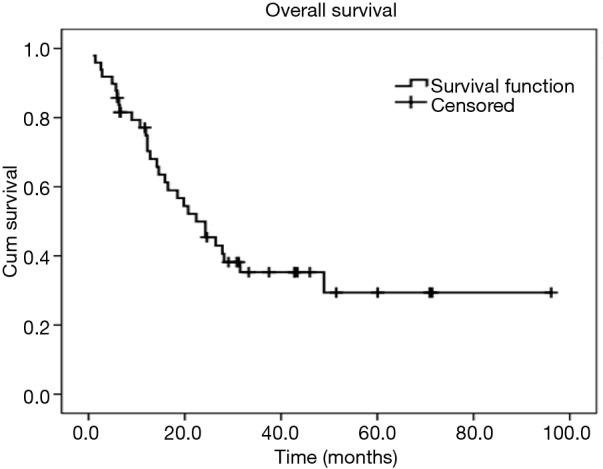
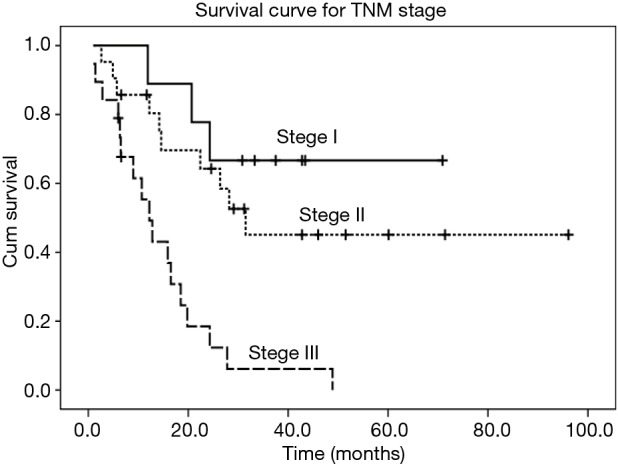
Results: A total of forty-nine patients were analyzed retrospectively. The mean age of the patients was 58.4±8.2 years with male predominance. Fifty-five percent of the esophageal NEC were located in the middle thoracic esophagus. Histologically, 28 (57.1%) patients were found to be small cell NECs. Fifty-one percent of the patients were found to have lymph node metastasis. According to the 2009 American Joint Committee on Cancer (AJCC) staging system for esophageal squamous cell carcinoma, 9 patients were at stage I, 21 patients stage II, and 19 patients stage III. Twenty-six patients (53.1%) received adjuvant therapy. After a median follow-up of 44.8 months [95% confidence interval (CI), 35.2-50.4 months], the median survival time of the patients was 22.4 months (95% CI, 14.0-30.8 months). The 1-year and 3-year survival rates for the whole cohort patients were 74.9% and 35.3%, respectively. In univariate analysis, TNM staging, lymph node metastasis and adjutant therapy significantly influenced survival time. In multivariate analysis, TNM staging was the only independent prognostic factor.
Conclusions: Esophageal NEC has a poor prognosis. The 2009 AJCC TNM staging system for esophageal squamous cell carcinoma may also fit for esophageal NEC. Surgery combined with adjuvant therapy may be a good option for treating limited disease stage esophageal NEC. Further prospective studies defining the optimum therapeutic regimen for esophageal NEC are needed.
Keywords: Neuroendocrine carcinoma (NEC); esophagus; prognosis; surgery.
Conflict of interest statement
Figures
Comment in
-
Is There a Role for Surgery in Treating Localized Esophageal Neuroendocrine Tumor?Ann Surg Oncol. 2020 Mar;27(3):960-961. doi: 10.1245/s10434-019-08118-9. Epub 2019 Dec 11. Ann Surg Oncol. 2020. PMID: 31828688 No abstract available.
References
LinkOut - more resources
Full Text Sources
Other Literature Sources