Triglyceride Levels and Fracture Risk in Midlife Women: Study of Women's Health Across the Nation (SWAN)
- PMID: 27294327
- PMCID: PMC5010577
- DOI: 10.1210/jc.2016-1366
Triglyceride Levels and Fracture Risk in Midlife Women: Study of Women's Health Across the Nation (SWAN)
Abstract
Context: Unfavorable lipid levels contribute to cardiovascular disease and may also harm bone health.
Objective: Our objective was to investigate relationships between fasting plasma lipid levels and incident fracture in midlife women undergoing the menopausal transition.
Design and setting: This was a 13-year prospective, longitudinal study of multiethnic women in five US communities, with near-annual assessments.
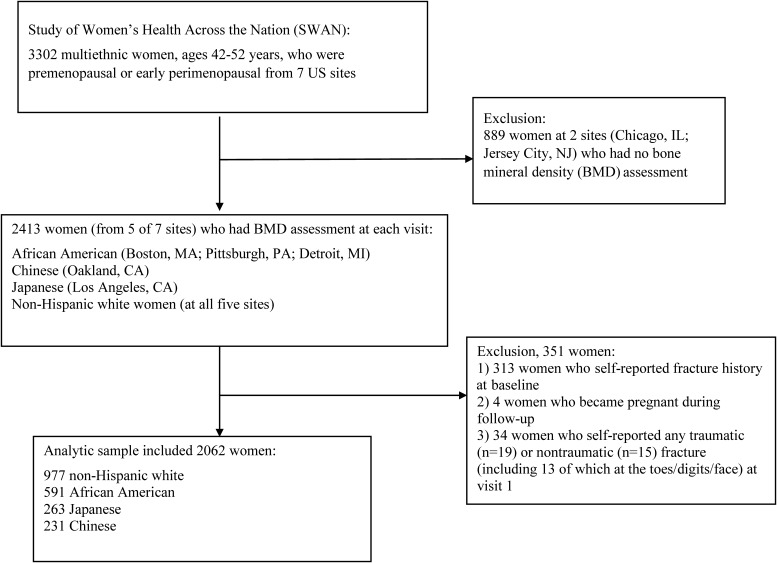
Participants: At baseline, 2062 premenopausal or early perimenopausal women who had no history of fracture were included.
Exposures: Fasting plasma total cholesterol, triglycerides (TG), low-density lipoprotein cholesterol, and high-density lipoprotein cholesterol at baseline and follow-up visits 1 and 3-7.
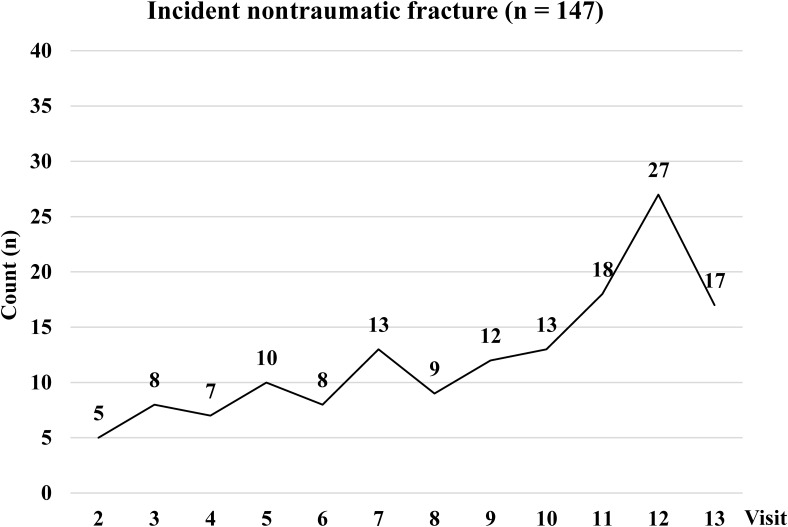
Main outcome measure(s): Incident nontraumatic fractures 1) 2 or more years after baseline, in relation to a single baseline level of lipids; and 2) 2-5 years later, in relation to time-varying lipid levels. Cox proportional hazards modelings estimated hazard ratios and 95% confidence interval (CI).
Results: Among the lipids, TG levels changed the most, with median levels increased by 16% during follow-up. An increase of 50 mg/dl in baseline TG level was associated with a 1.1-fold increased hazards of fracture (adjusted hazard ratio, 1.11; 95% CI, 1.04-1.18). Women with baseline TG higher than 300 mg/dl had an adjusted 2.5-fold greater hazards for fractures (95% CI, 1.13-5.44) than women with baseline TG lower than 150 mg/dl. Time-varying analyses showed a comparable TG level-fracture risk relationship. Associations between total cholesterol, low-density lipoprotein cholesterol, or high-density lipoprotein cholesterol levels and fractures were not observed.
Conclusions: Midlife women with high fasting plasma TG had an increased risk of incident nontraumatic fracture. Secondary Abstract: Midlife women with fasting plasma triglyceride (TG) of at least 300 mg/dl had 2.5-fold greater hazards of fracture in 2 years later and onward, compared to those with TG below 150 mg/dl, in a multiethnic cohort. Time-varying analyses revealed comparable results.
Figures
References
-
- Melton LJ, Chrischilles EA, Cooper C, Lane AW, Riggs BL. How many women have osteoporosis? J Bone Mineral Res. 2005;20:886–892. - PubMed
-
- Cauley JA, Wu L, Wampler NS, et al. Clinical risk factors for fractures in multi-ethnic women: the Women's Health Initiative. J Bone Miner Res. 2007;22:1816–1826. - PubMed
-
- Heath H, 3rd, Melton LJ, 3rd, Chu CP. Diabetes mellitus and risk of skeletal fracture. N Engl J Med. 1980;303:567–570. - PubMed
-
- Kanis J, Oden A, Johnell O. Acute and long-term increase in fracture risk after hospitalization for stroke. Stroke. 2001;32:702–706. - PubMed
-
- Sennerby U, Melhus H, Gedeborg R, et al. Cardiovascular diseases and risk of hip fracture. JAMA. 2009;302:1666–1673. - PubMed
Publication types
MeSH terms
Substances
Grants and funding
LinkOut - more resources
Full Text Sources
Other Literature Sources
Medical
Miscellaneous