. 2016 May;19(3):303-11.
doi: 10.1080/10253890.2016.1191466.

CD4(+) T cells confer anxiolytic and antidepressant-like effects, but enhance fear memory processes in Rag2(-/-) mice

Affiliations

CD4(+) T cells confer anxiolytic and antidepressant-like effects, but enhance fear memory processes in Rag2(-/-) mice

Sarah M Clark et al. Stress. 2016 May.

Abstract

Accumulating evidence supports a role of T cells in behavioral stress responsiveness. Our laboratory previously reported that lymphocyte deficient Rag2(-/-) mice on a BALB/c background display resilience to maladaptive stress responses when compared with immune competent mice in the predator odor exposure (POE) paradigm, while exhibiting similar behavior in a cued fear-conditioning (FC) paradigm. In the present study, Rag2(-/-) mice on a C57BL/6 background were assessed in the same behavioral paradigms, as well as additional tests of anxiety and depressive-like behavior. Furthermore, the effects of naïve CD4(+ ) T cells were evaluated by adoptive transfer of functional cells from nonstressed, wild-type donors to Rag2(-/-) mice. Consistent with our prior results, Rag2(-/-) mice displayed an attenuated startle response after POE. Nevertheless, reconstitution of Rag2(-/-) mice with CD4(+ ) T cells did not modify startle reactivity. Additionally, in contrast with our previous findings, Rag2(-/-) mice showed attenuated fear responses in the FC paradigm compared to wild-type mice and reconstitution with CD4(+ ) T cells promoted fear learning and memory. Notably, reconstitution with CD4(+ ) T cells had anxiolytic and antidepressant-like effects in Rag2(-/-) mice that had not been previously stressed, but had no effect after POE. Taken together, our results support a role of CD4(+ ) T cells in emotionality, but also indicate that they may promote fear responses by enhancing learning and memory processes.

Keywords: Adaptive immunity; anxiety; depression; fear memory; lymphocytes; startle reactivity.


Figures
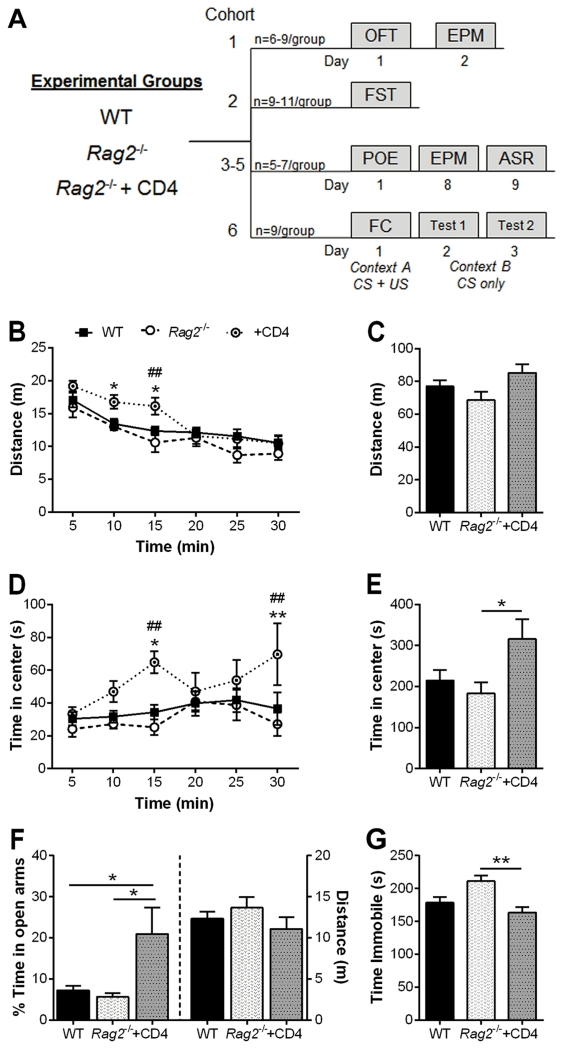
Figure 1
Figure 1. Open Field, Elevated Plus Maze and Forced Swim Tests
A) Overview of the behavioral paradigms utilized for these experiments, showing timelines of tests conducted in independent cohorts of mice. B) Horizontal locomotor activity in the open field test (OFT) over the course of the test (n = 6 – 9/group). Rag2−/− mice reconstituted with CD4+ T cells show a significant increase in locomotion during the first 15 min, and habituate thereafter to wild-type (WT) and Rag2−/− non-reconstituted activity levels. Two-way repeated measures ANOVA: time: p < 0.0001, immune status: n.s., interaction: p = 0.013; Holm-Sidak post hoc. C) No significant difference in cumulative distance traveled was detected. D) Time spent in center of the arena over the course of the test. Reconstituted mice displayed reduced anxiety-like behavior compared to WT and non-reconstituted Rag2−/− mice. Two-way repeated measures ANOVA: time: p = 0.024, immune status: p = 0.039, interaction: n.s.; Holm-Sidak post hoc. E) Cumulative time in center. Reconstitution of Rag2−/− mice with CD4+ T cells significantly reduced anxiety-like behavior compared to non-reconstituted Rag2−/− mice. ANOVA: p = 0.045, Tukey post hoc. F) Reconstituted Rag2−/− mice display reduced anxiety-like behavior in the elevated plus maze (EPM) compared to WT and Rag2−/− non-reconstituted mice (n = 6 – 9/group; ANOVA: p = 0.009, Tukey post hoc). G) CD4+ T cells reduced depressive-like behavior in the forced swim test (FST) in reconstituted Rag2−/− mice (n = 9 –11/group; ANOVA: p = 0.004, Tukey post hoc). POE: predator odor exposure; ASR: acoustic startle response; FC: fear conditioning; CS: conditioned stimulus, US: unconditioned stimulus. Mean ± SEM. * p < 0.05, ** p < 0.01. ## p < 0.01 (Rag2−/− vs reconstituted Rag2−/−).
Figure 2
Figure 2. Behavioral responses following exposure to predator odor
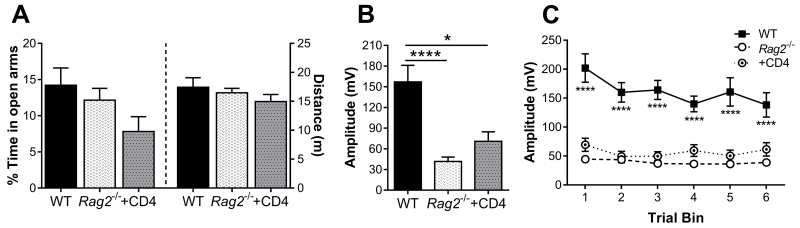
A) No significant difference in anxiety-like behavior was detected in the EPM after POE (Kruskal-Wallis non-parametric ANOVA: p = 0.069). B) The average initial startle response is significantly higher in wild-type (WT) mice versus Rag2−/− and Rag2−/− mice reconstituted with CD4+ T cells (Kruskal-Wallis non-parametric ANOVA: p < 0.001, Dunn’s post hoc). C) Trial-binned data of startle reactivity over the course of the test. Startle responses of WT mice remain significantly elevated above those of Rag2−/− mice regardless of reconstitution status (Two-way repeated measures ANOVA: time: p = 0.0004, immune status: p < 0.0001, interaction: p = 0.007). N = 16 – 21/group (3 independent cohorts). Mean ± SEM. * p < 0.05, **** p < 0.0001.
Figure 3
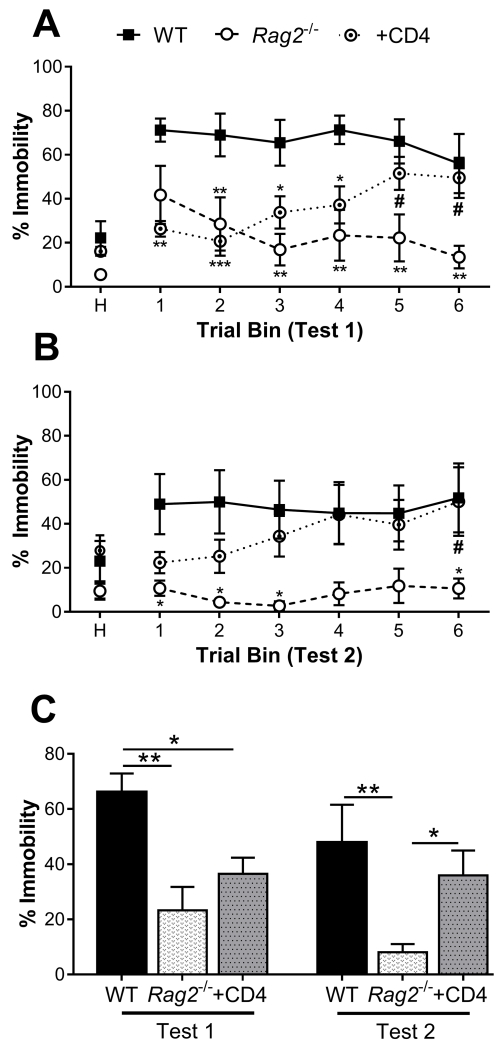
Figure 3. Fear learning and memory in a cued-fear conditioning paradigm
Trial-binned data of the cued fear response during A) Test 1 and B) Test 2, 24 h and 48 h after FC respectively. Rag2−/− mice have a reduced fear response that extinguishes over time compared to wild-type (WT) mice. Reconstitution of Rag2−/− mice with CD4+ T cells reverses this behavior, such that the fear response of reconstituted mice fails to extinguish and reaches levels comparable to WT mice by the end of each session. (Test 1: immune status: p = 0.003, time: n.s., interaction: p = 0.002; Test 2: immune status: p = 0.038, time and interaction: n.s.). C) Analysis of average percent immobility across test days indicates that Rag2−/− mice exhibit significantly attenuated fear responses compared to WT mice on Test 1 and to WT and reconstituted Rag2−/− mice on Test 2 (immune status: p = 0.007, test: p = 0.029, interaction: n.s.). n = 5 – 6/group. Two-way repeated measures ANOVA with Holm-Sidak post hoc. Mean ± SEM. H: 3 min habituation period. * p < 0.05, ** p < 0.01, *** p < 0.001. # p < 0.05 (Rag2−/− vs reconstituted Rag2−/−).
Figure 4
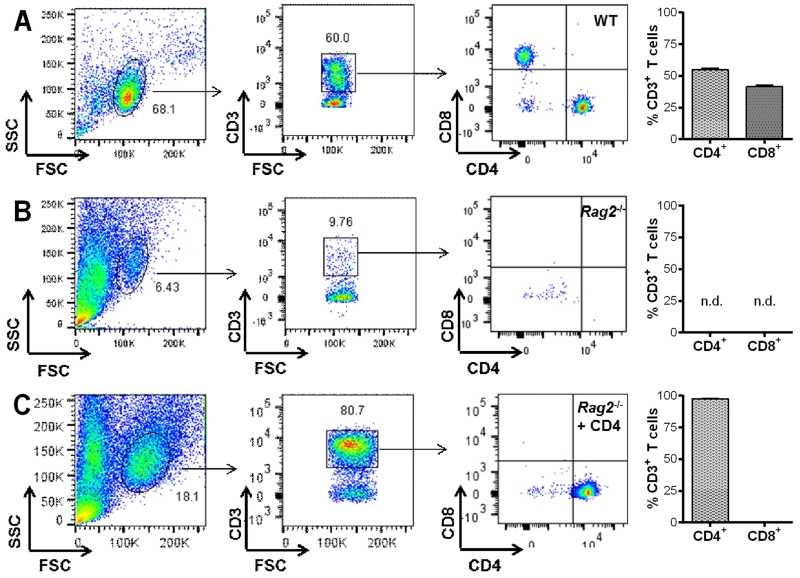
Figure 4. Analysis of reconstitution by flow cytometry
Representative dot plots with quantification of CD4+ and CD8+ T cells within the CD3+ lymphocyte population derived from the lymph nodes of A) wild-type (WT), B) Rag2−/− non-reconstituted mice and C) Rag2−/− mice reconstituted with CD4+ T cells.

References

    1. Beurel E, Harrington LE, Jope RS. Inflammatory T helper 17 cells promote depression-like behavior in mice. Biol Psychiatry. 2013;73(7):622–30. - PMC - PubMed
    1. Brachman RA, Lehmann ML, Maric D, Herkenham M. Lymphocytes from chronically stressed mice confer antidepressant-like effects to naive mice. J Neurosci. 2015;35(4):1530–8. - PMC - PubMed
    1. Brod S, Rattazzi L, Piras G, D’Acquisto F. ‘As above, so below’ examining the interplay between emotion and the immune system. Immunology. 2014;143(3):311–8. - PMC - PubMed
    1. Brynskikh A, Warren T, Zhu J, Kipnis J. Adaptive immunity affects learning behavior in mice. Brain Behav Immun. 2008;22(6):861–9. - PubMed
    1. Chun JJ, Schatz DG, Oettinger MA, Jaenisch R, Baltimore D. The recombination activating gene-1 (RAG-1) transcript is present in the murine central nervous system. Cell. 1991;64(1):189–200. - PubMed

Publication types