


A Synthesis of Hepatitis C prevalence estimates in Sub-Saharan Africa: 2000-2013
- PMID: 27296465
- PMCID: PMC4906983
- DOI: 10.1186/s12879-016-1584-1
A Synthesis of Hepatitis C prevalence estimates in Sub-Saharan Africa: 2000-2013
Abstract
Background: Hepatitis C (HCV) is a deleterious virus that can be cured with new, highly effective anti-viral treatments, yet more than 185 million individuals worldwide remain HCV positive (with the vast majority un-diagnosed or untreated). Of importance, HCV is a leading cause of chronic liver disease and liver cancer, especially in Sub-Saharan Africa (SSA) where the prevalence remains high but uncertain due to little population-based evidence of the epidemic. We aimed to synthesize available data to calculate and highlight the HCV disease burden in SSA.
Methods: Weighted random-effects generalized linear mixed models were used to estimate prevalence by risk cohort, African region (Southern, Eastern, Western, and Central Africa), type of assay used, publication year, and whether the estimate included children. A pooled prevalence estimate was also calculated. Multi-variable analyses were limited to cohort and region specific prevalence estimates in the adult population due to limited studies including children. Prevalence estimates were additionally weighted using the known adult population size within each region.
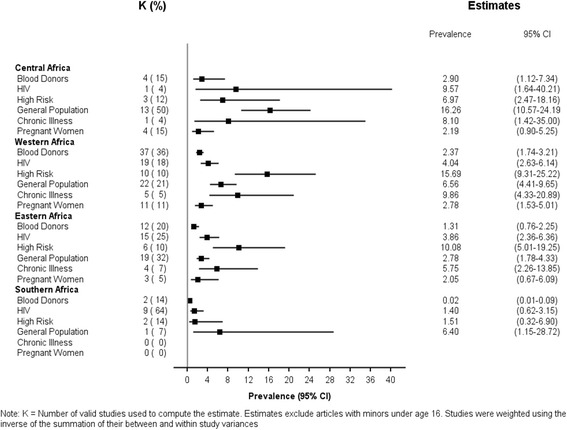
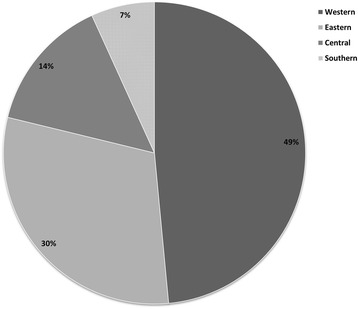
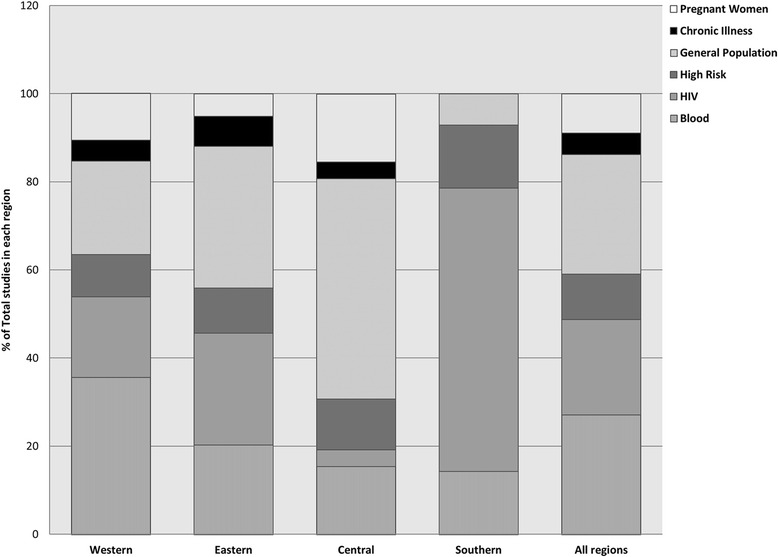
Results: We included more than 10 years of data. Almost half of the studies on HCV prevalence in SSA were from the Western region (49 %), and over half of all studies were from either blood donor (25 %) or general population cohorts (31 %). In uni-variable analyses, prevalence was lowest in Southern Africa (0.72 %), followed by Eastern Africa at 3.00 %, Western Africa at 4.14 %, and Central Africa at 7.82 %. Blood donors consistently had the lowest prevalence (1.78 %), followed by pregnant women (2.51 %), individuals with comorbid HIV (3.57 %), individuals from the general population (5.41 %), those with a chronic illness (7.99 %), and those at high risk for infection (10.18 %). After adjusting for the population size in each region, the overall adult prevalence of HCV in SSA rose from 3.82 to 3.94 %.
Conclusion: This meta-analysis offers a timely update to the HCV disease burden in SSA and offers additional evidence of the burgeoning epidemic. The study highlights the need to account for type of cohort and region variation when describing the HCV epidemic in SSA, the need for more studies that include children, as well as the need to factor in such variations when planning public health interventions.
Keywords: Africa; HCV; Hepatitis; Meta-analysis; Prevalence; Sub-Saharan.
Figures

References
-
- A SPECIAL MEETING REVIEW EDITION: Advances in the Treatment of Hepatitis C Virus Infection from The Liver Meeting 2013: The 64th Annual Meeting of the American Association for the Study of Liver DiseasesNovember 1–5, 2013* Washington DCSpecial Reporting on:* Simeprevir plus Sofosbuvir with or without Ribavirin Produces High SVR Rates in Genotype 1 HCV Infection* Novel Interferon- and Ribavirin-Free Regimen Results in SVR12 Rates of Over 90 % in HCV Genotype 1b Infection* Studies Confirm Efficacy of Adjunctive Simeprevir in Difficult-to-Treat HCV Genotype 1 Subpopulations* All-Oral Therapy with Sofosbuvir Plus Ribavirin Produces High SVR Rates in Patients Coinfected with HCV and HIV* Faldaprevir Combined with Pegylated Interferon and Ribavirin Demonstrates High Efficacy in DifficuIt-to-Treat HCV Infection* Once Daily Sofosbuvir/Ledipasvir Combination Elicits Rapid Decline in HCV RNAPLUS Meeting Abstract Summaries With Expert Commentary by: Ira M. Jacobson, MDWeill Cornell Medical CollegeNew York, New York. Gastroenterol Hepatol (N Y). 2014;10(1 Suppl 1):1–19. - PMC - PubMed
Publication types
MeSH terms
LinkOut - more resources
Full Text Sources
Other Literature Sources
Medical
Research Materials
