. 2016 Jun 13;9(1):337.
doi: 10.1186/s13071-016-1622-2.

Clonorchis sinensis omega-class glutathione transferases play major roles in the protection of the reproductive system during maturation and the response to oxidative stress

Affiliations

Clonorchis sinensis omega-class glutathione transferases play major roles in the protection of the reproductive system during maturation and the response to oxidative stress

Jeong-Geun Kim et al. Parasit Vectors. .

Abstract

Background: Clonorchis sinensis causes a major food-borne helminthic infection. This species locates in mammalian hepatobiliary ducts, where oxidative stressors and hydrophobic substances are profuse. To adapt to the hostile micromilieu and to ensure its long-term survival, the parasite continuously produces a diverse repertoire of antioxidant enzymes including several species of glutathione transferases (GSTs). Helminth GSTs play pertinent roles during sequestration of harmful xenobiotics since most helminths lack the cytochrome P-450 detoxifying enzyme.

Methods: We isolated and analyzed the biochemical properties of two omega-class GSTs of C. sinensis (CsGSTo1 and CsGSTo2). We observed spatiotemporal expression patterns in accordance with the maturation of the worm's reproductive system. Possible biological protective roles of CsGSTos in these organs under oxidative stress were investigated.

Results: The full-length cDNAs of CsGSTo1 and 2 constituted 965 bp and 1,061 bp with open reading frames of 737 bp (246 amino acids) and 669 bp (223 amino acids). They harbored characteristic N-terminal thioredoxin-like and C-terminal α-helical domains. A cysteine residue, which constituted omega-class specific active site, and the glutathione-binding amino acids, were recognized in appropriate positions. They shared 44 % sequence identity with each other and 14.8-44.8 % with orthologues/homologues from other organisms. Bacterially expressed recombinant proteins (rCsGSTo1 and 2) exhibited dehydroascorbate reductase (DHAR) and thioltransferase activities. DHAR activity was higher than thioltransferase activity. They showed weak canonical GST activity toward 1-chloro-2,4-dinitrobenzene. S-hexylglutathione potently and competitively inhibited the active-site at nanomolar concentrations (0.63 and 0.58 nM for rCsGSTo1 and 2). Interestingly, rCsGSTos exhibited high enzyme activity toward mu- and theta-class GST specific substrate, 4-nitrobenzyl chloride. Expression of CsGSTo transcripts and proteins increased beginning in 2-week-old juveniles and reached their highest levels in 4-week-old adults. The proteins were mainly expressed in the elements of the reproductive system, such as vitelline follicles, testes, seminal receptacle, sperm and eggs. Oxidative stressors induced upregulated expression of CsGSTos in these organs. Regardless of oxidative stresses, CsGSTos continued to be highly expressed in eggs. CsGSTo1 or 2 overexpressing bacteria demonstrated high resistance under oxidative killing.

Conclusions: CsGSTos might be critically involved in protection of the reproductive system during maturation of C. sinensis worms and in response to oxidative conditions, thereby contributing to maintenance of parasite fecundity.

Keywords: Clonorchis sinensis; Glutathione transferase (GST); Omega-class GST; Oxidative stress; Reproductive system; Sexual maturation.


Figures
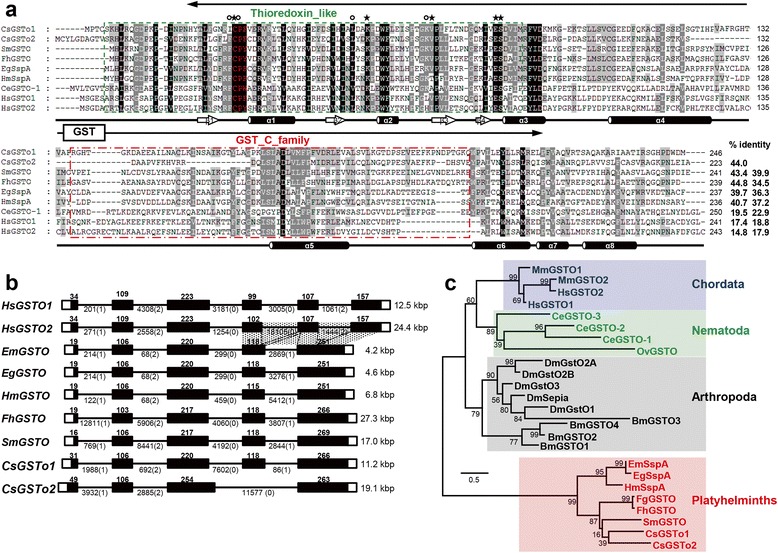
Fig. 1
Fig. 1
Structural property and phylogenetic position of C. sinensis omega GST1 and 2 (CsGSTo). a Comparison of primary structure of CsGSTo1 and 2 with other related members. Residues directly contacting glutathione are indicated by asterisks. Glutathione-binding residues are marked by closed circles. Cysteine residues that constitute the active site of omega GSTs are denoted by red letters. Putative thioredoxin and GST_C domains are indicated by dotted green- and red-boxes. Dots represent gaps introduced into the sequences to optimize sequence identities. CsGSTo1, Clonorchis sinensis omega GST1 (KX163088); CsGSTo2, C. sinensis omega GST2 (KX163089); SmGSTO, Schistosoma mansoni omega GST (AAO49385); FhGSTO, Fasciola hepatica omega GST (JX156880); EgSspA, Echinococcus granulosus stringent starvation protein A (CDJ25309); HmSspA: Hymenolepis microstoma stringent starvation protein A (CDJ10775); CeGSTO-1, Caenorhabditis elegans omega GST (GAA34234); HsGSTO1 and 2, Homo sapiens omega GST1 and 2 (AAF73376 and AAH56918). Gene names are adapted from the GenBank database (http://www.ncbi.nlm.nih.gov/). b Comparison of genomic structure of CsGSTo1 and 2 with platyhelminth and human orthologues. Coding DNA sequences are presented with solid squares in proportion to their relative sizes. The 5′- and 3′-untranslated regions are marked with open squares (voluntary length). Intervening introns are shown by solid lines (fixed length). Numerals in parentheses indicate the phase of each intron. The lengths of exons and introns in bp are presented. The dotted boxes show exons, which have acquired introns during evolution of paralogous/orthologous genes. c Phylogenetic relationships of CsGSTos. The phylogenetic position of CsGSTos was predicted on the basis of alignment of amino acid sequences. The tree was constructed by the neighbor-joining algorithm of PHYLIP. Numbers at the major branching nodes demonstrate their percentages of appearance in 1,000 bootstrap replicates. GenBank accession numbers of missing entities in a include FgGSTO, Fasciola gigantica omega GST (AFX98105); EmSspA, Echinococcus multilocularis stringent starvation protein A (EmuJ_000919600); CeGSTO-2, Caenorhabditis elegans omega GST-2 (CCD62560); CeGSTO-3, C. elegans omega GST-3 (CCD72880); OvGSTO, Onchocerca volvulus omega GST (AAF99575); BmGSTO1, Bombyx mory omega GST1 (NP_001040131); BmGSTO2, B. mory omega GST2 (NP_001037406); BmGSTO3, B. mory omega GST3 (NP_001040435); BmGSTO4, B. mory omega GST4 (NP_001108461); DmGstO1, Drosophila melanogaster omega GST-1 (NP_648237); DmSepia, D. melanogaster Sepia (NP_648235); DmGstO2A, D. melanogaster omega GST2A (NP_729388); DmGstO2B, D. melanogaster omega GST2B (NP_648236); DmGstO3, D. melanogaster omega GST3 (NP_648235)
Fig. 2
Fig. 2
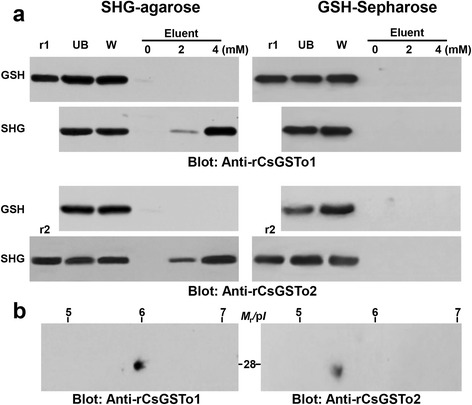
Binding affinity of the native CsGSTos toward S-hexylglutathione (SHG) and reduced glutathione (GSH). a C. sinensis adult extracts (200 μg) bound each with SHG-bead and glutathione-Sepharose 4B were eluted using 4 mM SGH or 4 mM GSH. The bound proteins (100 ng) were separated by 12 % reducing SDS-PAGE, transferred to nitrocellulose membranes and probed with anti-rCsGSTo1 and 2. The membranes were developed with ECL. r1 and r2, rCsGSTo1 and 2 (each 100 ng) loaded as positive controls. UB, unbound fractions of C. sinensis extracts; W, washing fractions; Eluent, bound fractions eluted with 0, 2 and 4 mM SHG or GSH. b 2-DE profile of native CsGSTo1 and 2. The bound proteins of SHG-agarose bead (10 μg) were isoelectrically focused using IPG strip (pH 3–10), after which resolved by 12 % SDS-PAGE and blotted onto nitrocellulose membrane. The membranes were incubated with anti-rCsGSTo1 and 2 antibodies (1:1,000 dilution) and subsequently with HRP-conjugated goat anti- mouse IgG (1:4,000 dilution). The blots were developed with ECL
Fig. 3
Fig. 3
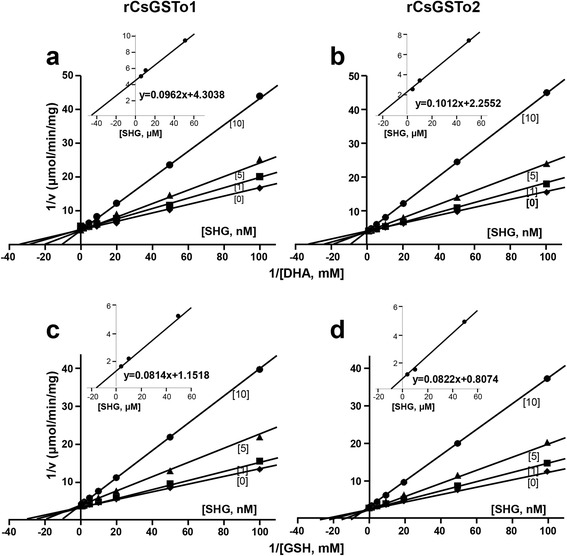
Steady-state kinetics of S-hexylglutathione (SHG) against rCsGSTo1 and 2. Lineweaver-Burk plot of inhibition mode of initial velocities of rCsGSTo1 and 2. a, b Activities (1/v) versus 1/[DHA] (mM-1) or rCsGSTo1 and 2. c, d Activities (1/v) versus 1/[GSH] (mM-1) in the absence (diamond) and presence of 1 nM (rectangle), 5 nM (triangle) and 10 nM (circle) of SHG. Variable concentrations of DHA and GSH from 0.01 to 100 mM were applied. Data are plotted in double reciprocal form. Insets show secondary plot of the 1/Vmax values obtained from the primary Lineweaver-Burk plot versus SHG concentration for the determination of Ki value. All assays were independently done in triplicate (n = 3, mean ± standard deviation, SD) and representative figures are shown
Fig. 4
Fig. 4
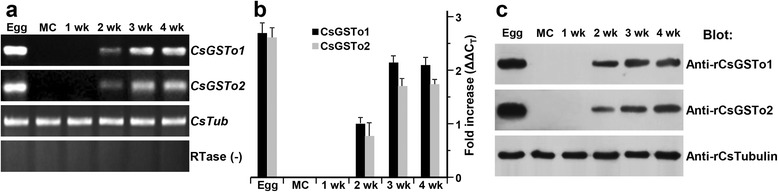
Expression profiles of the C. sinensis GSTo1 and CsGSTo2 according to developmental stages. a Total RNAs (1 μg) extracted from each of the developmental stages were reverse transcribed as indicated on top. The mRNA transcripts of CsGSTo1 and 2 amplified by a semiquantitative RT-PCR were analyzed by 2 % agarose gels with ethidium bromide staining. C. sinensis tubulin gene (CsTub), which was shown to be constitutively expressed throughout developmental stages, was used as a control. The reaction mixture that did not contain reverse transcriptase during synthesis of the first single strand cDNA was used as a negative control. Abbreviations: Egg, C. sinensis egg; MC, metacercaria; 1 wk, 1-week-old juvenile; 2 wk, 2-week-old juvenile; 3 wk, 3-week-old immature; 4 wk, 4-week-old-mature C. sinensis. b Alteration of CsGSTo transcripts by qRT-PCR. The mRNA transcripts in each of the RNA samples (200 ng) were reverse-transcribed and the resulting cDNAs were employed in qRT-PCR as templates. The fold increase was calculated by differences in threshold cycles (ΔΔCT) of the CsGSTo1 and 2 among different developmental stages. CsTub gene was used as normalization control. c Expressional changes of CsGSTo1 and 2 proteins determined by immunoblotting probed with anti-rCsGSTo1 and 2. C. sinensis tubulin (CsTub) was employed as a control. Each lane contained 100 ng protein
Fig. 5
Fig. 5
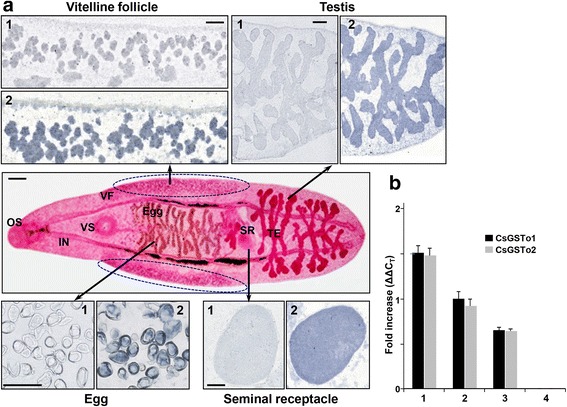
Immunolocalization of C. sinensis GSTo1 and compartmental expression of C. sinensis GSTo1 and 2 transcripts. a Adult worm sections (thickness 4-μm) were incubated with preimmune mouse serum (panels 1) or anti-rCsGST1 antibody (panels 2) at a same dilution ratio (1:200) and subsequently incubated with HRP-conjugated goat anti-mouse IgG antibody (1:1,000 dilutions). The slides were developed with the blue-immunohistochemistry chromogen 3,3'-diaminobenzidine blue supplemented with H2O2. Acetocarmine-stained in toto specimen is also seen. The regions marked by dotted-ellipses were separately prepared as vitelline follicle-enriched parenchyma for Western blot (see also Fig. 7). Abbreviations: OS, oral sucker; IN, intestine; VS, ventral sucker; VF, vitelline follicles; SR, seminal receptacle; TE, testis. Scale-bars: 50 μm. b Expression of CsGSTo transcripts in C. sinensis reproductive system by qRT-PCR. Total RNAs (each 200 ng) extracted from respective organs were reverse transcribed into cDNA and subjected to qRT-PCR. The fold increase was calculated by differences in threshold cycles (ΔΔCT). Key: 1, egg; 2, whole worm; 3, testis, seminal receptacle and vitelline follicle-enriched fractions; 4, parenchymal fractions without reproductive organs
Fig. 6
Fig. 6
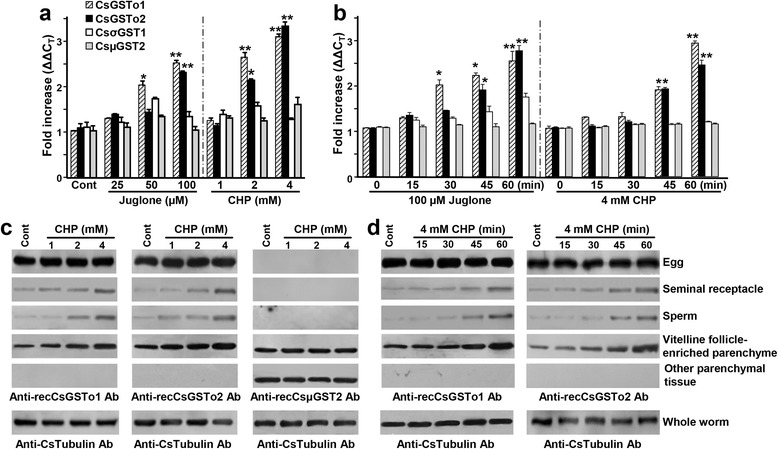
Induction profiles of C. sinensis GSTo transcripts and proteins under oxidative stress conditions. a The fresh live adults (10 worms per group) were stabilized in serum-free RPMI media for 1 h at 37 °C and were treated with Juglone (25–100 μM) or cumene hydroperoxide (CHP; 1–4 mM) for 1 h at 37 °C. Total RNAs (200 ng) were reverse-transcribed and subjected to qRT-PCR. The fold increase was calculated by differences in threshold cycles (ΔΔCT). b The worms were incubated in the presence of Juglone (100 μM) or CHP (4 mM) from 15–60 min as indicated. Total RNAs (200 ng) were extracted and fold increase (ΔΔCT) of each transcript was examined by qRT-PCR. *P < 0.05; **P < 0.01. c, d Proteins (20 μg) extracted from respective compartments the parasites incubated with different doses of CHP (1–4 mM) and different time intervals (15–60 min) were separated by 12 % reducing SDS-PAGE, blotted to nitrocellulose membranes and probed with anti-rCsGSTo1 and 2, respectively. C. sinensis tubulin, which did not show expressional changes upon oxidative stimuli, was used as a control. Positive signals were detected with ECL. Vitelline follicle-enriched fractions were prepared from the bilateral margins of middle portions of the worm, as marked in Fig. 5
Fig. 7
Fig. 7
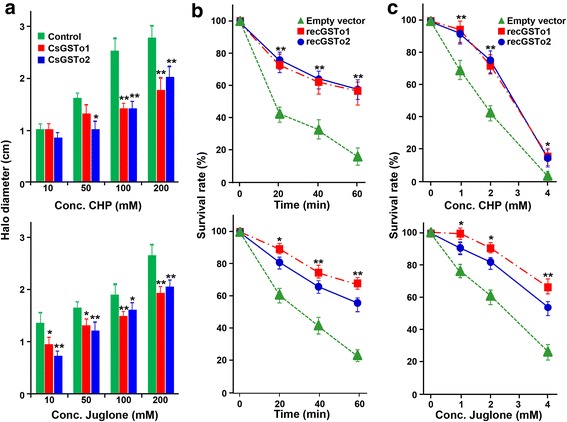
Protective roles of CsGSTos in E. coli transfected with CsGSTo expression plasmids under oxidative stress. a Disc diffusion assays using CsGFSTos overexpressing E. coli. LB agar was overlaid with top agar containing 5 × 108 E. coli cells transfected with recombinant CsGSTo plasmids or mock vector. Filter-discs soaked with 10, 50, 100 and 200 mM of cumene hydroperoxide (CHP) or Juglone were placed on the plate and incubated overnight, after which the inhibition zones (halo diameter) were measured. *P < 0.05; **P < 0.01. b Effect of CHP (upper panel) or Juglone (lower panel) on the survival of exponentially growing E. coli. Cells were incubated for 60 min at 37 °C in the presence of 2 mM CHP or Juglone. c Survival curves of E. coli following exposure to different doses of CHP or Juglone (1, 2 and 4 mM) for 20 min at 37 °C. *P < 0.05; **P < 0.01. Data shown represent mean ± standard deviation, SD (n = 3)

References

    1. Madsen H, Dung BT, The DT. Viet NK, Dalsgaard A, Van PT. The role of rice fields, fish ponds and water canals for transmission of fish-borne zoonotic trematodes in aquaculture ponds in Nam Dinh Province, Vietnam. Parasit Vectors. 2015;8:625. doi: 10.1186/s13071-015-1237-z. - DOI - PMC - PubMed
    1. Keiser J, Utzinger J. Food-borne trematodiases. Clin Microbiol Rev. 2009;22:466–483. doi: 10.1128/CMR.00012-09. - DOI - PMC - PubMed
    1. Marcos LA, Terashima A, Gotuzzo E. Update on hepatobiliary flukes: fascioliasis, opisthorchiasis and clonorchiasis. Curr Opin Infect Dis. 2008;21:523–530. doi: 10.1097/QCO.0b013e32830f9818. - DOI - PubMed
    1. Jang KT, Hong SM, Lee KT, Lee JG, Choi SH, Heo JS, et al. Intraductal papillary neoplasm of the bile duct associated with Clonorchis sinensis infection. Virchows Arch. 2008;453:589–598. doi: 10.1007/s00428-008-0682-x. - DOI - PubMed
    1. Choi D, Lim JH, Lee KT, Lee JK, Choi SH, Heo JS, et al. Cholangiocarcinoma and Clonorchis sinensis infection: a case–control study in Korea. J Hepatol. 2006;44:1066–1073. doi: 10.1016/j.jhep.2005.11.040. - DOI - PubMed

Publication types

Substances

LinkOut - more resources