


Comparison of cannabinoids in hair with self-reported cannabis consumption in heavy, light and non-cannabis users
- PMID: 27296783
- PMCID: PMC5396143
- DOI: 10.1111/dar.12412
Comparison of cannabinoids in hair with self-reported cannabis consumption in heavy, light and non-cannabis users
Abstract
Introduction: Biological tests of drug use can be used to inform clinical and legal decisions and hold potential to provide evidence for epidemiological studies where self-reported behaviour may be unavailable or unreliable. We test whether hair can be considered as a reliable marker of cannabis exposure.
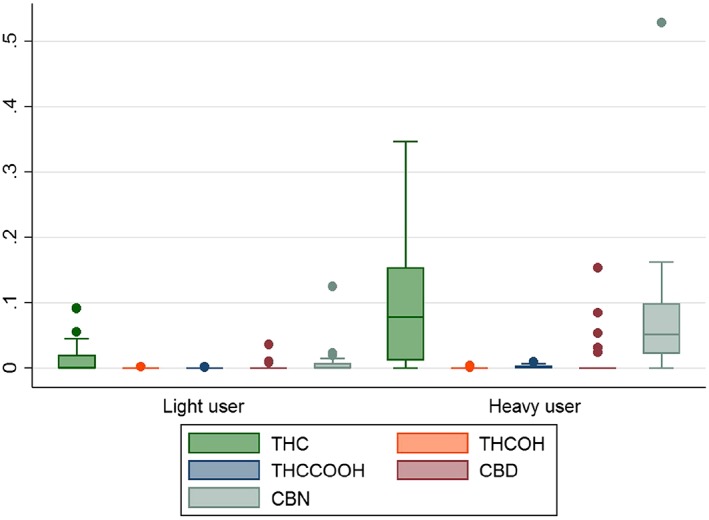
Methods: Hair samples were collected from 136 subjects who were self-reported heavy, light or non-users of cannabis and tested using GC-MS/MS. Sensitivity, specificity, positive predictive value and negative predictive value were calculated for five cannabinoids (tetrahydrocannabinol [THC], THC-OH, THC-COOH, cannabinol and cannabidiol). Samples also were segmented in 1 cm sections representing 1 month exposure and the correlation between amount of cannabinoid detected and self-reported cannabis consumption tested.
Results: All five cannabinoids were detected. Seventy-seven percent of heavy users, 39% of light users and 0% of non-users tested positive for THC. The sensitivity of detection of THC was 0.77 (0.56-0.91) comparing heavy cannabis smokers with light and non-users, whereas the sensitivity of other cannabinoids generally was considerably lower. The positive and negative predictive value of detection of THC were 0.57 (0.39-0.74) and 0.91 (0.82-0.97), respectively. A correlation of 0.52 (P < 0.001) was observed between self-reported monthly cannabis use and THC.
Discussion: Hair analysis can be used as a qualitative indicator of heavy (daily or near daily) cannabis consumption within the past 3 months. However, this approach is unable to reliably detect light cannabis consumption or determine the quantity of cannabis used by the individual. [Taylor M, Lees R, Henderson G, Lingford-Hughes A, Macleod J, Sullivan J, Hickman M. Comparison of cannabinoids in hair with self-reported cannabis consumption in heavy, light and non-cannabis users. Drug Alcohol Rev 2017;36:220-226].
Keywords: cannabinoid; cannabis; hair testing; sensitivity; specificity.
© 2016 The Authors Drug and Alcohol Review published by John Wiley & Sons Australia, Ltd on behalf of Australasian Professional Society on Alcohol and other Drugs.
Figures
References
-
- Macleod J, Hickman M, Smith GD. Reporting bias and self‐reported drug use. Addiction 2005;100:562–3. - PubMed
-
- Anthony J, Neumark Y, Van Etten M. Do I do what I say? A perspective on self‐report methods in Drug Dependence Epidemiology In: Stone A, ed. The science of self‐report: implication for research and practise. London: Lawrence Earlbaum Associates, 2000:175–99.
-
- Wolff K, Farrell M, Marsden J, et al A review of biological indicators of illicit drug use, practical considerations and clinical usefulness. Addiction 1999;94:1279–98. - PubMed
-
- Dolan K, Rouen D, Kimber J. An overview of the use of urine, hair, sweat and saliva to detect drug use. Drug and Alcohol Rev 2004;23:213–7. - PubMed
Publication types
MeSH terms
Substances
Grants and funding
LinkOut - more resources
Full Text Sources
Other Literature Sources
Medical
Miscellaneous
