


A Web-Based and Mobile Health Social Support Intervention to Promote Adherence to Inhaled Asthma Medications: Randomized Controlled Trial
- PMID: 27298211
- PMCID: PMC4923591
- DOI: 10.2196/jmir.4963
A Web-Based and Mobile Health Social Support Intervention to Promote Adherence to Inhaled Asthma Medications: Randomized Controlled Trial
Abstract
Background: Online communities hold great potential as interventions for health, particularly for the management of chronic illness. The social support that online communities can provide has been associated with positive treatment outcomes, including medication adherence. There are few studies that have attempted to assess whether membership of an online community improves health outcomes using rigorous designs.
Objective: Our objective was to conduct a rigorous proof-of-concept randomized controlled trial of an online community intervention for improving adherence to asthma medicine.
Methods: This 9-week intervention included a sample of asthmatic adults from the United Kingdom who were prescribed an inhaled corticosteroid preventer. Participants were recruited via email and randomized to either an "online community" or "no online community" (diary) condition. After each instance of preventer use, participants (N=216) were required to report the number of doses of medication taken in a short post. Those randomized to the online community condition (n=99) could read the posts of other community members, reply, and create their own posts. Participants randomized to the no online community condition (n=117) also posted their medication use, but could not read others' posts. The main outcome measures were self-reported medication adherence at baseline and follow-up (9 weeks postbaseline) and an objective measure of adherence to the intervention (visits to site).
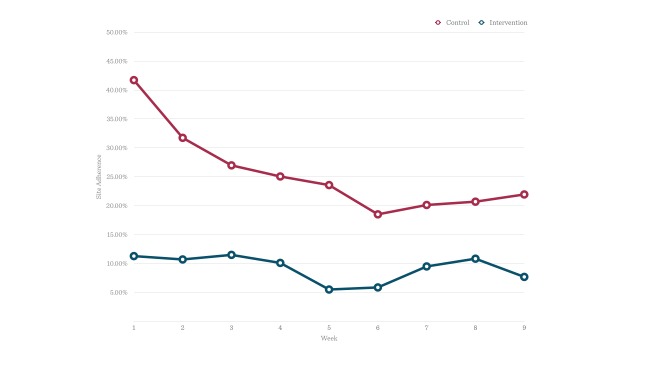
Results: In all, 103 participants completed the study (intervention: 37.8%, 39/99; control: 62.2%, 64/117). MANCOVA of self-reported adherence to asthma preventer medicine at follow-up was not significantly different between conditions in either intention-to-treat (P=.92) or per-protocol (P=.68) analysis. Site use was generally higher in the control compared to intervention conditions.
Conclusions: Joining an online community did not improve adherence to preventer medication for asthma patients. Without the encouragement of greater community support or more components to sustain engagement over time, the current findings do not support the use of an online community to improve adherence.
Clinicaltrial: International Standard Randomized Controlled Trial Number (ISRCTN): 29399269; http://www.isrctn.com/ISRCTN29399269/29399269 (Archived by WebCite at http://www.webcitation.org/6fUbEuVoT).
Keywords: Internet; adherence; asthma; attrition; engagement; online community; randomized controlled trial; social health network; social support; telemedicine.
Conflict of interest statement
Conflicts of Interest: None declared.
Figures


References
-
- Young C. Community management that works: how to build and sustain a thriving online health community. J Med Internet Res. 2013;15(6):e119. doi: 10.2196/jmir.2501. http://www.pubmedcentral.nih.gov/articlerender.fcgi?artid=3713910&tool=p... v15i6e119 - DOI - PMC - PubMed
-
- van der Eijk M, Faber MJ, Aarts JW, Kremer JA, Munneke M, Bloem BR. Using online health communities to deliver patient-centered care to people with chronic conditions. J Med Internet Res. 2013 Jun;15(6):e115. doi: 10.2196/jmir.2476. http://www.jmir.org/2013/6/e115/ v15i6e115 - DOI - PMC - PubMed
-
- Magnezi R, Bergman YS, Grosberg D. Online activity and participation in treatment affects the perceived efficacy of social health networks among patients with chronic illness. J Med Internet Res. 2014;16(1):e12. doi: 10.2196/jmir.2630. http://www.jmir.org/2014/1/e12/ v16i1e12 - DOI - PMC - PubMed
-
- World Health Organization. 2003. [2016-05-05]. Adherence to long-term therapies: evidence for action http://apps.who.int/iris/bitstream/10665/42682/1/9241545992.pdf .
-
- Swan M. Crowdsourced health research studies: an important emerging complement to clinical trials in the public health research ecosystem. J Med Internet Res. 2012;14(2):e46. doi: 10.2196/jmir.1988. http://www.jmir.org/2012/2/e46/ v14i2e46 - DOI - PMC - PubMed
Publication types
MeSH terms
Substances
LinkOut - more resources
Full Text Sources
Other Literature Sources
Medical
