. 2016 Jun 27;213(7):1255-65.
doi: 10.1084/jem.20151978. Epub 2016 Jun 13.

Clonal redemption of autoantibodies by somatic hypermutation away from self-reactivity during human immunization

Affiliations

Clonal redemption of autoantibodies by somatic hypermutation away from self-reactivity during human immunization

Joanne H Reed et al. J Exp Med. .

Abstract

Clonal anergy is an enigmatic self-tolerance mechanism because no apparent purpose is served by retaining functionally silenced B cells bearing autoantibodies. Human autoantibodies with IGHV4-34*01 heavy chains bind to poly-N-acetyllactosamine carbohydrates (I/i antigen) on erythrocytes and B lymphocytes, cause cold agglutinin disease, and are carried by 5% of naive B cells that are anergic. We analyzed the specificity of three IGHV4-34*01 IgG antibodies isolated from healthy donors immunized against foreign rhesus D alloantigen or vaccinia virus. Each IgG was expressed and analyzed either in a hypermutated immune state or after reverting each antibody to its unmutated preimmune ancestor. In each case, the preimmune ancestor IgG bound intensely to normal human B cells bearing I/i antigen. Self-reactivity was removed by a single somatic mutation that paradoxically decreased binding to the foreign immunogen, whereas other mutations conferred increased foreign binding. These data demonstrate the existence of a mechanism for mutation away from self-reactivity in humans. Because 2.5% of switched memory B cells use IGHV4-34*01 and >43% of these have mutations that remove I/i binding, clonal redemption of anergic cells appears efficient during physiological human antibody responses.


Figures

Figure 1.
Figure 1.
Somatic hypermutation of IGHV4-34 autoantibody Fog-1 removes self-reactivity while increasing binding to RhD alloantigen. (A and B) Variable domain amino acid sequence of the IMGT-predicted pFog-1 H chain (A) and L chain (B) and sequence substitutions acquired in the immune Fog-1 antibody (shown below in red). (C) Gating strategy for measuring self-reactivity of IgG by binding to mature naive B cells (CD19+, IgD+ CD27, CD14, and CD3), flow cytometric histograms representative of four independent experiments, and dose-dependent binding measured as relative MFI. Data points are the mean and standard deviation of four separate experiments using PBMCs from four individual donors. Statistical significance was assessed using two-way ANOVA (*, P ≤ 0.05 for Fog-1 H26Y vs. Fog-1 and pFog-1 Y26H; ****, P ≤ 0.0001 for pFog-1 vs. Fog-1, pFog-1 Y26H, and Fog-1 H26Y). The key demonstrates the number of amino acid substitutions (#aa subs) in each antibody. Numbering follows IMGT. SHM, somatic hypermutation. (D) Binding of Fog-1 and pFog-1 IgG to RhD+ and RhD erythrocytes. Data in D are representative of three separate experiments using erythrocytes from three individual donors. Statistical significance was determined by two-way ANOVA (****, P ≤ 0.0001 for Fog-1 and Fog-1 H26Y vs. pFog-1 and pFog Y26H). (E) Binding of pFog-1 to mature naive B cells at 4°C (continuous line) and 37°C (dashed line) by flow cytometry. Data are representative of two independent experiments, and statistical significance was determined by Student’s paired t test (P = 0.10). (F) Structural models depicting the hydrophobic patch region of pFog-1 (left) and Fog-1 (right). Preimmune residues are depicted in blue with immune substitutions in dark red and oxygen in light red.
Figure 2.
Figure 2.
Discrete somatic mutations acquired by antivaccinia antibody 166 independently remove self-reactivity and increase virus reactivity. (A and B) Variable domain amino acid sequence of the p166 H chain (A) and L chain (B) and sequence substitutions acquired in the immune 166 antibody (shown below in red). (C) Number of amino acid substitutions (#aa subs) in each antibody and binding to mature naive B cells. Data points are the mean and standard deviation of four independent experiments using PBMCs from four individual donors. Statistical significance was assessed using two-way ANOVA (****, P ≤ 0.0001 for p166 vs. 166, p166 Y26S, and 166 S26Y). SHM, somatic hypermutation. (D) Binding of each antibody to vaccinia virus measured by ELISA. The data are representative of three independent experiments with each data point showing the mean of duplicates. Statistical significance was determined by two-way ANOVA (*, P ≤ 0.05 for p166 vs. p166 Y26S; ***, P ≤ 0.001 for 166 and 166 S26Y vs. p166 and p166 Y26S). (E) Binding of p166 to mature naive B cells at 4°C (continuous line) and 37°C (dashed line). Data are representative of two independent experiments, and statistical significance was determined by Student’s paired t test (P = 0.05). (F) Three-dimensional structure of a hydrophobic patch for p166 (left) and 166 (right). Preimmune residues are depicted in blue with immune substitutions in dark red and oxygen in light red.
Figure 3.
Figure 3.
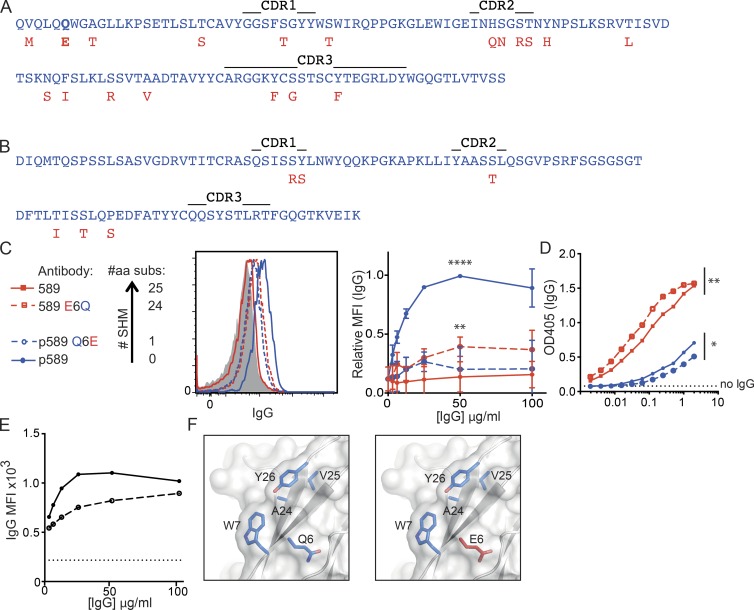
A single somatic mutation acquired by antivaccinia antibody 589 reduces self- and foreign reactivity, whereas other mutations increase binding to foreign antigens. (A and B) Variable region amino acid sequence of the p589 H chain (A) and L chain (B) and sequence substitutions acquired in the immune 589 antibody (shown below in red). (C) Key depicting the number of amino acids substitutions (#aa subs) in each antibody and its binding to mature naive B cells. Data points are the mean and standard deviation of three separate experiments using PBMCs from three individual donors. Statistical significance was assessed by two-way ANOVA (**, P ≤ 0.01 for 589 vs. 589 E6Q; ****, P ≤ 0.0001 for p589 vs. 589, p589 Q6E, and 589 E6Q). SHM, somatic hypermutation. (D) Binding of each antibody to vaccinia virus measured by ELISA. Data are representative of two separate experiments with each point the mean of duplicates. Statistical significance was determined by two-way ANOVA (*, P ≤ 0.05 for p589 vs. p589 Q6E; **, P ≤ 0.01 for 589 vs. 589 E6Q). (E) Binding of p589 at 4°C (continuous line) and 37°C (dashed line). Data are representative of two independent experiments with differences evaluated by Student’s paired t test (P = 0.02). (F) Structural modeling of a hydrophobic patch of p589 (left) and 589 (right). Preimmune residues are depicted in blue with immune substitutions in dark red and oxygen in light red.
Figure 4.
Figure 4.
Testing polyreactivity of IGHV4-34 antibodies. (A) Flow cytometric evaluation of binding preimmune and mutated IGHV4-34 and negative and low-positive control antibodies mGO53 and eiJB40, respectively, to intact (extracellular) and permeabilized (intracellular) HEK293 cells. Data are representative of two independent experiments. (B) Binding of IGHV4-34 IgG and control antibodies to LPS and dsDNA by ELISA. Data points are the mean and standard deviation of triplicate data points, representative of two independent experiments.

References

    1. Bretscher P., and Cohn M.. 1970. A Theory of self-nonself discrimination: Paralysis and induction involve the recognition of one and two determinants on an antigen, respectively. Science. 169:1042–1049. 10.1126/science.169.3950.1042 - DOI - PubMed
    1. Brochet X., Lefranc M.P., and Giudicelli V.. 2008. IMGT/V-QUEST: the highly customized and integrated system for IG and TR standardized V-J and V-D-J sequence analysis. Nucleic Acids Res. 36:W503–W508. 10.1093/nar/gkn316 - DOI - PMC - PubMed
    1. Burnet F.M. 1959. The clonal selection theory of acquired immunity. Cambridge University Press, Cambridge, MA: 10.5962/bhl.title.8281 - DOI
    1. Butt D., Chan T.D., Bourne K., Hermes J.R., Nguyen A., Statham A., O’Reilly L.A., Strasser A., Price S., Schofield P., et al. 2015. FAS inactivation releases unconventional germinal center B cells that escape antigen control and drive IgE and autoantibody production. Immunity. 42:890–902. 10.1016/j.immuni.2015.04.010 - DOI - PubMed
    1. Bye J.M., Carter C., Cui Y., Gorick B.D., Songsivilai S., Winter G., Hughes-Jones N.C., and Marks J.D.. 1992. Germline variable region gene segment derivation of human monoclonal anti-Rh(D) antibodies. Evidence for affinity maturation by somatic hypermutation and repertoire shift. J. Clin. Invest. 90:2481–2490. 10.1172/JCI116140 - DOI - PMC - PubMed

Publication types

MeSH terms

Associated data