


The shaping of human diversity: filters, boundaries and transitions
- PMID: 27298471
- PMCID: PMC4920297
- DOI: 10.1098/rstb.2015.0241
The shaping of human diversity: filters, boundaries and transitions
Abstract
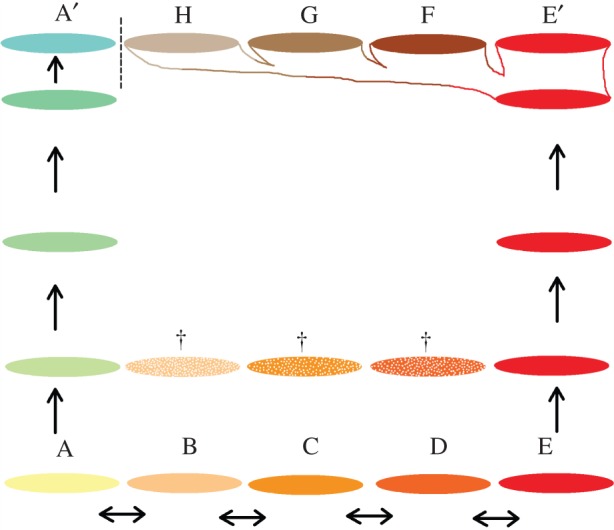
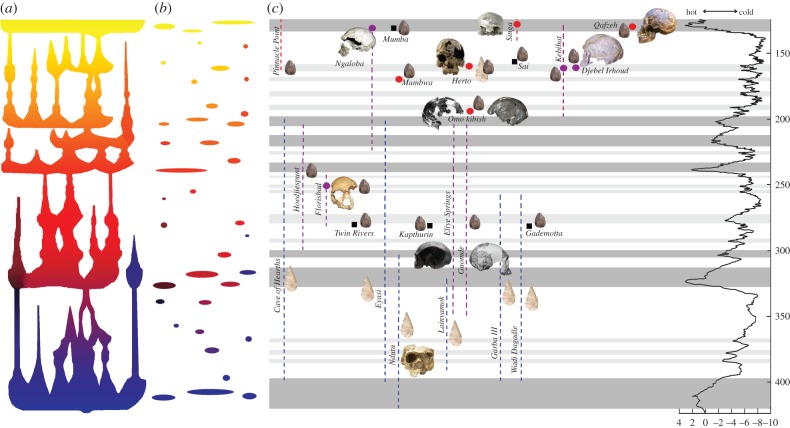
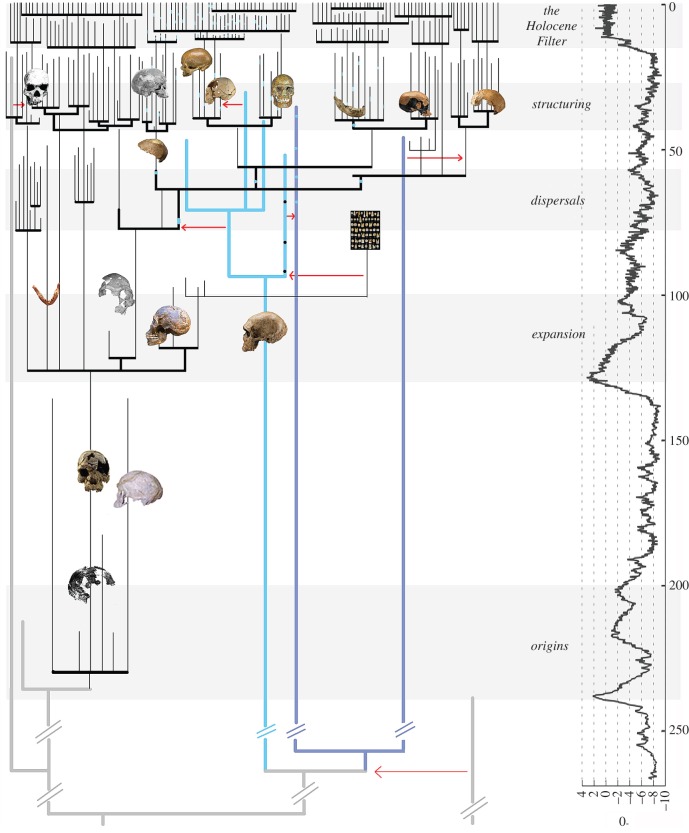
The evolution of modern humans was a complex process, involving major changes in levels of diversity through time. The fossils and stone tools that record the spatial distribution of our species in the past form the backbone of our evolutionary history, and one that allows us to explore the different processes-cultural and biological-that acted to shape the evolution of different populations in the face of major climate change. Those processes created a complex palimpsest of similarities and differences, with outcomes that were at times accelerated by sharp demographic and geographical fluctuations. The result is that the population ancestral to all modern humans did not look or behave like people alive today. This has generated questions regarding the evolution of human universal characters, as well as the nature and timing of major evolutionary events in the history of Homo sapiens The paucity of African fossils remains a serious stumbling block for exploring some of these issues. However, fossil and archaeological discoveries increasingly clarify important aspects of our past, while breakthroughs from genomics and palaeogenomics have revealed aspects of the demography of Late Quaternary Eurasian hominin groups and their interactions, as well as those between foragers and farmers. This paper explores the nature and timing of key moments in the evolution of human diversity, moments in which population collapse followed by differential expansion of groups set the conditions for transitional periods. Five transitions are identified (i) at the origins of the species, 240-200 ka; (ii) at the time of the first major expansions, 130-100 ka; (iii) during a period of dispersals, 70-50 ka; (iv) across a phase of local/regional structuring of diversity, 45-25 ka; and (v) during a phase of significant extinction of hunter-gatherer diversity and expansion of particular groups, such as farmers and later societies (the Holocene Filter), 15-0 ka.This article is part of the themed issue 'Major transitions in human evolution'.
Keywords: African prehistory; Holocene filter; dispersals; human evolution; human evolutionary genetics; modern human origins.
© 2016 The Authors.
Figures
References
-
- Weidenreich F. 1943. The skull of Sinanthropus pekinensis: a comparative study of a primitive hominid skull. Palaeontol. Sin. New Series D no. 10 (Whole Series no. 127).
-
- Wolpoff MH. 1989. Multiregional evolution: the fossil alternative to Eden. In The human revolution (eds Mellars P, Stringer CB), pp. 62–108. Edinburgh, UK: Edinburgh University Press.
-
- Foley RA, Lahr MM. 1992. Beyond ‘out of Africa’: reassessing the origins of Homo sapiens. J. Hum. Evol. 22, 523–529. (10.1016/0047-2484(92)90085-N) - DOI
Publication types
MeSH terms
LinkOut - more resources
Full Text Sources
Other Literature Sources
Miscellaneous
