


The Size of the Human Proteome: The Width and Depth
- PMID: 27298622
- PMCID: PMC4889822
- DOI: 10.1155/2016/7436849
The Size of the Human Proteome: The Width and Depth
Abstract
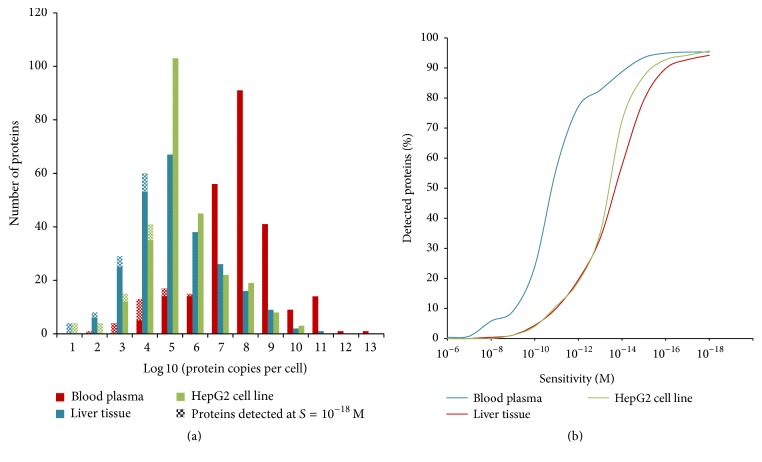
This work discusses bioinformatics and experimental approaches to explore the human proteome, a constellation of proteins expressed in different tissues and organs. As the human proteome is not a static entity, it seems necessary to estimate the number of different protein species (proteoforms) and measure the number of copies of the same protein in a specific tissue. Here, meta-analysis of neXtProt knowledge base is proposed for theoretical prediction of the number of different proteoforms that arise from alternative splicing (AS), single amino acid polymorphisms (SAPs), and posttranslational modifications (PTMs). Three possible cases are considered: (1) PTMs and SAPs appear exclusively in the canonical sequences of proteins, but not in splice variants; (2) PTMs and SAPs can occur in both proteins encoded by canonical sequences and in splice variants; (3) all modification types (AS, SAP, and PTM) occur as independent events. Experimental validation of proteoforms is limited by the analytical sensitivity of proteomic technology. A bell-shaped distribution histogram was generated for proteins encoded by a single chromosome, with the estimation of copy numbers in plasma, liver, and HepG2 cell line. The proposed metabioinformatics approaches can be used for estimation of the number of different proteoforms for any group of protein-coding genes.
Figures
References
-
- Collins F. S., Lander E. S., Rogers J., Waterston R. H. Finishing the euchromatic sequence of the human genome. Nature. 2005;50:162–168. - PubMed
-
- Roth M. J., Forbes A. J., Boyne M. T., II, Kim Y.-B., Robinson D. E., Kelleher N. L. Precise and parallel characterization of coding polymorphisms, alternative splicing, and modifications in human proteins by mass spectrometry. Molecular and Cellular Proteomics. 2005;4(7):1002–1008. doi: 10.1074/mcp.M500064-MCP200. - DOI - PMC - PubMed
Publication types
LinkOut - more resources
Full Text Sources
Other Literature Sources
Research Materials
Miscellaneous
