Review
. 2016 Jun;17(6):e254-e262.
doi: 10.1016/S1470-2045(16)30030-4.

Antibody-drug conjugates for cancer therapy

Affiliations
Review

Antibody-drug conjugates for cancer therapy

Anish Thomas et al. Lancet Oncol. 2016 Jun.

Abstract

Antibody-drug conjugates are monoclonal antibodies conjugated to cytotoxic agents. They use antibodies that are specific to tumour cell-surface proteins and, thus, have tumour specificity and potency not achievable with traditional drugs. Design of effective antibody-drug conjugates for cancer therapy requires selection of an appropriate target, a monoclonal antibody against the target, potent cytotoxic effector molecules, and conjugation of the monoclonal antibody to cytotoxic agents. Substantial advances in all these aspects in the past decade have resulted in regulatory approval of ado-trastuzumab emtansine and brentuximab vedotin for clinical use. Several promising antibody-drug conjugates are now in late-phase clinical testing. Ongoing efforts are focused on identifying better targets, more effective cytotoxic payloads, and further improvements in antibody-drug linker technology. Improved understanding of the mechanistic basis of antibody-drug conjugate activity will enable design of rational combination therapies with other agents, including immunotherapy.


Conflict of interest statement

Declaration of interests

We declare no competing interests.

Figures
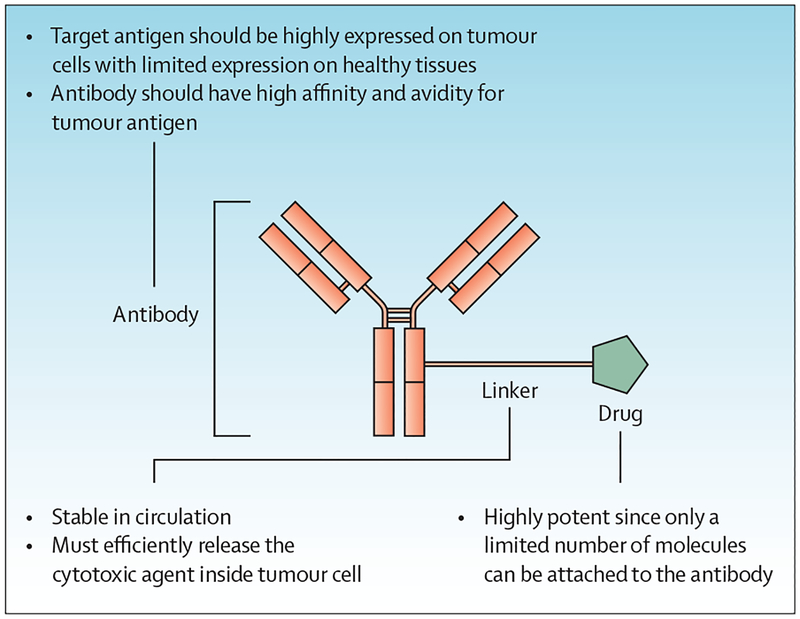
Figure 1:
Figure 1:. Structure of an antibody–drug conjugate
An antibody–drug conjugate consists of a monoclonal antibody conjugated to a cytotoxic agent via a linker. The antibody is specific to tumour cell surface proteins, thereby providing the specificity and potency not achievable with traditional drugs. The linker is the short chemical spacer that binds the drug to the antibody, which must be stable in circulation. In the cell, most linkers are labile; however, some are stable, requiring degradation of the antibody and linker to release the cytotoxic agent. The cytotoxic drug used in antibody–drug conjugates is usually highly potent, with IC50 values in the subnanomolar range in cell culture.
Figure 2:
Figure 2:. Contrast between early-generation and new-generation antibody–drug conjugates
Early antibody–drug conjugates (left) were mouse monoclonal antibodies linked covalently to anticancer drugs such as doxorubicin, vinblastine, and methotrexate, and had several limitations. Technological advances have enabled design of antibody–drug conjugates that comprise humanised antibodies (right), which are less immunogenic than earlier antibody–drug conjugates, with several favourable pharmacokinetic properties. IC50=concentration needed to achieve 50% inhibition. DM1=emtansine. DM4=ravtansine. MMAE=monomethyl auristatin E. MMAF=monomethyl auristatin F.
Figure 3:
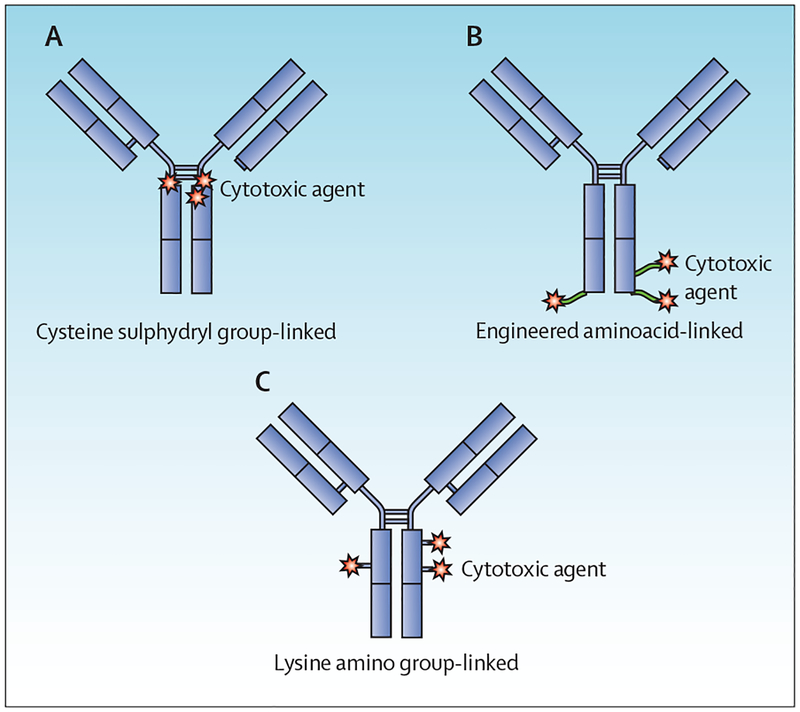
Figure 3:. Ways to link drugs in antibody–drug conjugates
(A) Drug is linked through intra-strand sulphydryl linkages. (B) Drug is linked through genetically engineered unnatural aminoacids to provide specific binding sites and, thus, one chemical species. (C) Drug is linked through the epsilon amino groups of lysine.

References

    1. Pastan I, Hassan R, Fitzgerald DJ, Kreitman RJ. Immunotoxin therapy of cancer. Nat Rev Cancer 2006; 6: 559–65. - PubMed
    1. Olsen E, Duvic M, Frankel A, et al. Pivotal phase III trial of two dose levels of denileukin diftitox for the treatment of cutaneous T-cell lymphoma. J Clin Oncol 2001; 19: 376–88. - PubMed
    1. Kreitman RJ, Tallman MS, Robak T, et al. Ph ase I trial of anti-CD22 recombinant immunotoxin moxetumomab pasudotox (CAT-8015 or HA22) in patients with hairy cell leukemia. J Clin Oncol 2012; 30: 1822–28. - PMC - PubMed
    1. Hassan R, Miller AC, Sharon E, et al. Major cancer regressions in mesothelioma after treatment with an anti-mesothelin immunotoxin and immune suppression. Sci Transl Med 2013; 5: 208ra147. - PMC - PubMed
    1. Hassan R, Alewine C, Pastan I. New life for immunotoxin cancer therapy. Clin Cancer Res 2016; 22: 1055–58. - PMC - PubMed

Publication types

MeSH terms