


Association of Pharmacological Treatments for Obesity With Weight Loss and Adverse Events: A Systematic Review and Meta-analysis
- PMID: 27299618
- PMCID: PMC5617638
- DOI: 10.1001/jama.2016.7602
Association of Pharmacological Treatments for Obesity With Weight Loss and Adverse Events: A Systematic Review and Meta-analysis
Erratum in
-
Factual Error in Questions and Discussion.JAMA. 2016 Sep 6;316(9):995. doi: 10.1001/jama.2016.11657. JAMA. 2016. PMID: 27599344 No abstract available.
Abstract
Importance: Five medications have been approved for the management of obesity, but data on comparative effectiveness are limited.
Objective: To compare weight loss and adverse events among drug treatments for obesity using a systematic review and network meta-analysis.
Data sources: MEDLINE, EMBASE, Web of Science, Scopus, and Cochrane Central from inception to March 23, 2016; clinical trial registries.
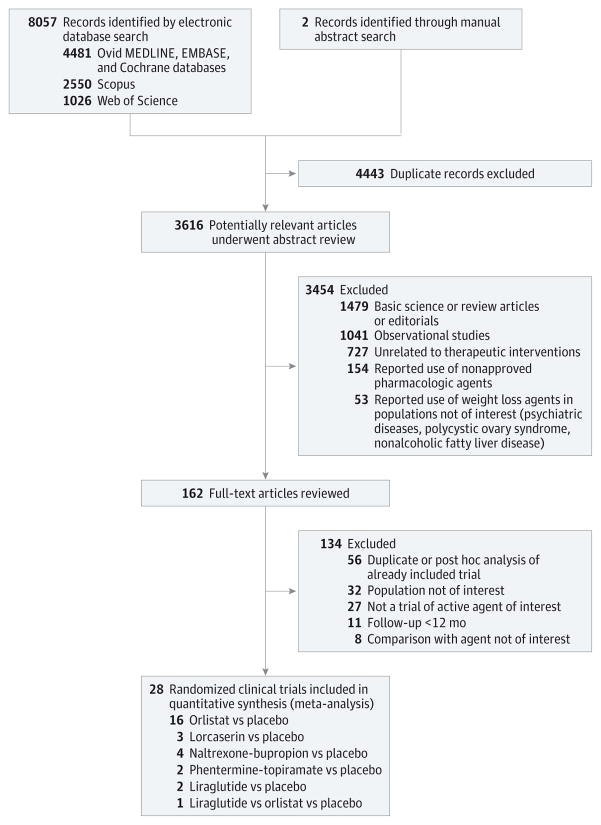
Study selection: Randomized clinical trials conducted among overweight and obese adults treated with US Food and Drug Administration-approved long-term weight loss agents (orlistat, lorcaserin, naltrexone-bupropion, phentermine-topiramate, or liraglutide) for at least 1 year compared with another active agent or placebo.
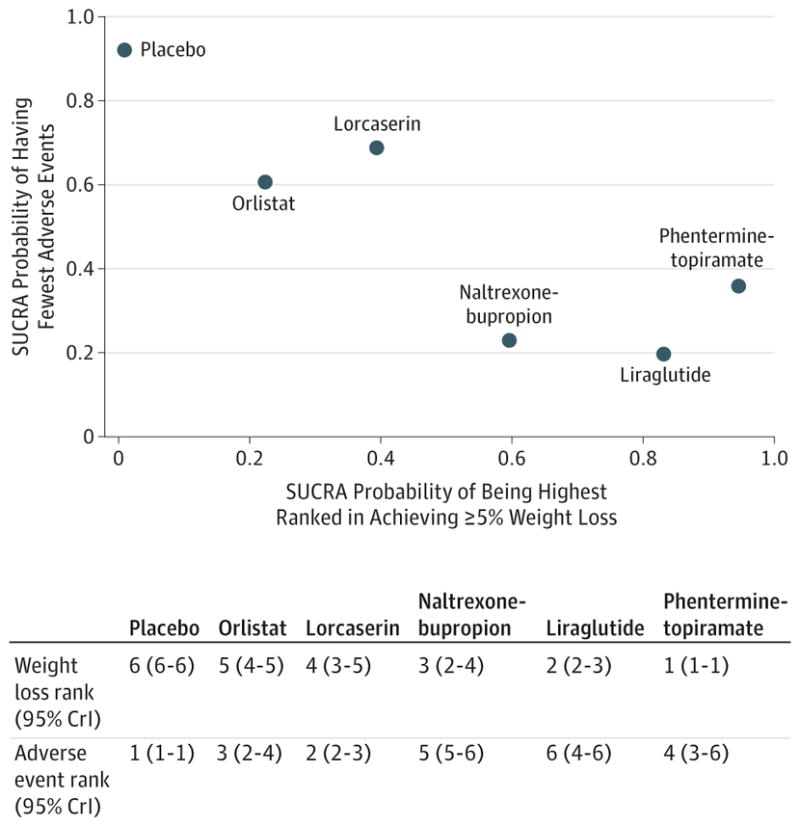
Data extraction and synthesis: Two investigators identified studies and independently abstracted data using a predefined protocol. A Bayesian network meta-analysis was performed and relative ranking of agents was assessed using surface under the cumulative ranking (SUCRA) probabilities. Quality of evidence was assessed using GRADE criteria.
Main outcomes and measures: Proportions of patients with at least 5% weight loss and at least 10% weight loss, magnitude of decrease in weight, and discontinuation of therapy because of adverse events at 1 year.
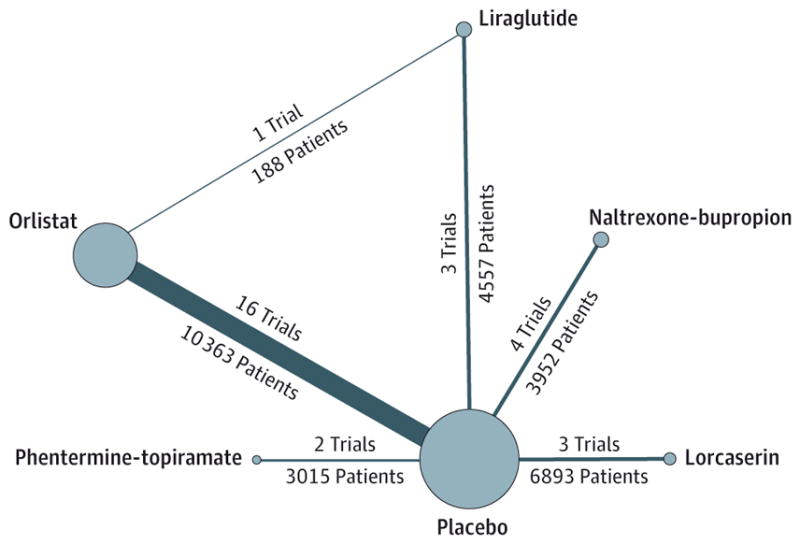
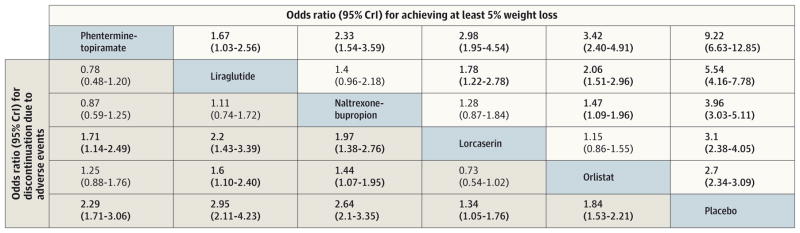
Results: Twenty-eight randomized clinical trials with 29 018 patients (median age, 46 years; 74% women; median baseline body weight, 100.5 kg; median baseline body mass index, 36.1) were included. A median 23% of placebo participants had at least 5% weight loss vs 75% of participants taking phentermine-topiramate (odds ratio [OR], 9.22; 95% credible interval [CrI], 6.63-12.85; SUCRA, 0.95), 63% of participants taking liraglutide (OR, 5.54; 95% CrI, 4.16-7.78; SUCRA, 0.83), 55% taking naltrexone-bupropion (OR, 3.96; 95% CrI, 3.03-5.11; SUCRA, 0.60), 49% taking lorcaserin (OR, 3.10; 95% CrI, 2.38-4.05; SUCRA, 0.39), and 44% taking orlistat (OR, 2.70; 95% CrI, 2.34-3.09; SUCRA, 0.22). All active agents were associated with significant excess weight loss compared with placebo at 1 year-phentermine-topiramate, 8.8 kg (95% CrI, -10.20 to -7.42 kg); liraglutide, 5.3 kg (95% CrI, -6.06 to -4.52 kg); naltrexone-bupropion, 5.0 kg (95% CrI, -5.94 to -3.96 kg); lorcaserin, 3.2 kg (95% CrI, -3.97 to -2.46 kg); and orlistat, 2.6 kg (95% CrI, -3.04 to -2.16 kg). Compared with placebo, liraglutide (OR, 2.95; 95% CrI, 2.11-4.23) and naltrexone-bupropion (OR, 2.64; 95% CrI, 2.10-3.35) were associated with the highest odds of adverse event-related treatment discontinuation. High attrition rates (30%-45% in all trials) were associated with lower confidence in estimates.
Conclusions and relevance: Among overweight or obese adults, orlistat, lorcaserin, naltrexone-bupropion, phentermine-topiramate, and liraglutide, compared with placebo, were each associated with achieving at least 5% weight loss at 52 weeks. Phentermine-topiramate and liraglutide were associated with the highest odds of achieving at least 5% weight loss.
Conflict of interest statement
Figures
Comment in
-
Weight loss drugs are compared for effectiveness.BMJ. 2016 Jun 14;353:i3330. doi: 10.1136/bmj.i3330. BMJ. 2016. PMID: 27307315 No abstract available.
References
-
- US Food and Drug Administration. [Accessed April 26, 2016];FDA-approved drug products: Contrave. 2014 http://www.accessdata.fda.gov/drugsatfda_docs/label/2014/200063s000lbl.pdf.
-
- US Food and Drug Administration. [Accessed April 26, 2016];FDA-approved drug products: Saxenda. 2015 http://www.accessdata.fda.gov/drugsatfda_docs/label/2015/206321s001lbl.pdf.
-
- Hutton B, Salanti G, Caldwell DM, et al. The PRISMA extension statement for reporting of systematic reviews incorporating network meta-analyses of health care interventions: checklist and explanations. Ann Intern Med. 2015;162(11):777–784. - PubMed
Publication types
MeSH terms
Substances
Grants and funding
LinkOut - more resources
Full Text Sources
Other Literature Sources
Medical
