


Development of the Pulmonary Arterial Hypertension-Symptoms and Impact (PAH-SYMPACT®) questionnaire: a new patient-reported outcome instrument for PAH
- PMID: 27301413
- PMCID: PMC4908719
- DOI: 10.1186/s12931-016-0388-6
Development of the Pulmonary Arterial Hypertension-Symptoms and Impact (PAH-SYMPACT®) questionnaire: a new patient-reported outcome instrument for PAH
Abstract
Background: Regulators and clinical experts increasingly recognize the importance of incorporating patient-reported outcomes (PROs) in clinical studies of therapies for pulmonary arterial hypertension (PAH). No PAH-specific instruments have been developed to date in accordance with the 2009 FDA guidance for the development of PROs as endpoints in clinical trials. A qualitative research study was conducted to develop a new instrument assessing PAH symptoms and their impacts following the FDA PRO guidance.
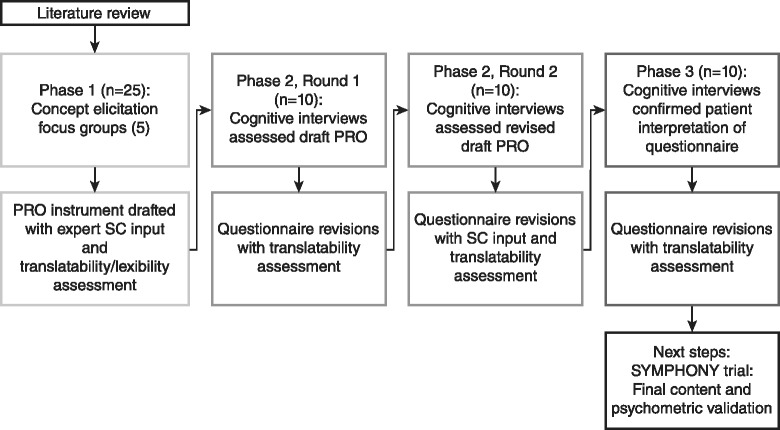
Methods: A cross-sectional study was conducted at 5 centers in the US in symptomatic PAH patients aged 18-80 years. Concept elicitation was based on 5 focus group discussions, after which saturation of emergent concepts was reached. A PRO instrument for PAH symptoms and their impacts was drafted. To assess the appropriateness of items, instructions, response options, and recall periods, 2 rounds of one-on-one cognitive interviews were conducted, with instrument revisions following each round. Additional interviews tested the usability of an electronic version (ePRO). PRO development considered input from an international Steering Committee, and translatability and lexibility assessments.
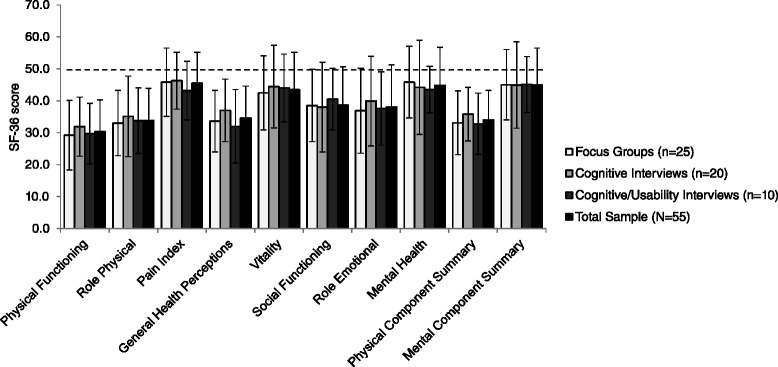
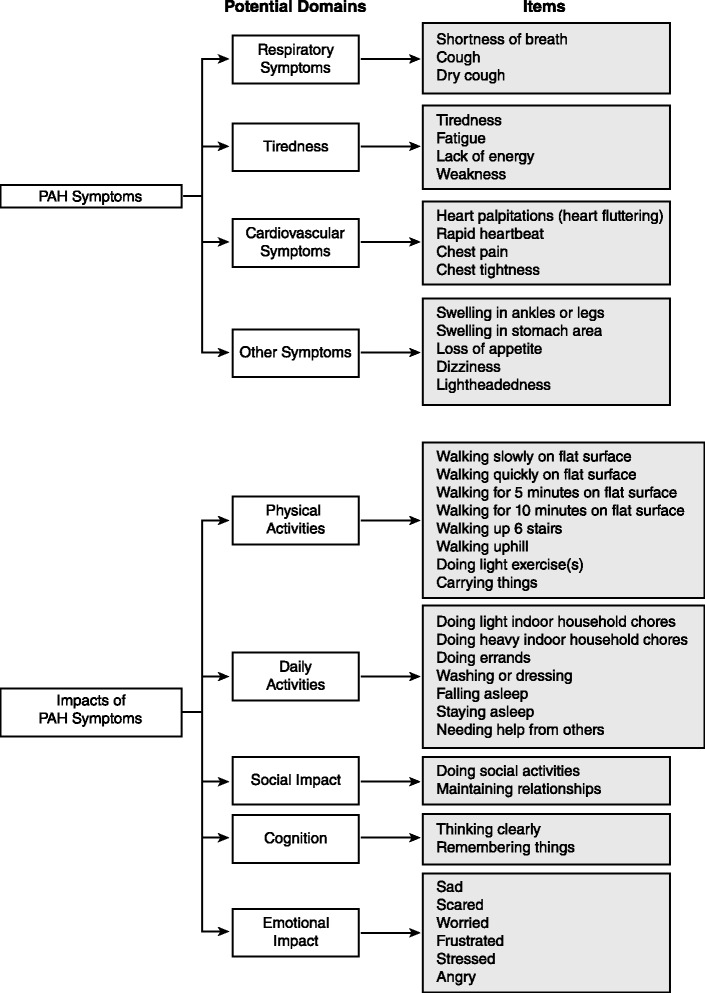
Results: Focus groups comprised 25 patients (5 per group); 20 additional patients participated in cognitive interviews (10 per round); and 10 participated in usability interviews. Participants had a mean ± SD age of 53.1 ± 15.8 years, were predominantly female (93 %), and were diverse in race/ethnicity, WHO functional class (FC I/II: 56 %, III/IV: 44 %), and PAH etiology (idiopathic: 56 %, familial: 2 %, associated: 42 %). The draft PRO instrument (PAH-SYMPACT®) was found to be clear, comprehensive, and relevant to PAH patients in cognitive interviews. Items were organized in a draft conceptual framework with 16 symptom items in 4 domains (respiratory symptoms, tiredness, cardiovascular symptoms, other symptoms) and 25 impact items in 5 domains (physical activities, daily activities, social impact, cognition, emotional impact). The recall period is the past 24 h for symptoms, and the past 7 days for impacts.
Conclusions: The PAH-SYMPACT® was shown to capture symptoms and their impacts relevant to PAH patients, demonstrating content saturation, concept validity, and ePRO usability. Final content and psychometric validation of the instrument will be based on the results of an ongoing Phase IIIb clinical trial in PAH patients.
Keywords: Activities of daily living; Health-related quality of life; Patient-reported outcomes; Pulmonary arterial hypertension; Symptoms.
Figures
References
-
- Galiè N, Hoeper MM, Humbert M, Torbicki A, Vachiery JL, Barbera JA, et al. Guidelines for the diagnosis and treatment of pulmonary hypertension: the Task Force for the Diagnosis and Treatment of Pulmonary Hypertension of the European Society of Cardiology (ESC) and the European Respiratory Society (ERS), endorsed by the International Society of Heart and Lung Transplantation (ISHLT) Eur Heart J. 2009;30:2493–537. doi: 10.1093/eurheartj/ehp297. - DOI - PubMed
-
- McLaughlin VV, Archer SL, Badesch DB, Barst RJ, Farber HW, Lindner JR, et al. ACCF/AHA 2009 expert consensus document on pulmonary hypertension. A report of the American College of Cardiology Foundation Task Force on Expert Consensus Documents and the American Heart Association developed in collaboration with the American College of Chest Physicians, American Thoracic Society, Inc., and the Pulmonary Hypertension Association. J Am Coll Cardiol. 2009;53:1573–619. doi: 10.1016/j.jacc.2009.01.004. - DOI - PubMed
Publication types
MeSH terms
LinkOut - more resources
Full Text Sources
Other Literature Sources
Medical
Miscellaneous
