. 2017 Feb;42(3):628-637.
doi: 10.1038/npp.2016.95. Epub 2016 Jun 15.

Impaired Flexible Reward-Based Decision-Making in Binge Eating Disorder: Evidence from Computational Modeling and Functional Neuroimaging

Affiliations

Impaired Flexible Reward-Based Decision-Making in Binge Eating Disorder: Evidence from Computational Modeling and Functional Neuroimaging

Andrea M F Reiter et al. Neuropsychopharmacology. 2017 Feb.

Abstract

Despite its clinical relevance and the recent recognition as a diagnostic category in the DSM-5, binge eating disorder (BED) has rarely been investigated from a cognitive neuroscientific perspective targeting a more precise neurocognitive profiling of the disorder. BED patients suffer from a lack of behavioral control during recurrent binge eating episodes and thus fail to adapt their behavior in the face of negative consequences, eg, high risk for obesity. To examine impairments in flexible reward-based decision-making, we exposed BED patients (n=22) and matched healthy individuals (n=22) to a reward-guided decision-making task during functional resonance imaging (fMRI). Performing fMRI analysis informed via computational modeling of choice behavior, we were able to identify specific signatures of altered decision-making in BED. On the behavioral level, we observed impaired behavioral adaptation in BED, which was due to enhanced switching behavior, a putative deficit in striking a balance between exploration and exploitation appropriately. This was accompanied by diminished activation related to exploratory decisions in the anterior insula/ventro-lateral prefrontal cortex. Moreover, although so-called model-free reward prediction errors remained intact, representation of ventro-medial prefrontal learning signatures, incorporating inference on unchosen options, was reduced in BED, which was associated with successful decision-making in the task. On the basis of a computational psychiatry account, the presented findings contribute to defining a neurocognitive phenotype of BED.


Figures
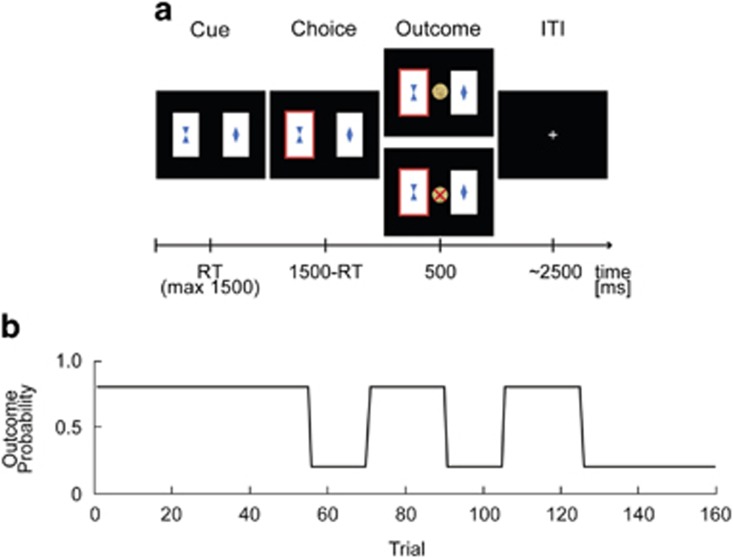
Figure 1
Figure 1
Anti-correlated decision-making task. (a) Exemplary trial sequence. Binary choice task: participants were instructed to choose the card that they thought would lead to a monetary reward. After the participant had selected one stimulus this card was highlighted and feedback was displayed. Outcome stimuli were a 10 Eurocents coin (in the case of a win) and a crossed 10 Eurocents coin (in the case of a loss). (b) One of the stimuli had a reward probability of 80% and a punishment probability of 20% (vice versa for the other stimulus). Reward contingencies were stable for the first 55 trials (pre-reversal block) and also for the last 35 trials (post-reversal block). In the intermediate block, reward contingencies changed four times (reversal block).
Figure 2
Figure 2
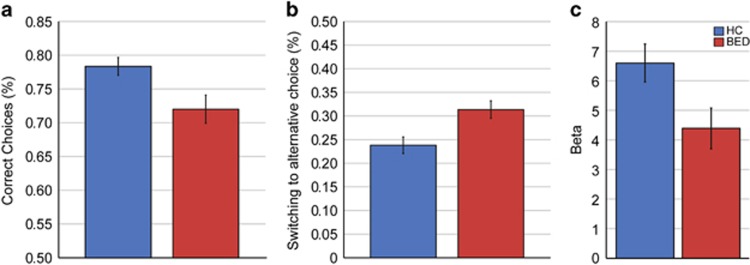
Behavioral results. (a) Raw data results. Correct choices differed significantly between groups (t=3.48, p=0.001, left panel). (b) BED patients showed enhanced switching behavior between the two stimuli (F=8.75, p=0.005). (c). Comparison of modeling parameters revealed that BED patients had a lower decision parameter β. Lower values of β indicate a higher degree of stochastic choices unrelated to the current choice values. Hence, lower values in BED indicate enhanced exploratory choices (t=2.51, p=0.016). BED, binge eating disorder; HC, healthy controls.
Figure 3
Figure 3
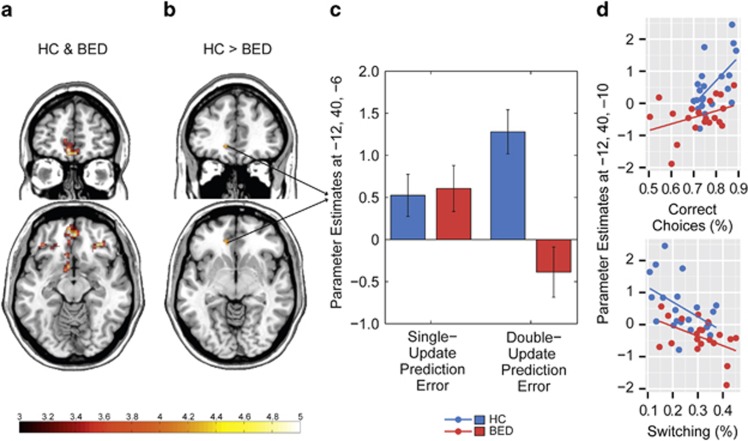
Neural correlates of single-update and double-update prediction error processing. (a) Across both groups, peak conjoint activity elicited by PESU and PEDU was observed in the ventro-medial prefrontal cortex (vmPFC, X=-6 Y=52 Z=-12, t=4.86, p-FWE for the whole brain=0.03, see Supplementary Table S6). (b, c) Comparing PESU and PEDU between groups revealed significantly reduced activation associated with of PEDU signatures in BED in the medial prefrontal cortex (X=−12, Y=40, Z=−6, t=4.06, FWE-corrected for vmPFC p=0.03). For display purposes, threshold is set at p<0.001, cluster level k=10. (d) Parameter estimates at the peak-coordinate of the group difference in vmPFC for PEDU were extracted and, for both groups separately, correlated with behavioral performance (percentage of correct choices, percentage of switching). This revealed a significant positive association between activation associated with PEDU and correct choices in both, BED (r=0.60, p=0.005) and HC (r=0.53, p=0.02). The correlation between PEDU related activation and switching was significant (r=−0.35, p=0.03) and did not indicate any evidence for an interaction effect with group (t<1.41, p>0.17, R2 change due to moderator<0.03). PEs, prediction errors; BED, binge eating patients; DU, double update; HC, healthy controls; SU, single update.
Figure 4
Figure 4
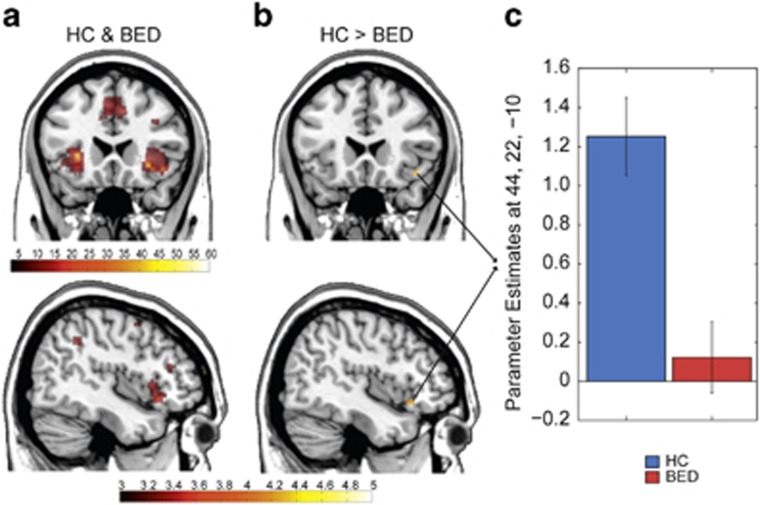
Neural correlates of the exploration–exploitation trade-off. (a). Across both groups, exploratory trials vs exploitative trials were associated with bilateral activation of the anterior insula/ventro–lateral prefrontal cortex (see also Supplementary Table S7). (b,c) Comparing activation in exploratory vs exploitative trials between groups demonstrated that BED patients show significantly diminished activity in the aI/vlPFC during exploratory trials (X=44, Y=22, Z=−10, t=3.91, FWE-corrected for the aI/vlPFC, p-FWE<0.05). For display purposes, threshold is set at p<0.001, cluster level k=10. FWE, family-wise-error.

References

    1. Abe H, Lee D (2011). Distributed coding of actual and hypothetical outcomes in the orbital and dorsolateral prefrontal cortex. Neuron 70: 731–741. - PMC - PubMed
    1. American Psychiatric Association (2013) The Diagnostic and Statistical Manual of Mental Disorder: DSM 5. American Psychiatric Association: Washington D.C, USA.
    1. Amthauer RBB, Liepmann D, Beauducel A (1999) Intelligenz-Struktur-Test 2000. Horgrefe: Göttingen, Germany.
    1. Badre D, Doll BB, Long NM, Frank MJ (2012). Rostrolateral prefrontal cortex and individual differences in uncertainty-driven exploration. Neuron 73: 595–607. - PMC - PubMed
    1. Bartra O, McGuire JT, Kable JW (2013). The valuation system: a coordinate-based meta-analysis of BOLD fMRI experiments examining neural correlates of subjective value. Neuroimage 76: 412–427. - PMC - PubMed

Publication types

LinkOut - more resources