


Electronic tools to support medication reconciliation: a systematic review
- PMID: 27301747
- PMCID: PMC7654089
- DOI: 10.1093/jamia/ocw068
Electronic tools to support medication reconciliation: a systematic review
Abstract
Objectives: Medication reconciliation (MedRec) is essential for reducing patient harm caused by medication discrepancies across care transitions. Electronic support has been described as a promising approach to moving MedRec forward. We systematically reviewed the evidence about electronic tools that support MedRec, by (a) identifying tools; (b) summarizing their characteristics with regard to context, tool, implementation, and evaluation; and (c) summarizing key messages for successful development and implementation.
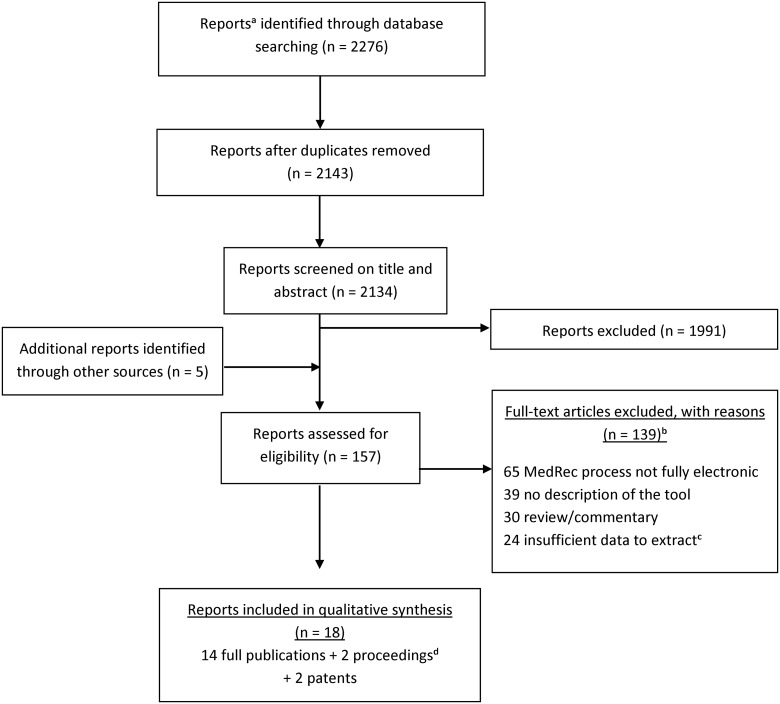
Materials and methods: We searched PubMed, the Cumulative Index to Nursing and Allied Health Literature, Embase, PsycINFO, and the Cochrane Library, and identified additional reports from reference lists, reviews, and patent databases. Reports were included if the electronic tool supported medication history taking and the identification and resolution of medication discrepancies. Two researchers independently selected studies, evaluated the quality of reporting, and extracted data.
Results: Eighteen reports relative to 11 tools were included. There were eight quality improvement projects, five observational effectiveness studies, three randomized controlled trials (RCTs) or RCT protocols (ie, descriptions of RCTs in progress), and two patents. All tools were developed in academic environments in North America. Most used electronic data from multiple sources and partially implemented functionalities considered to be important. Relevant information on functionalities and implementation features was frequently missing. Evaluations mainly focused on usability, adherence, and user satisfaction. One RCT evaluated the effect on potential adverse drug events.
Conclusion: Successful implementation of electronic tools to support MedRec requires favorable context, properly designed tools, and attention to implementation features. Future research is needed to evaluate the effect of these tools on the quality and safety of healthcare.
Keywords: continuity of care; health information technology; medication reconciliation; patient safety; quality improvement.
© The Author 2016. Published by Oxford University Press on behalf of the American Medical Informatics Association. All rights reserved. For Permissions, please email: journals.permissions@oup.com.
Figures
References
-
- Bassi J, Lau F, Bardal S. Use of information technology in medication reconciliation: a scoping review. Ann Pharmacotherapy. 2010; 44(5):885–897. - PubMed
-
- Kwan JL, Lo L, Sampson M, Shojania KG. Medication reconciliation during transitions of care as a patient safety strategy: a systematic review. Ann Int Med. 2013;158(5 Pt 2):397–403. - PubMed
Publication types
MeSH terms
LinkOut - more resources
Full Text Sources
Other Literature Sources
