Review
. 2016 May 26:7:735.
doi: 10.3389/fpls.2016.00735. eCollection 2016.

Glycosylation Is a Major Regulator of Phenylpropanoid Availability and Biological Activity in Plants

Affiliations
Review

Glycosylation Is a Major Regulator of Phenylpropanoid Availability and Biological Activity in Plants

Julien Le Roy et al. Front Plant Sci. .

Abstract

The phenylpropanoid pathway in plants is responsible for the biosynthesis of a huge amount of secondary metabolites derived from phenylalanine and tyrosine. Both flavonoids and lignins are synthesized at the end of this very diverse metabolic pathway, as well as many intermediate molecules whose precise biological functions remain largely unknown. The diversity of these molecules can be further increased under the action of UDP-glycosyltransferases (UGTs) leading to the production of glycosylated hydroxycinnamates and related aldehydes, alcohols and esters. Glycosylation can change phenylpropanoid solubility, stability and toxic potential, as well as influencing compartmentalization and biological activity. (De)-glycosylation therefore represents an extremely important regulation point in phenylpropanoid homeostasis. In this article we review recent knowledge on the enzymes involved in regulating phenylpropanoid glycosylation status and availability in different subcellular compartments. We also examine the potential link between monolignol glycosylation and lignification by exploring co-expression of lignin biosynthesis genes and phenolic (de)glycosylation genes. Of the different biological roles linked with their particular chemical properties, phenylpropanoids are often correlated with the plant's stress management strategies that are also regulated by glycosylation. UGTs can for instance influence the resistance of plants during infection by microorganisms and be involved in the mechanisms related to environmental changes. The impact of flavonoid glycosylation on the color of flowers, leaves, seeds and fruits will also be discussed. Altogether this paper underlies the fact that glycosylation and deglycosylation are powerful mechanisms allowing plants to regulate phenylpropanoid localisation, availability and biological activity.

Keywords: UDP-glycosyltransferase; beta-glucosidase; compartmentalization; flavonoids; glycosylation; lignin; phenylpropanoids.


Figures
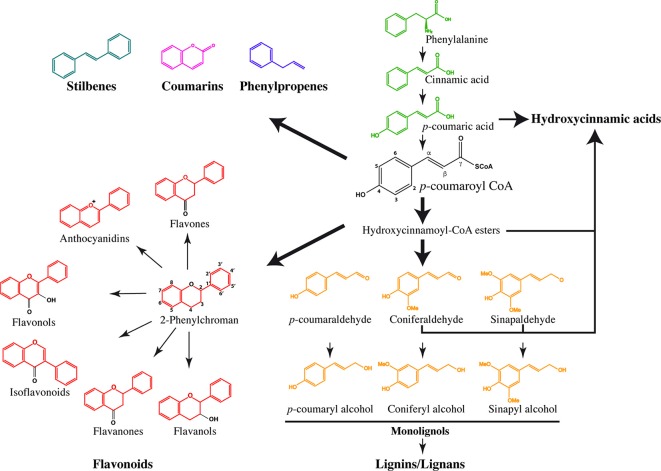
Figure 1
Figure 1
Schematic view of the phenylpropanoid biosynthesis. The general phenylpropanoid pathway begins by successive reactions resulting in the transformation of phenylalanine into p-coumaryl CoA, which is the common precursor of stilbenes, coumarins, phenylpropenes, 2-phenylchroman-containing flavonoids, and monolignols. The pathways leading to the production of hydroxycinnamic acids were obtained based on phenylpropanoid analysis in Arabidopsis mutants.
Figure 2
Figure 2
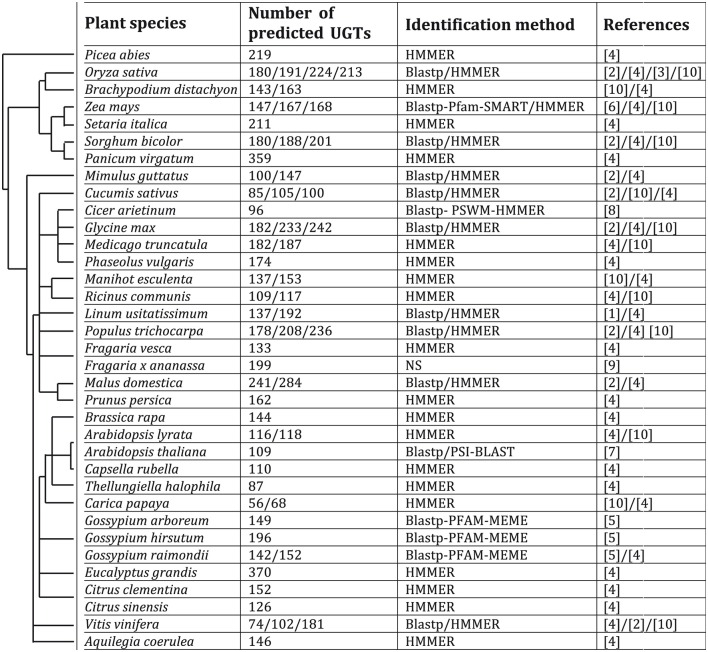
Predicted UGT enzymes in different higher plants. Species are arranged in an order based on taxonomic families. [1], Barvkar et al. (2012); [2], Caputi et al. (2012); [3], Cao et al. (2008); [4], Ekstrom et al. (2014); [5], Huang et al. (2015); [6], Li et al. (2014); [7], Ross et al. (2001); [8], Sharma et al. (2014); [9], Song et al. (2015); [10], Yonekura-Sakakibara and Hanada (2011).
Figure 3
Figure 3
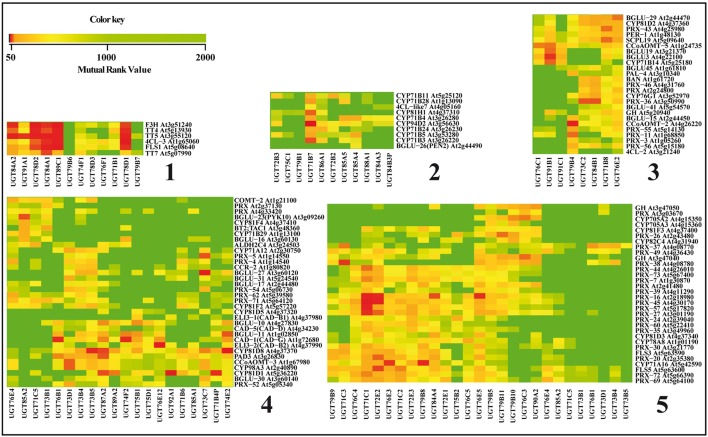
Co-expression of UGT and phenylpropanoid genes. Five relevant groups of coexpressed genes delimited by hierarchical clustering indicated on the left of the heatmap were extracted from the global heat map presented in Supplementary Figure 1. Groups 1, 2, and 5 contain genes known to be involved in the glycosylation of the major phenylpropanoids and groups 3 and 4 contain genes with high coregulation values. When the mutual rank (MR) value <0, there is co-expression a50, co-expression between the genes is considered as strong; if 51 < MR < 1000, there is co-expression and if MR>1001, there is no co-expression.
Figure 4
Figure 4
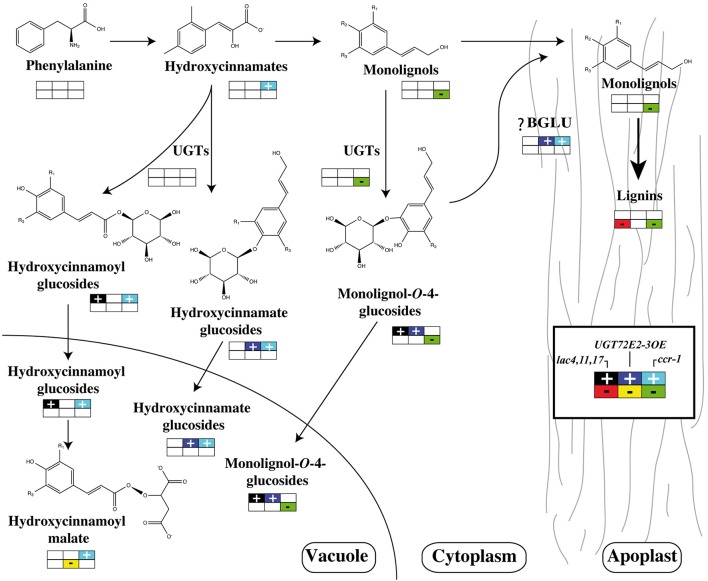
Effects of phenylpropanoid gene mutations or UGT gene overexpression. A schematic view of lignin, glucoconjugated monolignols, hydroxycinnamate glucosides, or hydroxycinnamoyl esters are presented in ccr-1 and lac4,11,17 mutants and 35S:UGT72E2-3 overexpressors. For metabolites and transcripts, a color code indicates an accumulation or a reduction compared to the wild-type. Data were extracted from Vanholme et al. (2012), Zhao et al. (2013), and Lanot et al. (2006, 2008) respectively.

References

    1. Ahn Y. O., Shimizu B., Sakata K., Gantulga D., Zhou C., Bevan D. R., et al. . (2010). Scopolin-hydrolyzing beta-glucosidases in roots of Arabidopsis. Plant Cell Physiol. 51, 132–143. 10.1093/pcp/pcp174 - DOI - PubMed
    1. Ahrazem O., Rubio-Moraga A., Trapero-Mozos A., Climent M. F., Gomez-Cadenas A., Gomez-Gomez L. (2015). Ectopic expression of a stress-inducible glycosyltransferase from saffron enhances salt and oxidative stress tolerance in Arabidopsis while alters anchor root formation. Plant Sci 234, 60–73. 10.1016/j.plantsci.2015.02.004 - DOI - PubMed
    1. Alejandro S., Lee Y., Tohge T., Sudre D., Osorio S., Park J., et al. . (2012). AtABCG29 is a monolignol transporter involved in lignin biosynthesis. Curr. Biol. 22, 1207–1212. 10.1016/j.cub.2012.04.064 - DOI - PubMed
    1. Babst B. A., Chen H. Y., Wang H. Q., Payyavula R. S., Thomas T. P., Harding S. A., et al. . (2014). Stress-responsive hydroxycinnamate glycosyltransferase modulates phenylpropanoid metabolism in Populus. J. Exp. Bot. 65, 4191–4200. 10.1093/jxb/eru192 - DOI - PMC - PubMed
    1. Baiya S., Hua Y., Ekkhara W., Ketudat Cairns J. R. (2014). Expression and enzymatic properties of rice (Oryza sativa L.) monolignol beta-glucosidases. Plant Sci. 227, 101–109. 10.1016/j.plantsci.2014.07.009 - DOI - PubMed

LinkOut - more resources