. 2016 Oct;157(10):2285-2296.
doi: 10.1097/j.pain.0000000000000644.

Reduced thermal sensitivity and increased opioidergic tone in the TASTPM mouse model of Alzheimer's disease

Affiliations

Reduced thermal sensitivity and increased opioidergic tone in the TASTPM mouse model of Alzheimer's disease

Yahyah Aman et al. Pain. 2016 Oct.

Abstract

Individuals with Alzheimer's disease (AD) are in susceptible patient groups in which pain is an important clinical issue that is often underdiagnosed. However, it is unclear whether decreased pain complaints in patients with AD result from elevated pain tolerance or an impaired ability to communicate sensations. Here, we explored if AD-related pathology is present in key regions of the pain pathway and assessed whether nociceptive thresholds to acute noxious stimulation are altered in the double-mutant APPswe × PS1.M146V (TASTPM) transgenic mouse model of AD. TASTPM mice exhibited an age-dependant cognitive deficit at the age of 6 months, but not at 4 months, a deficit that was accompanied by amyloid plaques in the cortex, hippocampus, and thalamus. In the spinal cord, β-amyloid (APP/Aβ) immunoreactivity was observed in dorsal and ventral horn neurons, and the expression of vesicular glutamate transporter 2 (VGLUT2) was significantly reduced, while the expression of the inhibitory peptides enkephalins was increased in TASTPM dorsal horn, consistent with an increased inhibitory tone. TASTPM mice displayed reduced sensitivity to acute noxious heat, which was reversed by naloxone, an opioid antagonist. This study suggests that increased inhibition and decreased excitation in the spinal cord may be responsible for the reduced thermal sensitivity associated with AD-related pathology.


Conflict of interest statement

Sponsorships or competing interests that may be relevant to content are disclosed at the end of this article.

Figures
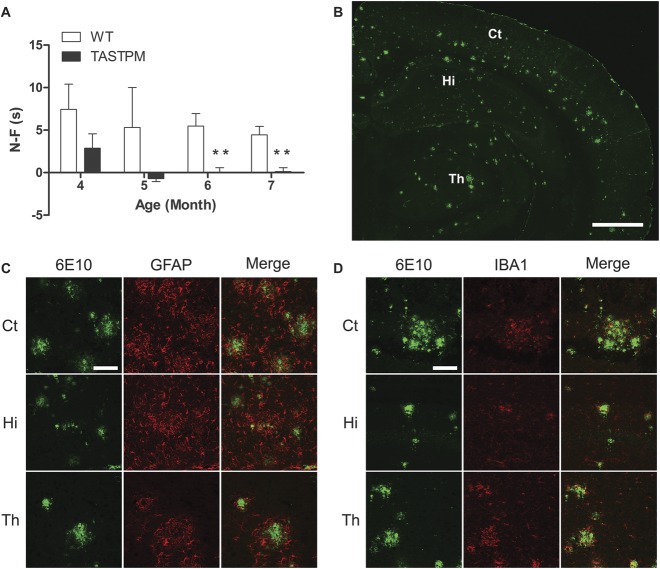
Figure 1.
Figure 1.
Cognitive and pathological features of the TASTPM mouse model of Alzheimer's disease (AD). TASTPM (9 males and 6 females) mice displayed memory deficits compared with wild-type (WT) mice (5 males and 5 females) at the age of 6 and 7 months but not earlier (A) (**P < 0.01, t test or Mann–Whitney Rank Sum test). Data values are expressed as mean ± SEM (n = 10-15 per experimental group). Coronal brain sections from TASTPM mice (male) displayed AD-related pathological hallmark namely amyloid plaques composed of aggregated Aβ (B) accompanied by glial fibrillary acidic protein (GFAP)-positive astrocytes (C) and ionized calcium binding adaptor molecule 1 (IBA1)-labelled microglia (D) forming a barrier around Aβ pathology. The scale bar represents 1 mm (B) and 100 μm (C–D). Ct, cerebral cortex; Hi, hippocampus; Th, thalamus.
Figure 2.
Figure 2.
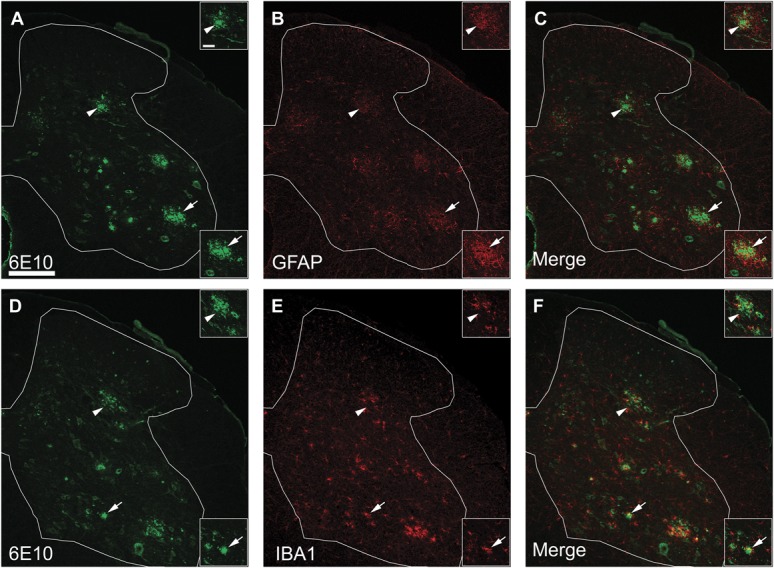
Aβ deposits in the spinal cord of 12-month-old TASTPM mice. Transverse lumbar spinal cord sections from 12-month-old TASTPM mice (male) were stained with antibodies against β-amyloid 1-16 (6E10) (A and D) with either glial fibrillary acidic protein (GFAP) (B) or ionized calcium binding adaptor molecule 1 (IBA1) (E). Merged images are shown for 6E10 with GFAP (C) or IBA1 (F) co-immunostaining in the spinal cord. Pathological amyloid plaques composed of Aβ are evident in the dorsal (arrowheads) and ventral horns (arrows) of the spinal cord (A and D). A high-power magnification (insets) revealed GFAP (A–C) and IBA1 (D–F) immunoreactivity surrounding the 6E10-labelled amyloid plaques in the dorsal and ventral horns. Scale bars: 200 μm (A–F) and 50 μm (insets).
Figure 3.
Figure 3.
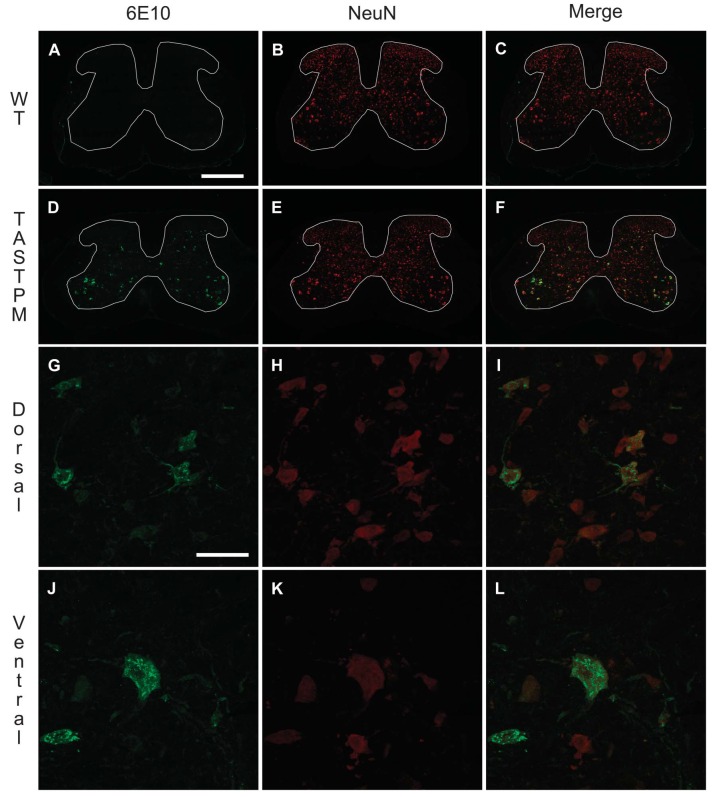
Aβ expression in the spinal cord. Transverse lumbar spinal cord sections from 6- to 7-month-old TASTPM and wild-type (WT) male mice were stained with antibodies against β-amyloid 1-16 (6E10) (A, D, G, and J) and neuronal nuclei marker (NeuN) (B, E, H, and K). Merged images are shown for 6E10 and NeuN co-immunostaining in the spinal cord of WT (C) and TASTPM (F) mice as well as TASTPM dorsal horn (I) and ventral horn (L). 6E10 staining was only detected in the spinal cord of the transgenic TASTPM mice and was distributed throughout the grey matter. A high-power magnification revealed colocalisation of 6E10 and NeuN in the dorsal horn laminae III-IV and motor neurons in the ventral horn of the transgenic TASTPM mice spinal cord. Scale bars: 500 μm (A–F) and 50 μm (G–L).
Figure 4.
Figure 4.
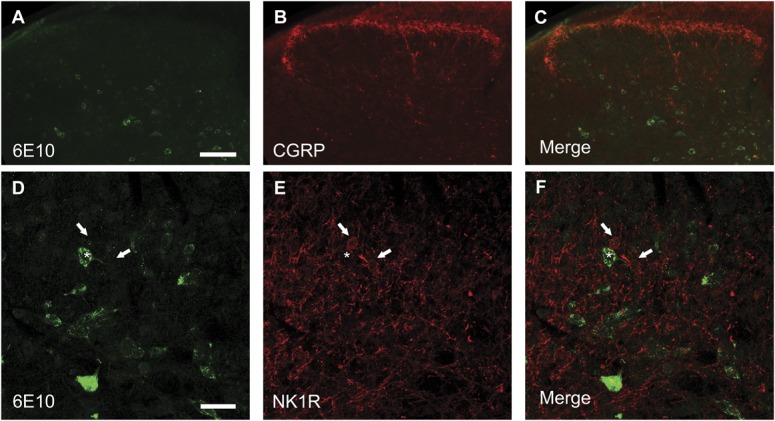
Aβ absent in primary afferent terminals and NK1 receptor–positive neurons. Transverse spinal cord sections from 6- to 7-month old TASTPM mice (male) were stained with antibodies against β-amyloid 1-16 (6E10) (A and D), calcitonin gene-related peptide (CGRP) (B) and neurokinin 1 receptor (NK1R) (E). Merged images are shown for 6E10 costained with CGRP (C) and NK1R (F). β-amyloid 1-16 was absent in primary afferent CGRP-immunopositive terminals and was also not present in NK1R-positive neurons (arrows) in the dorsal horn lamina III of the TASTPM spinal cord. Scale bars: 100 μm (A–C) and 30 μm (D–F).
Figure 5.
Figure 5.
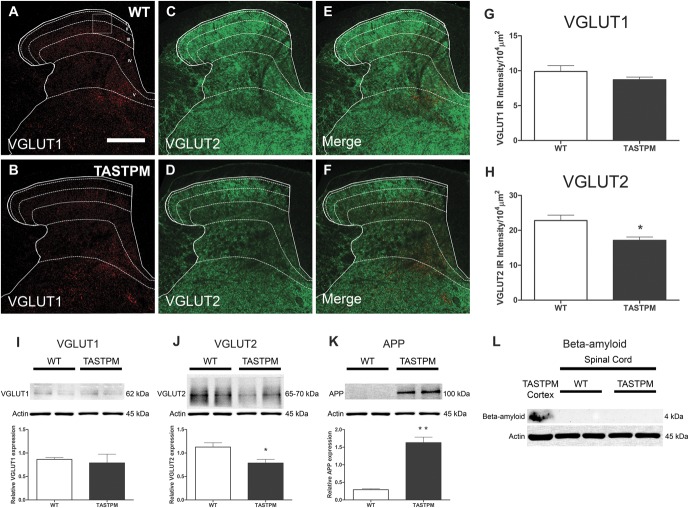
Aβ and VGLUTs expression in the spinal cord. Transverse spinal cord sections from 6- to 7-month-old TASTPM and wild-type (WT) mice (male) were stained with antibodies against vesicular glutamate transporter 1 (VGLUT1) (A and D) and vesicular glutamate transporter 2 (VGLUT2) (B and E). Merged images are shown for VGLUT1 costaining with VGLUT2 (C and F). The distribution of VGLUT1 in TASTPM and WT spinal cord was mainly in the deeper dorsal horn laminae (III-VI) (A and D), while VGLUT2 was found throughout the grey matter but with less prominence in the medial part of the TASTPM deep dorsal horn (B and E). Quantitative analysis of VGLUT1 and VGLUT2 immunostaining intensity in the dorsal horn revealed significantly reduced VGLUT2 intensity in the dorsal horn of the TASTPM mice compared with WT controls (*P < 0.05, t test, H) but no difference in VGLUT1 intensity (P > 0.05, t test, G). Data values are expressed as mean ± SEM (n = 4 (2 males and 2 females) per experimental group). Scale bars: 200 μm (A–F). Quantitative levels of VGLUTs, amyloid precursor protein (APP), and β-amyloid (Aβ) determined by Western blot revealed significantly higher expression of APP and reduced levels of VGLUT2 in the lumbar (L3-L5) spinal cord of TASTPM mice compared with WT controls (*P < 0.05, **P < 0.01, t test) relative to β-actin (loading control) (I–K). Aβ peptide was only detected in the TASTPM cerebral cortex, however, absent in both WT and TASTPM spinal cords (L). Data values are expressed as mean ± SEM (n = 3 [1 male and 2 females] per experimental group).
Figure 6.
Figure 6.
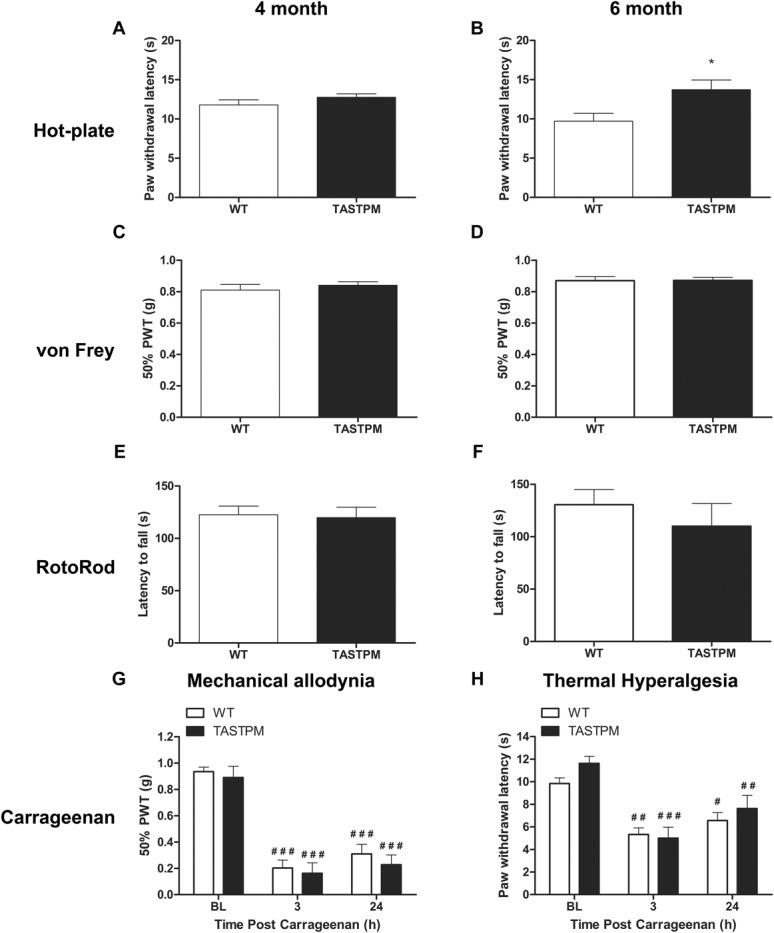
Nociceptive thresholds and motor coordination. TASTPM mice (9 males and 7 females) displayed comparable nociceptive thresholds to wild-type (WT) (5 males and 5 females) mice in response to noxious thermal stimulation at the age of 4 months (A); however, an increased paw withdrawal latency compared with WT mice at the age of 6 months (B) (*P < 0.05, Mann-Whitney Rank Sum test). TASTPM mice exhibited responses comparable with WT mice in response to noxious mechanical stimulation (C and D). No motor deficit in the TASTPM mice at the age of 4 and 6 months, as no significant difference in the latency to fall from an accelerating RotoRod was observed when compared with WT controls (E and F). Data are expressed as mean ± SEM (n = 10-16 per experimental group). Mechanical thresholds (G) and thermal withdrawal latencies (H) of the ipsilateral hind paw in response to intraplantar carrageenan (1%) injection in 6- to 7-month-old TASTPM and WT mice. Both TASTPM and WT mice developed mechanical allodynia and thermal hyperalgesia 3 hours postcarrageenan, which persisted at 24 hours. At no point were there any significant differences in behavioural responses of the TASTPM (2 males and 3 females) compared with WT controls (1 male and 3 females). Data are presented as mean ± SEM (n = 4-5 per experimental group); 2-way repeated-measures analysis of variance followed by post hoc Tukey multiple comparison test (#P < 0.05, ##P < 0.01, and ###P < 0.001 compared with respective baseline).
Figure 7.
Figure 7.
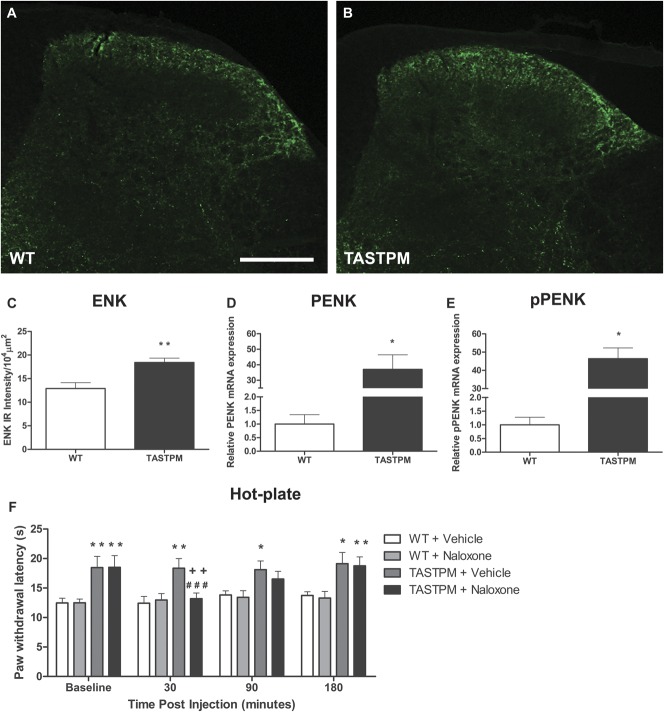
Expression of enkephalins in the spinal cord and effect of naloxone on thermal thresholds. Transverse lumbar spinal cord sections from 6- to 7-month-old TASTPM (5 males and 5 females) and wild-type (WT) (4 males and 4 females) mice were stained with met-enkephalin (ENK) (A and B). Quantitative analysis of met-ENK immunostaining in the dorsal horn revealed significantly higher met-ENK intensity in the dorsal horn of TASTPM compared with WT controls (**P < 0.01, Mann-Whitney Rank Sum test, C). Values are expressed as mean ± SEM (n = 8-10 per experimental group) and scale bar represents 200 μm. In addition, RT-PCR displayed significantly higher mRNA expression of preproenkephalin (pPENK, D) and proenkephalin (PENK, E) in 6- to 7-month-old TASTPM (2 males and 2 females) dorsal horn (L3-L5) compared age-matched WT (4 females) controls (*P < 0.05, Mann-Whitney Rank Sum test). Data are expressed as mean ± SEM (n = 4 per experimental group). Administration of naloxone (1 mg/kg intraperitoneally), an opioid antagonist, reduced paw withdrawal latency in 6- to 7-month-old TASTPM mice (4 males and 5 females) compared with baseline (###P < 0.001) and TASTPM saline (4 males and 5 females) control (++P < 0.01) after 30 minutes. However, there was no effect of naloxone observed in WT mice (5 males and 5 females) compared with their respective baseline and WT saline (5 males and 5 females) control. TASTPM mice exhibited significantly higher paw withdrawal latency compared with WT mice injected with saline at baseline and recovered back to baseline levels and significantly higher 3 hours after naloxone administration (*P < 0.05, **P < 0.01) using 2-way repeated-measures analysis of variance followed by Tukey multiple comparison test (F). Data are presented as mean ± SEM (n = 9-10 per experimental group).

References

    1. Ballard CG, Gauthier S, Cummings JL, Brodaty H, Grossberg GT, Robert P, Lyketsos CG. Management of agitation and aggression associated with Alzheimer disease. Nat Rev Neurol 2009;5:245–55. - PubMed
    1. Benedetti F, Arduino C, Vighetti S, Asteggiano G, Tarenzi L, Rainero I. Pain reactivity in Alzheimer patients with different degrees of cognitive impairment and brain electrical activity deterioration. PAIN 2004;111:22–9. - PubMed
    1. Brooks SP, Dunnett SB. Tests to assess motor phenotype in mice: a user's guide. Nat Rev Neurosci 2009;10:519–29. - PubMed
    1. Brumovsky P, Watanabe M, Hokfelt T. Expression of the vesicular glutamate transporters-1 and -2 in adult mouse dorsal root ganglia and spinal cord and their regulation by nerve injury. Neuroscience 2007;147:469–90. - PubMed
    1. Cameron D, Polgar E, Gutierrez-Mecinas M, Gomez-Lima M, Watanabe M, Todd AJ. The organisation of spinoparabrachial neurons in the mouse. PAIN 2015;156:2061–71. - PMC - PubMed

MeSH terms