Review
. 2016 Jun 12;9(1):499-519.
doi: 10.1146/annurev-anchem-071015-041550.

Progress in Top-Down Proteomics and the Analysis of Proteoforms

Affiliations
Review

Progress in Top-Down Proteomics and the Analysis of Proteoforms

Timothy K Toby et al. Annu Rev Anal Chem (Palo Alto Calif). .

Abstract

From a molecular perspective, enactors of function in biology are intact proteins that can be variably modified at the genetic, transcriptional, or post-translational level. Over the past 30 years, mass spectrometry (MS) has become a powerful method for the analysis of proteomes. Prevailing bottom-up proteomics operates at the level of the peptide, leading to issues with protein inference, connectivity, and incomplete sequence/modification information. Top-down proteomics (TDP), alternatively, applies MS at the proteoform level to analyze intact proteins with diverse sources of intramolecular complexity preserved during analysis. Fortunately, advances in prefractionation workflows, MS instrumentation, and dissociation methods for whole-protein ions have helped TDP emerge as an accessible and potentially disruptive modality with increasingly translational value. In this review, we discuss technical and conceptual advances in TDP, along with the growing power of proteoform-resolved measurements in clinical and translational research.

Keywords: intact protein analysis; mass spectrometry; proteoforms; top-down proteomics; translational proteomics.


Figures
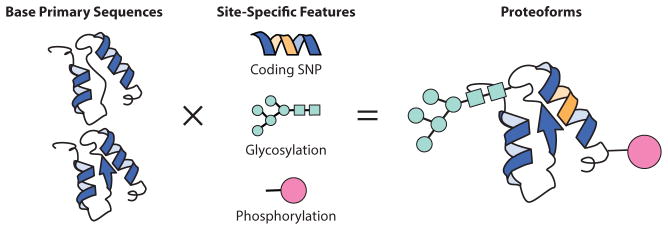
Figure 1
Figure 1
Proteoforms capture molecular specificity. A base primary sequence derived from a single gene, once combinatorially modified into a final functional form, is termed a “proteoform.”
Figure 2
Figure 2
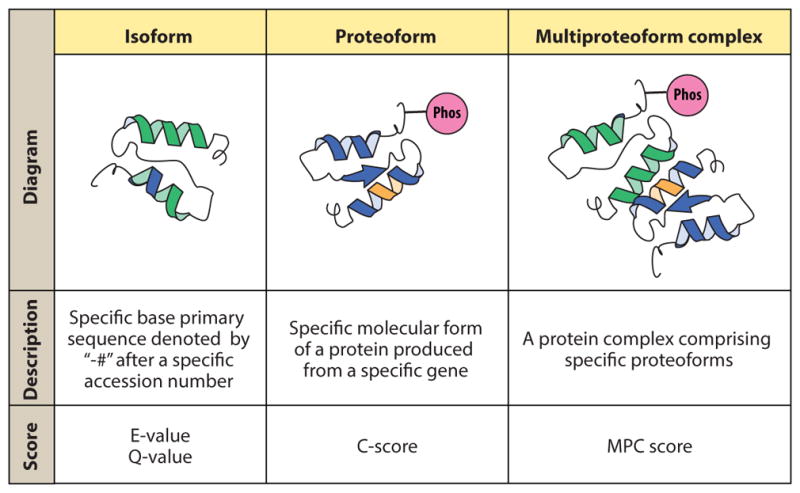
Semantics and nomenclature in top-down proteomics. Abbreviations: MPC, multi-proteoform complex; Phos, phosphorylation.
Figure 3
Figure 3
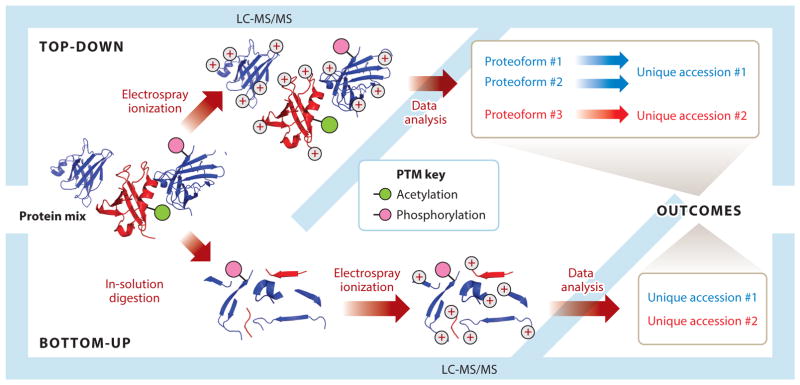
Divergent workflows in top-down and bottom-up proteomics. Top-down simply removes the digestion step used in bottom-up to generate peptides for analysis. Abbreviations: LC-MS/MS, liquid chromatography online with tandem mass spectrometry; PTM, post-translational modification.
Figure 4
Figure 4
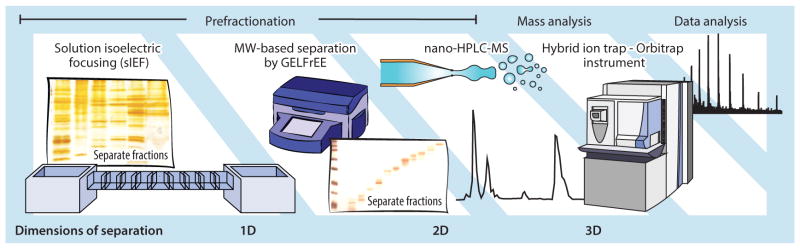
Multidimensional workflow in global, high-throughput proteomics, depicting a complex, large-scale top-down experiment for global proteome analysis. Multiple dimensions of prefractionation are combined prior to mass spectometry measurement to increase proteome coverage by analysis of several fractions. Abbreviations: GELFrEE, gel-elution liquid fraction entrapment electrophoresis; MW, molecular weight; nano-HPLC-MS, nanoliter-flow high-performance liquid chromatography online with mass spectrometry; sIEF, solution isoelectric focusing.

References

    1. Smith L, Kelleher N Consort. Top Down Proteom. Proteoform: a single term describing protein complexity. Nat Methods. 2013;10:186–87. - PMC - PubMed
    1. Chait B. Mass spectrometry: bottom-up or top-down? Science. 2006;314:65–66. - PubMed
    1. Nesvizhskii A, Aebersold R. Interpretation of shotgun proteomic data: the protein inference problem. Mol Cell Proteom. 2005;4:1419–40. - PubMed
    1. Gross JH. Mass Spectrometry: A Textbook. New York: Springer; 2004.
    1. Walther T, Mann M. Mass spectrometry-based proteomics in cell biology. J Cell Biol. 2010;190:491–500. - PMC - PubMed

Publication types

LinkOut - more resources