


Technical Limitations of the C1q Single-Antigen Bead Assay to Detect Complement Binding HLA-Specific Antibodies
- PMID: 27306532
- PMCID: PMC5457814
- DOI: 10.1097/TP.0000000000001270
Technical Limitations of the C1q Single-Antigen Bead Assay to Detect Complement Binding HLA-Specific Antibodies
Abstract
Background: Solid-phase assays to distinguish complement binding from noncomplement binding HLA-specific antibodies have been introduced, but technical limitations may compromise their interpretation. We have examined the extent to which C1q-binding to HLA-class I single-antigen beads (SAB) is influenced by denatured HLA on SAB, antibody titre, and complement interference that causes a misleading low assessment of HLA-specific antibody levels.
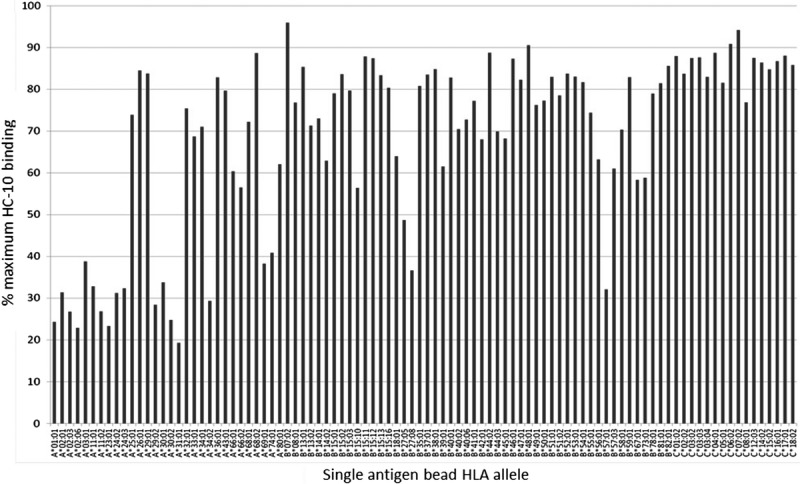
Methods: Sera from 25 highly sensitized patients were tested using Luminex IgG-SAB and C1q-SAB assays. Sera were tested undiluted, at 1:20 dilution to detect high-level IgG, and after ethylene diamine tetraacetic acid treatment to obviate complement interference. Conformational HLA and denatured HLA protein levels on SAB were determined using W6/32 and HC-10 monoclonal antibodies, respectively. Denatured HLA was expressed as HC-10 binding to untreated SAB as a percentage of maximal binding to acid-treated SAB.
Results: For undiluted sera, Luminex mean fluorescence intensity (MFI) values for IgG-SAB and C1q-SAB correlated poorly (r = 0.42). ethylene diamine tetraacetic acid and serum dilution improved the correlation (r = 0.57 and 0.77, respectively). Increasing levels of denatured HLA interfered with the detection of C1q binding. Consequently, the correlation between IgG-SAB MFI and C1q-SAB MFI was lowest using undiluted sera and SAB with greater than 30% denatured HLA (r = 0.40) and highest using diluted sera and SAB with 30% or less denatured HLA (r = 0.86).
Conclusions: Antibody level, complement interference, and denatured HLA class I on SAB may all affect the clinical interpretation of the C1q-SAB assay. The C1q-SAB assay represents a substantial additional cost for routine clinical use, and we question its justification given the potential uncertainty about its interpretation.
Conflict of interest statement
The authors declare no conflicts of interest.
Figures



References
-
- Gloor JM, Winters JL, Cornell LD, et al. Baseline donor-specific antibody levels and outcomes in positive crossmatch kidney transplantation. Am J Transplant. 2010;10:582–589. - PubMed
-
- Otten HG, Verhaarb MC, Borsta HPE, et al. Pretransplant donor-specific HLA class-I and -II antibodies are associated with an increased risk for kidney graft failure. Am J Transplant. 2012;12:1618–1623. - PubMed
-
- Pei R, Lee JH, Shih NJ, et al. Single human leukocyte antigen flow cytometry beads for accurate identification of human leukocyte antigen antibody specificities. Transplantation. 2003;75:43–49. - PubMed
-
- Vlad G, Ho EK, Vasilescu ER, et al. Relevance of different antibody detection methods for the prediction of antibody-mediated rejection and deceased-donor kidney allograft survival. Hum Immunol. 2009;70:589–594. - PubMed
Publication types
MeSH terms
Substances
Grants and funding
LinkOut - more resources
Full Text Sources
Other Literature Sources
Molecular Biology Databases
Research Materials
