


Accelerometry and physical activity questionnaires - a systematic review
- PMID: 27306667
- PMCID: PMC4910242
- DOI: 10.1186/s12889-016-3172-0
Accelerometry and physical activity questionnaires - a systematic review
Abstract
Background: The aim of this study is to review accelerometer wear methods and correlations between accelerometry and physical activity questionnaire data, depending on participant characteristics.
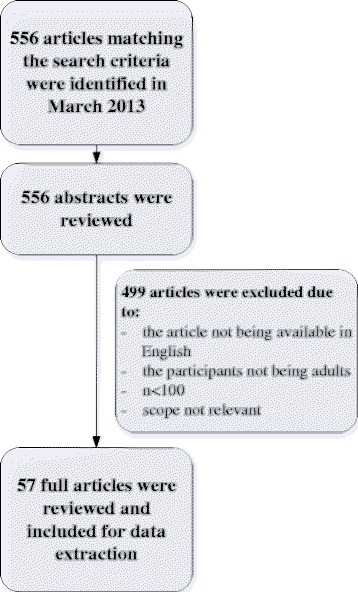
Methods: We included 57 articles about physical activity measurement by accelerometry and questionnaires. Criteria were to have at least 100 participants of at least 18 years of age with manuscripts available in English. Accelerometer wear methods were compared. Spearman and Pearson correlation coefficients between questionnaires and accelerometers and differences between genders, age categories, and body mass index (BMI) categories were assessed.
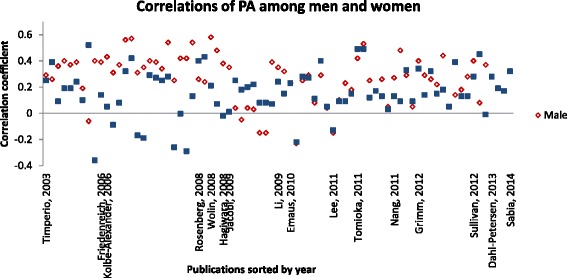
Results: In most investigations, requested wear time was seven days during waking hours and devices were mostly attached on hips with waist belts. A minimum of four valid days with wear time of at least ten hours per day was required in most studies. Correlations (r = Pearson, ρ = Spearman) of total questionnaire scores against accelerometer measures across individual studies ranged from r = 0.08 to ρ = 0.58 (P < 0.001) for men and from r = -0.02 to r = 0.49 (P < 0.01) for women. Correlations for total physical activity among participants with ages ≤65 ranged from r = 0.04 to ρ = 0.47 (P < 0.001) and from r = 0.16 (P = 0.02) to r = 0.53 (P < 0.01) among the elderly (≥65 years). Few studies investigated stratification by BMI, with varying cut points and inconsistent results.
Conclusion: Accelerometers appear to provide slightly more consistent results in relation to self-reported physical activity among men. Nevertheless, due to overall limited consistency, different aspects measured by each method, and differences in the dimensions studied, it is advised that studies use both questionnaires and accelerometers to gain the most complete physical activity information.
Keywords: Accelerometry; Adults; Physical activity measurement; Questionnaires.
Figures
References
-
- World Health Organization . Global recommendations on physical activity for health. Geneva: World Health Organization; 2010. - PubMed
-
- National Institutes of Health . Types of Physical Activity. 2011.
Publication types
MeSH terms
Grants and funding
LinkOut - more resources
Full Text Sources
Other Literature Sources
Medical
