Predicting Achievable Fundamental Frequency Ranges in Vocalization Across Species
- PMID: 27309543
- PMCID: PMC4911068
- DOI: 10.1371/journal.pcbi.1004907
Predicting Achievable Fundamental Frequency Ranges in Vocalization Across Species
Abstract
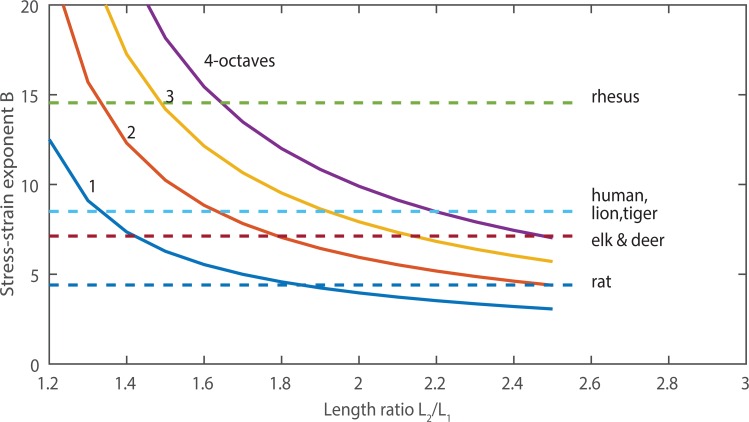
Vocal folds are used as sound sources in various species, but it is unknown how vocal fold morphologies are optimized for different acoustic objectives. Here we identify two main variables affecting range of vocal fold vibration frequency, namely vocal fold elongation and tissue fiber stress. A simple vibrating string model is used to predict fundamental frequency ranges across species of different vocal fold sizes. While average fundamental frequency is predominantly determined by vocal fold length (larynx size), range of fundamental frequency is facilitated by (1) laryngeal muscles that control elongation and by (2) nonlinearity in tissue fiber tension. One adaptation that would increase fundamental frequency range is greater freedom in joint rotation or gliding of two cartilages (thyroid and cricoid), so that vocal fold length change is maximized. Alternatively, tissue layers can develop to bear a disproportionate fiber tension (i.e., a ligament with high density collagen fibers), increasing the fundamental frequency range and thereby vocal versatility. The range of fundamental frequency across species is thus not simply one-dimensional, but can be conceptualized as the dependent variable in a multi-dimensional morphospace. In humans, this could allow for variations that could be clinically important for voice therapy and vocal fold repair. Alternative solutions could also have importance in vocal training for singing and other highly-skilled vocalizations.
Conflict of interest statement
The authors have declared that no competing interests exist.
Figures
References
-
- Bradbury J, Vehrencamp S. Principles of Animal Communication, Second Edition Sinauer; 2011.
-
- Tembrock G. Akustische Kommunikation bei Säugetieren. Darmstadt: Wissenschaftliche Buchgesellschaft; (1996).
-
- Fletcher NH. A simple frequency-scaling rule for animal communication. J Acoust Soc Am. 2004; 115: 2334–2338. - PubMed
-
- Ryan MJ, Brenowitz EA. The role of body size, phylogeny, and ambient noise in the evolution of bird song. Am Nat. 1985; 126: 87–100.
-
- Masataka N. Lack of correlation between body size and frequency of vocalizations in young female Japanese macaques (Macaca fuscata). Folia Primatol. 1994; 63: 115–118. - PubMed
Publication types
MeSH terms
Grants and funding
LinkOut - more resources
Full Text Sources
Other Literature Sources