


Descriptive Epidemiology of Generalized Anxiety Disorder in Canada
- PMID: 27310239
- PMCID: PMC5302105
- DOI: 10.1177/0706743716645304
Descriptive Epidemiology of Generalized Anxiety Disorder in Canada
Abstract
Objective: The first national survey to assess the prevalence of generalized anxiety disorder (GAD) in Canada was the 2012 Canadian Community Health Survey: Mental Health and Well-Being (CCHS-MH). The World Mental Health Composite International Diagnostic Interview (WMH-CIDI), used within the representative sample of the CCHS-MH, provides the best available description of the epidemiology of this condition in Canada. This study uses the CCHS-MH data to describe the epidemiology of GAD.
Method: The analysis estimated proportions and odds ratios and used logistic regression modelling. All results entailed appropriate sampling weights and bootstrap variance estimation procedures.
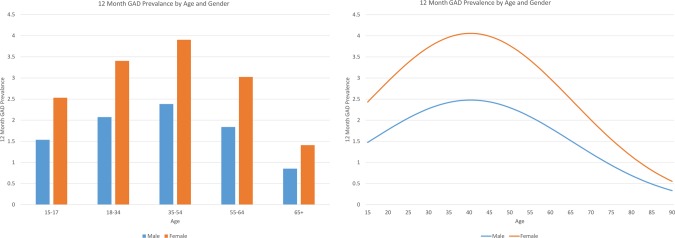
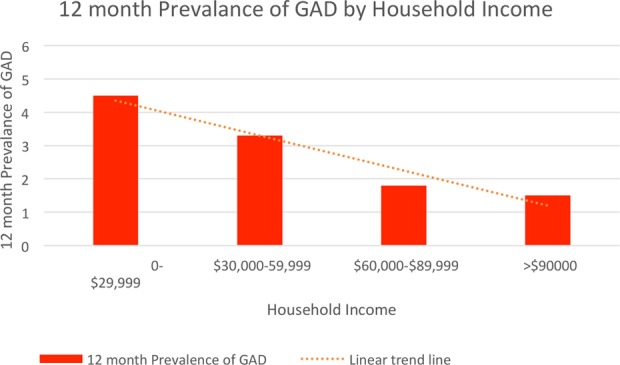
Results: The lifetime prevalence of GAD is 8.7% (95% CI, 8.2% to 9.3%), and the 12-month prevalence is 2.6% (95% CI, 2.3% to 2.8%). GAD is significantly associated with being female (OR 1.6; 95% CI, 1.3 to 2.1); being middle-aged (age 35-54 years) (OR 1.6; 95% CI, 1.0 to 2.7); being single, widowed, or divorced (OR 1.9; 95% CI, 1.4 to 2.6); being unemployed (OR 1.9; 95% CI, 1.5 to 2.5); having a low household income (<$30 000) (OR 3.2; 95% CI, 2.3 to 4.5); and being born in Canada (OR 2.0; 95% CI, 1.4 to 2.8).
Conclusions: The prevalence of GAD was slightly higher than international estimates, with similar associated demographic variables. As expected, GAD was highly comorbid with other psychiatric conditions but also with indicators of pain, stress, stigma, and health care utilization. Independent of comorbid conditions, GAD showed a significant degree of impact on both the individual and society. Our results show that GAD is a common mental disorder within Canada, and it deserves significant attention in health care planning and programs.
Objectif:: La première enquête nationale qui a évalué la prévalence du trouble d’anxiété généralisée (TAG) au Canada a été l’Enquête sur la santé dans les collectivités canadiennes – Santé mentale (ESCC – SM) de 2012. L’entrevue WMH-CIDI, utilisée dans l’échantillon représentatif de l’ESCC – SM, offre la meilleure description disponible de l’épidémiologie de cette affection au Canada. Cette étude décrit l’épidémiologie du TAG à l’aide des données de l’ESCC – SM.
Méthode:: L’analyse a estimé les proportions, les rapports de cotes, et utilisé les modèles de régression logistique. Tous les résultats produits utilisaient les procédures de poids d’échantillonnage appropriées et d’estimation de variance bootstrap.
Résultats:: La prévalence du TAG de durée de vie est de 8,7% (IC à 95% 8,2 à 9,3), et la prévalence de 12 mois est de 2,6% (IC à 95% 2,3 à 2,8). Le TAG est significativement associé au fait d’être femme (RC 1,6; IC à 95% 1,3 à 2,1), d’âge moyen (âge 35-54; RC 1,6; IC à 95% 1,0 à 2,7), célibataire, veuf ou divorcé (RC 1,9; IC à 95% 1,4 à 2,6), sans emploi (RC 1,9; IC à 95% 1,5 à 2,5), d’avoir un faible revenu du ménage (< 30 000 $) (RC 3,2; IC à 95% 2,3 à 4,5) et d’être né au Canada (RC 2,0; IC à 95% 1,4 à 2,8).
Conclusions:: La prévalence du TAG était légèrement plus élevée que les estimations internationales, avec des variables démographiques associées semblables. Comme prévu, le TAG était très comorbide avec d’autres affections psychiatriques, mais aussi avec des indicateurs de douleur, de stress, de stigmates et d’utilisation des soins de santé. Indépendamment des affections comorbides, le TAG révélait un degré significatif d’impact sur la personne et la société. Nos résultats indiquent que le TAG est un trouble mental commun au Canada, et qu’il mérite une attention significative dans la planification et les programmes de soins de santé.
Keywords: anxiety; cross-sectional studies; epidemiology; generalized anxiety disorder; major depressive disorder; population studies.
Conflict of interest statement
The author(s) declared no potential conflicts of interest with respect to the research, authorship, and/or publication of this article.
Figures
References
-
- Global Burden of Disease. Seattle, WA: Institute for Health Metrics and Evaluation; 2015. [Accessed 8 April 2016]. Available at: http://vizhub.healthdata.org/gbd-compare/
-
- Wittchen HU. Generalized anxiety disorder: prevalence, burden, and cost to society. Depress Anxiety. 2002;16(4):162–171. - PubMed
-
- Lieb R, Becker E, Altamura C. The epidemiology of generalized anxiety disorder in Europe. Eur Neuropsychopharmacol. 2005;15(4):445–452. - PubMed
-
- Pearson C, Janz T, Ali J. Mental and substance use disorders in Canada. Health at a Glance. Statistics Canada Catalogue no. 82-624-X. Ottawa (ON): Statistics Canada; 2013.
-
- Kessler RC, Keller MB, Wittchen H-U. The epidemiology of generalized anxiety disorder. Psychiatr Clin North Am. 2001;24(1):19–39. - PubMed
Publication types
MeSH terms
LinkOut - more resources
Full Text Sources
Other Literature Sources
Medical
Research Materials
