


Social support and the self-rated health of older people: A comparative study in Tainan Taiwan and Fuzhou Fujian province
- PMID: 27310979
- PMCID: PMC4998465
- DOI: 10.1097/MD.0000000000003881
Social support and the self-rated health of older people: A comparative study in Tainan Taiwan and Fuzhou Fujian province
Erratum in
-
Erratum: Medicine, Volume 95, Issue 24: Erratum.Medicine (Baltimore). 2016 Aug 7;95(31):e5074. doi: 10.1097/01.md.0000490009.39850.74. eCollection 2016 Aug. Medicine (Baltimore). 2016. PMID: 31265618 Free PMC article.
Abstract
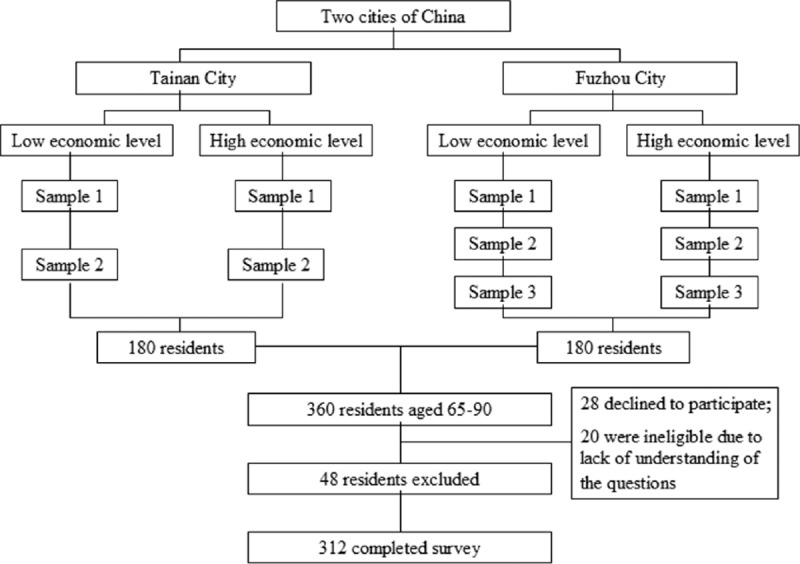
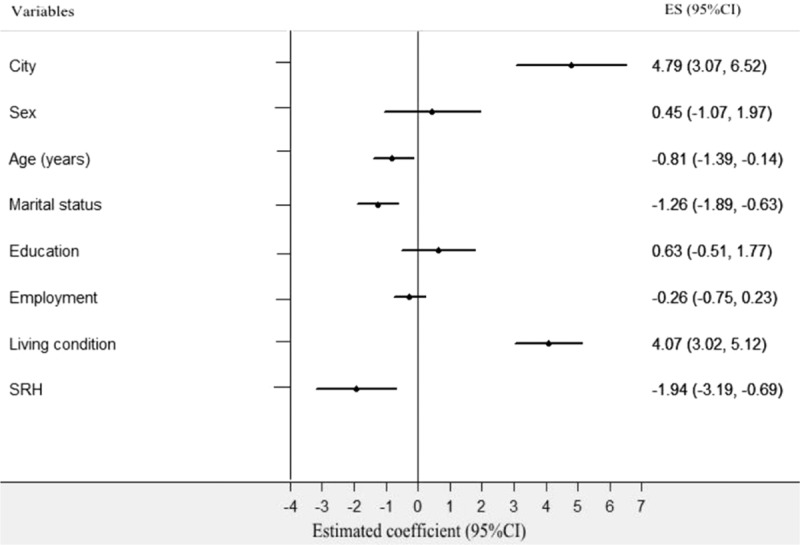
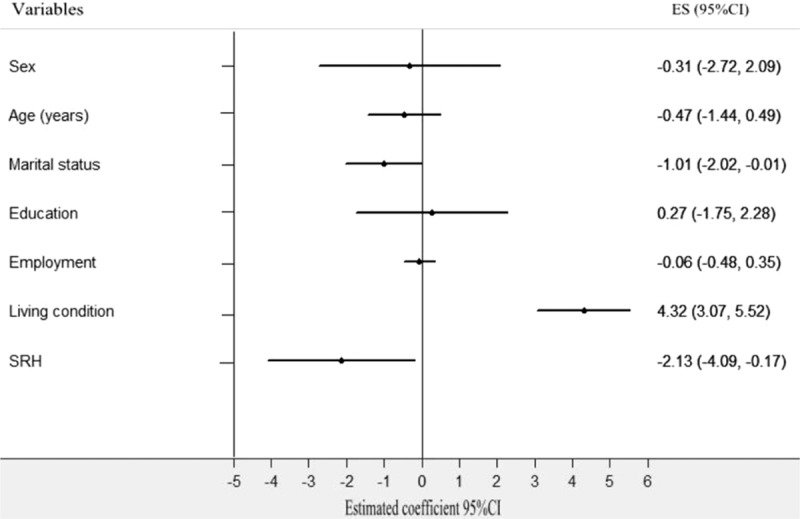
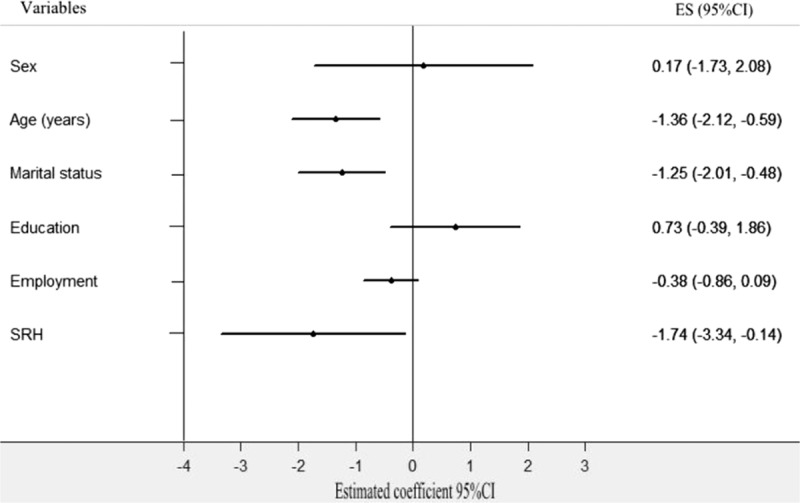
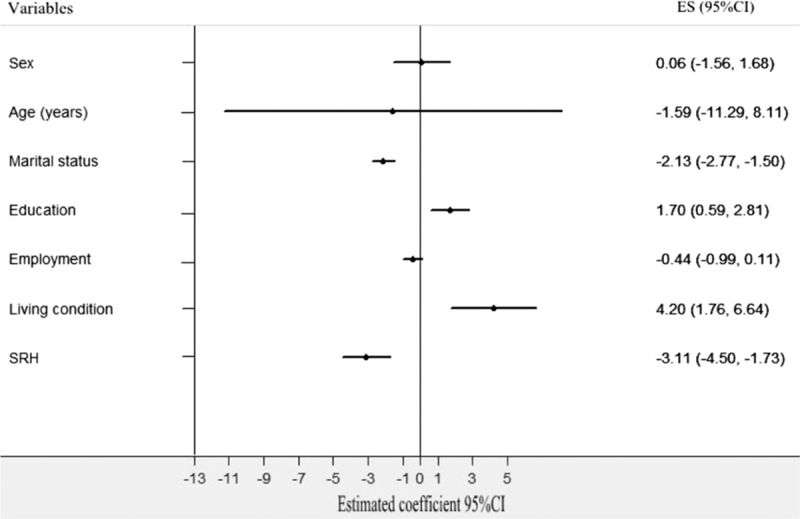
The lack of social support in elderly populations incurs real societal costs and can lead to their poor health. The aim of this study is to investigate the self-rated health (SRH) and social support among older people as well as its associated factors.We conducted a cross-sectional study among 312 urban community-dwelling elderly aged 65 to 90 years in Tainan Taiwan and Fuzhou Fujian Province from March 2012 to October 2012. A Spearson correlation test, independent t test, a Pearson χ test, a linear regression analysis, and a multiple-level model were performed to analyze the results.The participants identified children as the most important source of objective and subjective support, followed by spouse and relatives. Tainan's elderly received more daily life assistance and emotional support, showed stronger awareness of the need to seek help, and maintained a higher frequency of social interactions compared with the elderly in Fuzhou. The mean objective support, subjective support, and support utilization scores as well as the overall social support among Tainan's elderly were significantly high compared with the scores among Fuzhou's elderly. Further, Tainan's elderly rated better SRH than Fuzhou's elderly. Correlation analysis showed that social support was significantly correlated with city, age, living conditions, marital status, and SRH. Multiple linear regression analysis, with social support as a dependent variable, retained the following independent predictors in the final regression model: city (4.792, 95% confidence interval [CI]: 3.068-6.516, P = 0.000), age (-0.805, 95% CI: -1.394 to -0.135, P = 0.013), marital status (-1.260, 95% CI: -1.891 to -0.629, P = 0.000), living conditions (4.069, 95% CI: 3.022-5.116, P = 0.000), and SRH -1.941, 95% CI: -3.194 to -0.688, P = 0.003). The multiple-level model showed that city would impact older people's social support (χ = 5.103, P < 0.001). Marital status (-2.133, 95% CI: -2.768 to -1.499, P = 0.000), education (1.697, 95% CI: 0.589-2.805 P = 0.003), living conditions (4.20, 95% CI: 1.762-6.638, P = 0.000), and SRH (-3.144, 95% CI: -4.502 to -1.727, P = 0.000) were the associated factors. Thus, city, age, marital status, education, living conditions, and SRH might be the associated factors for social support among older people.This study presents some feasible implications for social support improvement in China and in other nations worldwide.
Conflict of interest statement
The authors report no conflicts of interest.
Figures
References
-
- Burke KE, Schnittger R, O’Dea B, et al. Factors associated with perceived health in older adult Irish population. Aging Ment Health 2012;16:288–95. - PubMed
-
- Kalache A, Barreto SM, Keller I. Johnson M. Global ageing: the demographic revolution in All cultures and societies. The Cambridge Handbook of Age, Ageing. Cambridge: Cambridge University Press; 2005. 30–46.
-
- Bowling A, Gabriel Z. An international model of quality of life in older age. Results from the ESRC? MRC HSRC quality of life survey in Britain. Soc Indic Res 2004;69:1–36.
Publication types
MeSH terms
LinkOut - more resources
Full Text Sources
Other Literature Sources
