


The anatomy of clinical decision-making in multidisciplinary cancer meetings: A cross-sectional observational study of teams in a natural context
- PMID: 27310981
- PMCID: PMC4998467
- DOI: 10.1097/MD.0000000000003885
The anatomy of clinical decision-making in multidisciplinary cancer meetings: A cross-sectional observational study of teams in a natural context
Erratum in
-
Erratum: Medicine, Volume 95, Issue 24: Erratum.Medicine (Baltimore). 2016 Aug 7;95(31):e5074. doi: 10.1097/01.md.0000490009.39850.74. eCollection 2016 Aug. Medicine (Baltimore). 2016. PMID: 31265618 Free PMC article.
Abstract
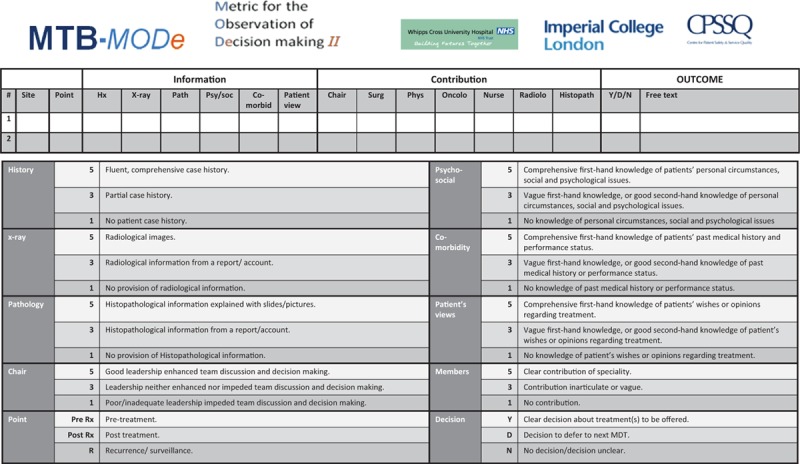
In the UK, treatment recommendations for patients with cancer are routinely made by multidisciplinary teams in weekly meetings. However, their performance is variable.The aim of this study was to explore the underlying structure of multidisciplinary decision-making process, and examine how it relates to team ability to reach a decision.This is a cross-sectional observational study consisting of 1045 patient reviews across 4 multidisciplinary cancer teams from teaching and community hospitals in London, UK, from 2010 to 2014. Meetings were chaired by surgeons.We used a validated observational instrument (Metric for the Observation of Decision-making in Cancer Multidisciplinary Meetings) consisting of 13 items to assess the decision-making process of each patient discussion. Rated on a 5-point scale, the items measured quality of presented patient information, and contributions to review by individual disciplines. A dichotomous outcome (yes/no) measured team ability to reach a decision. Ratings were submitted to Exploratory Factor Analysis and regression analysis.The exploratory factor analysis produced 4 factors, labeled "Holistic and Clinical inputs" (patient views, psychosocial aspects, patient history, comorbidities, oncologists', nurses', and surgeons' inputs), "Radiology" (radiology results, radiologists' inputs), "Pathology" (pathology results, pathologists' inputs), and "Meeting Management" (meeting chairs' and coordinators' inputs). A negative cross-loading was observed from surgeons' input on the fourth factor with a follow-up analysis showing negative correlation (r = -0.19, P < 0.001). In logistic regression, all 4 factors predicted team ability to reach a decision (P < 0.001).Hawthorne effect is the main limitation of the study.The decision-making process in cancer meetings is driven by 4 underlying factors representing the complete patient profile and contributions to case review by all core disciplines. Evidence of dual-task interference was observed in relation to the meeting chairs' input and their corresponding surgical input into case reviews.
Conflict of interest statement
The authors report no conflicts of interest.
Figures

References
-
- The Department of Health. Manual for cancer services. London, UK: The Department of Health; 2004.
-
- Hong NJ, Wright EF, Gagliardi AR, Paszat LF. Examining the potential relationship between multidisciplinary cancer care and patient survival: an international literature review. J Surg Oncol 2010;1022:125–34. - PubMed
-
- The Department of Health. National peer review report: Cancer services 2012/2013. London, UK: The Department of Health; 2013.
-
- Lamb BW, Wong HWL, Vincent C, et al. Teamwork and team performance in multidisciplinary cancer teams: development of an observational assessment tool. BMJ Qual Saf 2013;20:849–56. - PubMed
-
- Lamb BW, Green JSA, Benn J, et al. Improving decision-making in multidisciplinary tumor boards: prospective longitudinal evaluation of multicomponent intervention for 1,421 patients. J Am Coll Surg 2013;2173:412–20. - PubMed
Publication types
MeSH terms
LinkOut - more resources
Full Text Sources
Other Literature Sources
