


Significant interarm blood pressure difference predicts cardiovascular risk in hypertensive patients: CoCoNet study
- PMID: 27310982
- PMCID: PMC4998468
- DOI: 10.1097/MD.0000000000003888
Significant interarm blood pressure difference predicts cardiovascular risk in hypertensive patients: CoCoNet study
Erratum in
-
Erratum: Medicine, Volume 95, Issue 24: Erratum.Medicine (Baltimore). 2016 Aug 7;95(31):e5074. doi: 10.1097/01.md.0000490009.39850.74. eCollection 2016 Aug. Medicine (Baltimore). 2016. PMID: 31265618 Free PMC article.
-
Erratum: Significant interarm blood pressure difference predicts cardiovascular risk in hypertensive patients: CoCoNet study: Erratum.Medicine (Baltimore). 2016 Aug 26;95(34):e68bf. doi: 10.1097/01.md.0000494761.18368.bf. eCollection 2016 Aug. Medicine (Baltimore). 2016. PMID: 31265633 Free PMC article.
Abstract
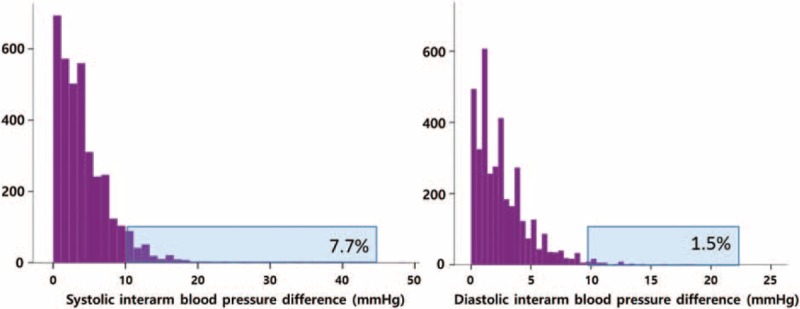
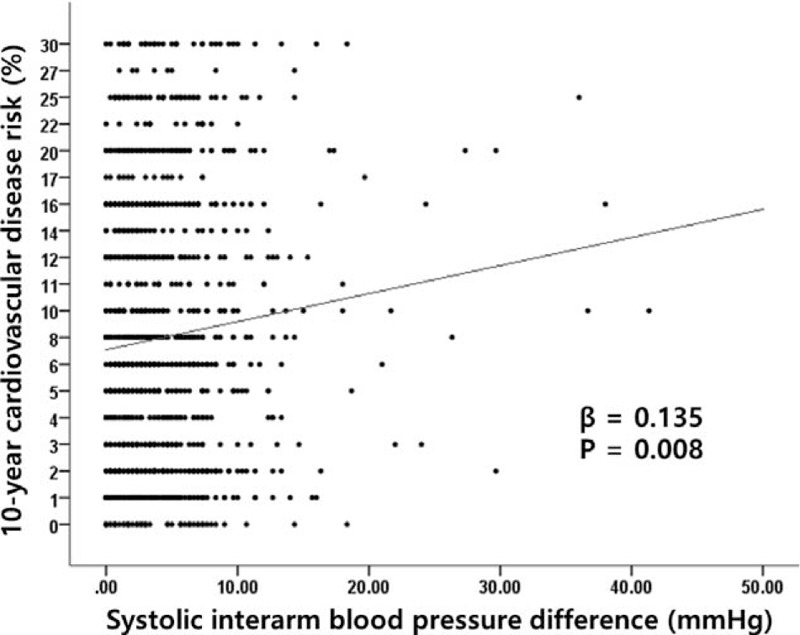
There has been a rising interest in interarm blood pressure difference (IAD), due to its relationship with peripheral arterial disease and its possible relationship with cardiovascular disease. This study aimed to characterize hypertensive patients with a significant IAD in relation to cardiovascular risk. A total of 3699 patients (mean age, 61 ± 11 years) were prospectively enrolled in the study. Blood pressure (BP) was measured simultaneously in both arms 3 times using an automated cuff-oscillometric device. IAD was defined as the absolute difference in averaged BPs between the left and right arm, and an IAD ≥ 10 mm Hg was considered to be significant. The Framingham risk score was used to calculate the 10-year cardiovascular risk. The mean systolic IAD (sIAD) was 4.3 ± 4.1 mm Hg, and 285 (7.7%) patients showed significant sIAD. Patients with significant sIAD showed larger body mass index (P < 0.001), greater systolic BP (P = 0.050), more coronary artery disease (relative risk = 1.356, P = 0.034), and more cerebrovascular disease (relative risk = 1.521, P = 0.072). The mean 10-year cardiovascular risk was 9.3 ± 7.7%. By multiple regression, sIAD was significantly but weakly correlated with the 10-year cardiovascular risk (β = 0.135, P = 0.008). Patients with significant sIAD showed a higher prevalence of coronary artery disease, as well as an increase in 10-year cardiovascular risk. Therefore, accurate measurements of sIAD may serve as a simple and cost-effective tool for predicting cardiovascular risk in clinical settings.
Conflict of interest statement
The authors have no conflicts of interest to disclose.
Figures
References
-
- Hensen H. Beiträge zur Physiologie und Pathologie des Blutdrucks. Naumburg a. S.: Lippert & Co.; 1900.
-
- Clark CE. Difference in blood pressure measurements between arms: methodological and clinical implications. Curr Pharm Des 2015;21:737–43. - PubMed
-
- Fonseca-Reyes S, Forsyth-MacQuarrie AM, Garcia de Alba-Garcia JE. Simultaneous blood pressure measurement in both arms in hypertensive and nonhypertensive adult patients. Blood Press Monit 2012;17:149–54. - PubMed
-
- Clark CE, Steele AM, Taylor RS, et al. Interarm blood pressure difference in people with diabetes: measurement and vascular and mortality implications: a cohort study. Diabetes Care 2014;37:1613–20. - PubMed
-
- Tanaka Y, Fukui M, Tanaka M, et al. The inter-arm difference in systolic blood pressure is a novel risk marker for subclinical atherosclerosis in patients with type 2 diabetes. Hypertens Res 2014;37:548–52. - PubMed
Publication types
MeSH terms
LinkOut - more resources
Full Text Sources
Other Literature Sources
Medical
