


Impact of Age on the Prognosis of Operable Gastric Cancer Patients: An Analysis Based on SEER Database
- PMID: 27311007
- PMCID: PMC4998493
- DOI: 10.1097/MD.0000000000003944
Impact of Age on the Prognosis of Operable Gastric Cancer Patients: An Analysis Based on SEER Database
Erratum in
-
Erratum: Medicine, Volume 95, Issue 24: Erratum.Medicine (Baltimore). 2016 Aug 7;95(31):e5074. doi: 10.1097/01.md.0000490009.39850.74. eCollection 2016 Aug. Medicine (Baltimore). 2016. PMID: 31265618 Free PMC article.
-
Erratum: Impact of Age on the Prognosis of Operable Gastric Cancer Patients: An Analysis Based on SEER Database: Erratum.Medicine (Baltimore). 2016 Aug 26;95(34):e21ed. doi: 10.1097/01.md.0000494763.03121.ed. eCollection 2016 Aug. Medicine (Baltimore). 2016. PMID: 31265626 Free PMC article.
Abstract
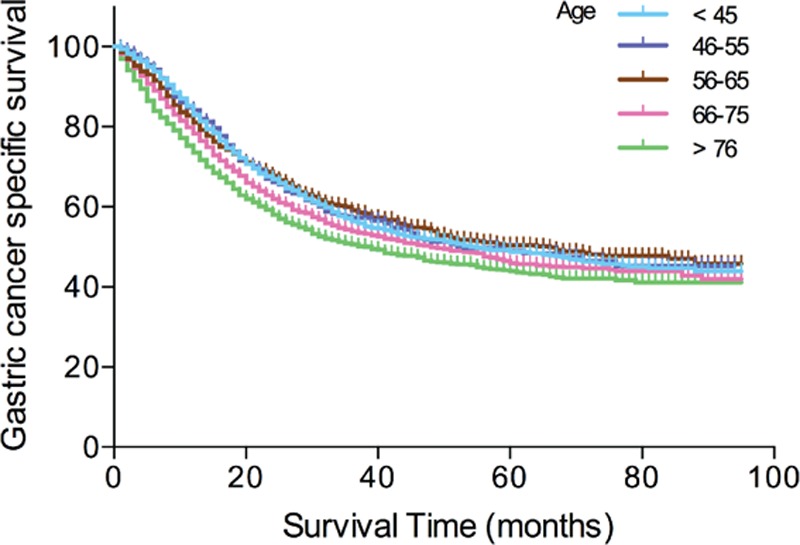
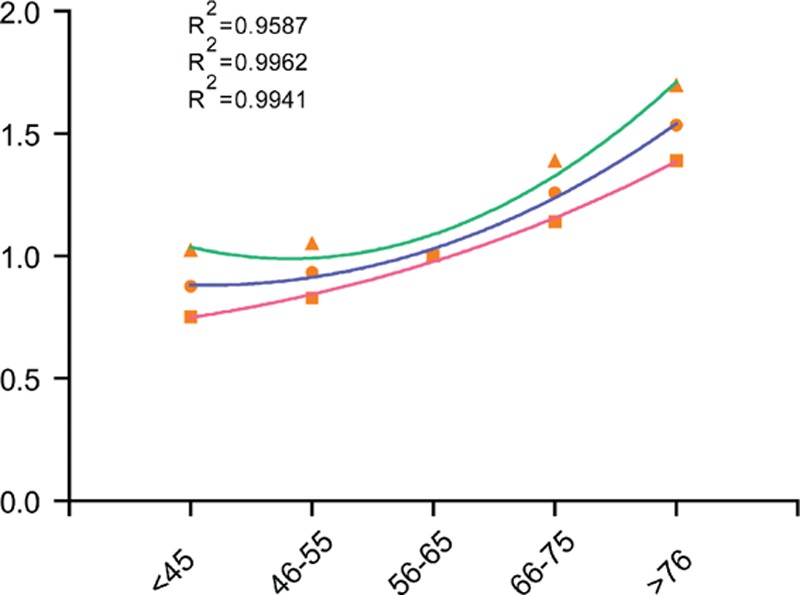
To investigate the impact of age on the clinicopathological features and survival of patients with gastric cancer (GC), and hope to better define age-specific patterns of GC and possible associated risk factors.Using the surveillance, epidemiology, and end results (SEER) database to search the patients who diagnosed GC between 2007 and 2011 with a known age. The overall and 5-year gastric cancer specific survival (CSS) data were obtained using Kaplan-Meier plots. Multivariable Cox regression models were built for the analysis of long-term survival outcomes and risk factors.A total of 7762 GC patients treated with surgery during the 4-year study period were included in the final study cohort. We divided into five subgroups according to the different age ranges. The overall 5-year cause-specific survival (CSS) was 60.3% in Group 1 (below 45 years), 60.3% in the Group 2 (45-55 years), 61.2% in Group 3 (56-65 years), 59.2% in Group 4 (66-75 years), and 59.2% in Group 5 (older than 76 years). Kaplan-Meier plots showed that patients older than 76 years had the worst 5-year CSS of 56.0% rate in all the subgroups. Age, tumor size, primary site, histological type, and Tumor Node Metastasis stage were identified as significant risk factors for poor survival on univariate analysis (all P < 0.001, log-rank test). Additionally, as the age increased, the risk of death for GC demonstrated a significant increase.In conclusion, our analysis of the SEER database revealed that the prognosis of GC varies with age. Patients at age 56 to 65 group have more favorable clinicopathologic characteristics and better CSS than other groups.
Conflict of interest statement
The authors have no conflicts of interest to disclose.
Figures
References
-
- Siegel RL, Miller KD, Jemal A. Cancer statistics, 2015. CA Cancer J Clin 2015;65:5–29. - PubMed
-
- Noh SH, Park SR, Yang HK, et al. Adjuvant capecitabine plus oxaliplatin for gastric cancer after D2 gastrectomy (CLASSIC): 5-year follow-up of an open-label, randomised phase 3 trial. Lancet Oncol 2014;15:1389–96. - PubMed
-
- Ferlay J, Shin HR, Bray F, et al. Estimates of worldwide burden of cancer in 2008: GLOBOCAN 2008. Int J Cancer 2010;127:2893–917. - PubMed
-
- Takatsu Y, Hiki N, Nunobe S, et al. Clinicopathological features of gastric cancer in young patients. Gastric Cancer 2016;19:472–8. - PubMed
Publication types
MeSH terms
LinkOut - more resources
Full Text Sources
Other Literature Sources
Medical
Miscellaneous
