


Reversion of β-Cell Autoimmunity Changes Risk of Type 1 Diabetes: TEDDY Study
- PMID: 27311490
- PMCID: PMC5001144
- DOI: 10.2337/dc16-0181
Reversion of β-Cell Autoimmunity Changes Risk of Type 1 Diabetes: TEDDY Study
Abstract
Objective: β-Cell autoantibodies are a feature of the preclinical phase of type 1 diabetes. Here, we asked how frequently they revert in a cohort of children at risk for type 1 diabetes and whether reversion has any effect on type 1 diabetes risk.
Research design and methods: Children were up to 10 years of age and screened more than once for insulin autoantibody, GAD antibody, and insulinoma antigen-2 antibodies. Persistent autoantibody was defined as an autoantibody present on two or more consecutive visits and confirmed in two reference laboratories. Reversion was defined as two or more consecutive negative visits after persistence. Time-dependent Cox regression was used to examine how reversion modified the risk of development of multiple autoantibodies and type 1 diabetes.
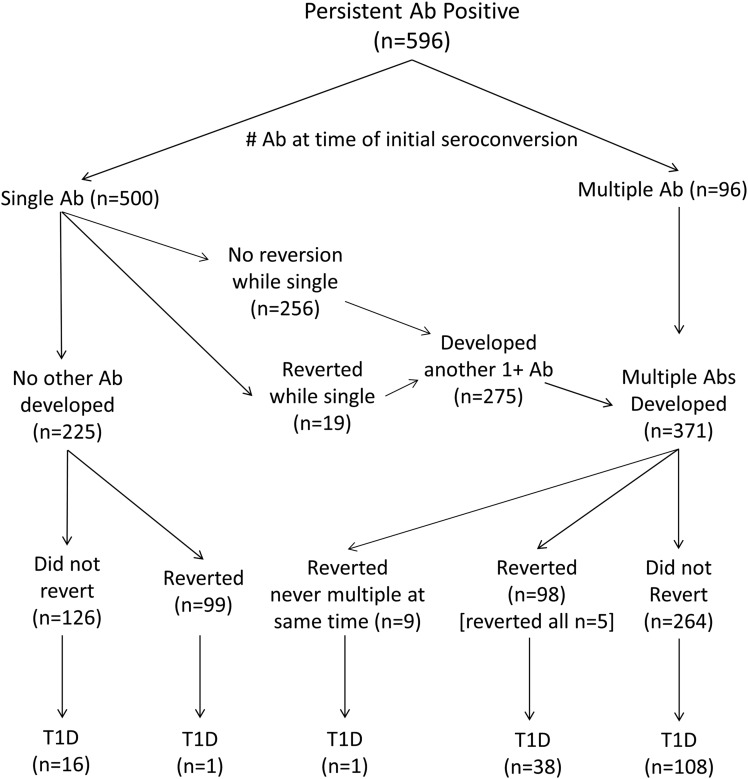
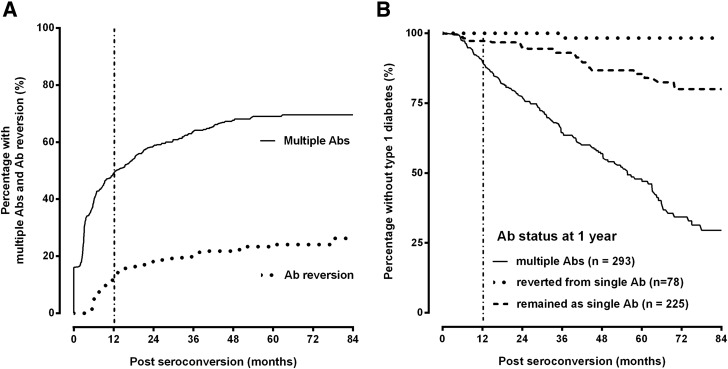
Results: Reversion was relatively frequent for autoantibodies to GAD65 (19%) and insulin (29%), but was largely restricted to children who had single autoantibodies (24%) and rare in children who had developed multiple autoantibodies (<1%). Most (85%) reversion of single autoantibodies occurred within 2 years of seroconversion. Reversion was associated with HLA genotype, age, and decreasing titer. Children who reverted from single autoantibodies to autoantibody negative had, from birth, a risk for type 1 diabetes of 0.14 per 100 person-years; children who never developed autoantibodies, 0.06 per 100 person-years; and, children who remained single-autoantibody positive, 1.8 per 100 person-years.
Conclusions: Type 1 diabetes risk remained high in children who had developed multiple β-cell autoantibodies even when individual autoantibodies reverted. We suggest that monitoring children with single autoantibodies for at least 1 year after seroconversion is beneficial for stratification of type 1 diabetes risk.
© 2016 by the American Diabetes Association.
Figures
References
-
- Bingley PJ, Bonifacio E, Williams AJ, Genovese S, Bottazzo GF, Gale EA. Prediction of IDDM in the general population: strategies based on combinations of autoantibody markers. Diabetes 1997; 46:1701–1710 - PubMed
-
- Bonifacio E, Bingley PJ. Islet autoantibodies and their use in predicting insulin-dependent diabetes. Acta Diabetol 1997;34:185–193 - PubMed
-
- Kimpimäki T, Kulmala P, Savola K, et al. . Natural history of beta-cell autoimmunity in young children with increased genetic susceptibility to type 1 diabetes recruited from the general population. J Clin Endocrinol Metab 2002;87:4572–4579 - PubMed
MeSH terms
Substances
Grants and funding
- U01 DK063821/DK/NIDDK NIH HHS/United States
- UC4 DK063863/DK/NIDDK NIH HHS/United States
- HHSN267200700014C/DK/NIDDK NIH HHS/United States
- U01 DK063861/DK/NIDDK NIH HHS/United States
- UL1 TR001427/TR/NCATS NIH HHS/United States
- U01 DK063790/DK/NIDDK NIH HHS/United States
- UL1 TR001082/TR/NCATS NIH HHS/United States
- UL1 TR000064/TR/NCATS NIH HHS/United States
- U01 DK063836/DK/NIDDK NIH HHS/United States
- U01 DK063829/DK/NIDDK NIH HHS/United States
- U01 DK063865/DK/NIDDK NIH HHS/United States
- UC4 DK095300/DK/NIDDK NIH HHS/United States
- UC4 DK063861/DK/NIDDK NIH HHS/United States
- UC4 DK063829/DK/NIDDK NIH HHS/United States
- UC4 DK063821/DK/NIDDK NIH HHS/United States
- UC4 DK117483/DK/NIDDK NIH HHS/United States
- UC4 DK063836/DK/NIDDK NIH HHS/United States
- UC4 DK112243/DK/NIDDK NIH HHS/United States
- UC4 DK063865/DK/NIDDK NIH HHS/United States
- U01 DK063863/DK/NIDDK NIH HHS/United States
- UC4 DK106955/DK/NIDDK NIH HHS/United States
- UC4 DK100238/DK/NIDDK NIH HHS/United States
LinkOut - more resources
Full Text Sources
Other Literature Sources
Medical
Research Materials
