


Exercise as an adjunctive treatment for cannabis use disorder
- PMID: 27314543
- PMCID: PMC5055462
- DOI: 10.1080/00952990.2016.1185434
Exercise as an adjunctive treatment for cannabis use disorder
Abstract
Background: Despite cannabis being the most widely used illicit substance in the United States, individuals diagnosed with cannabis use disorder (CUD) have few well-researched, affordable treatment options available to them. Although found to be effective for improving treatment outcomes in other drug populations, exercise is an affordable and highly accessible treatment approach that has not been routinely investigated in cannabis users.
Objectives: The aim of this paper is to inform the topic regarding exercise's potential as an adjunctive treatment for individuals with CUD.
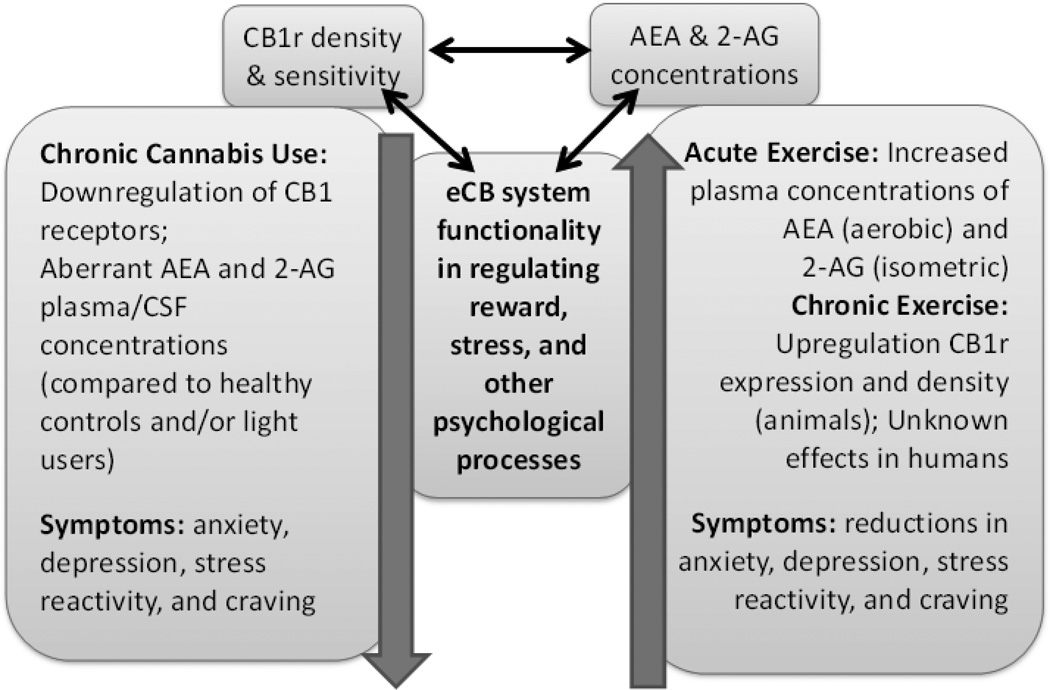
Methods: We reviewed the evidence surrounding cannabis use and its current treatment in the United States, explored the rationale for including exercise in the treatment of substance use disorders (SUDs), and in particular, proposed a biological mechanism (i.e., endocannabinoids (eCBs)) that should be examined when utilizing exercise for the treatment of CUD.
Results: Cannabis use is widespread and increasing in the United States. Chronic, heavy cannabis use may dysregulate the endogenous cannabinoid system, which has implications for several psychobiological processes that interact with the eCB system such as reward processing and the stress response. Given that exercise is a potent activator of the eCB system, it is mechanistically plausible that exercise could be an optimal method to supplement cessation efforts by reducing psychophysical withdrawal, managing stress, and attenuating drug cravings.
Conclusion: We suggest there is a strong behavioral and physiological rationale to design studies which specifically assess the efficacy of exercise, in combination with other therapies, in treating CUD. Moreover, it will be especially important to include the investigation of psychobiological mechanisms (e.g., eCBs, hippocampal volume), which have been associated with both exercise and SUDs, to examine the broader impact of exercise on behavioral and physiological responses to treatment.
Keywords: Exercise; anandamide; cannabis use disorder; endocannabinoid; treatment.
Figures
References
-
- Center for Behavior Health Statistics and Quality. Rockville, MD: Substance Abuse and Mental Health Services Administration; 2015. Behavioral Health Trends in the United States: Results from the 2014 National Survey on Drug Use and Health (HHS Publication No. SMA 15-4927, NSDUH Series H-50)
-
- Mills B, Yepes A, Nugent K. Synthetic Cannabinoids. Am. J. Med. Sci. 2015;350:59–62. - PubMed
-
- National Institute on Drug Abuse. National Institutes of Health; U.S. Department of Health and Human Services. Treatment Approaches for Drug Addiction. [Revised January 2016]; Retrieved from http://www.drugabuse.gov/publications/drugfacts/treatment-approaches-dru....
Publication types
MeSH terms
Substances
Grants and funding
LinkOut - more resources
Full Text Sources
Other Literature Sources
Medical
