. 2016 Jun 18;17(1):84.
doi: 10.1186/s12863-016-0395-0.

Repetitive element hypermethylation in multiple sclerosis patients

Affiliations

Repetitive element hypermethylation in multiple sclerosis patients

K Y Neven et al. BMC Genet. .

Abstract

Background: Multiple sclerosis (MS) is a complex disorder of the central nervous system whose cause is currently unknown. Evidence is increasing that DNA methylation alterations could be involved in inflammatory and neurodegenerative diseases and could contribute to MS pathogenesis. Repetitive elements Alu, LINE-1 and SAT-α, are widely known as estimators of global DNA methylation. We investigated Alu, LINE-1 and SAT-α methylation levels to evaluate their difference in a case-control setup and their role as a marker of disability.

Results: We obtained blood samples from 51 MS patients and 137 healthy volunteers matched by gender, age and smoking. Methylation was assessed using bisulfite-PCR-pyrosequencing. For all participants, medical history, physical and neurological examinations and screening laboratory tests were collected. All repetitive elements were hypermethylated in MS patients compared to healthy controls. A lower Expanded Disability Status Scale (EDSS) score was associated with a lower levels of LINE-1 methylation for 'EDSS = 1.0' and '1.5 ≤ EDSS ≤ 2.5' compared to an EDSS higher than 3, while Alu was associated with a higher level of methylation in these groups: 'EDSS = 1.0' and '1.5 ≤ EDSS ≤ 2.5'.

Conclusions: MS patients exhibit an hypermethylation in repetitive elements compared to healthy controls. Alu and LINE-1 were associated with degree of EDSS score. Forthcoming studies focusing on epigenetics and the multifactorial pathogenetic mechanism of MS could elucidate these links further.

Keywords: DNA methylation; Epigenetics; Expanded disability status scale; Hypermethylation; Multiple sclerosis; Repetitive elements.


Figures
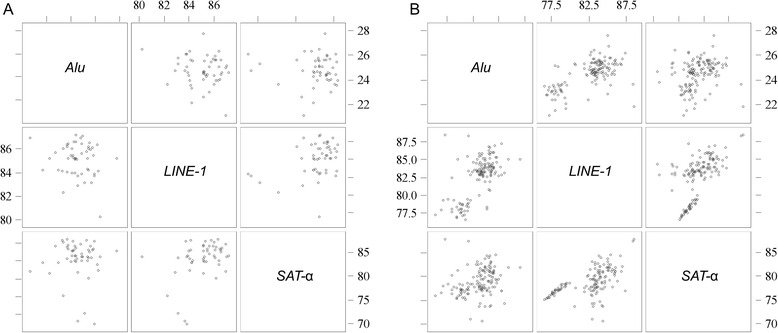
Fig. 1
Fig. 1
Scatter plot comparing Alu, LINE-1 and SAT-α methylation levels. In panel a, the correlation is represented for the MS patients, in panel b for the healthy controls. For the latter group, all repetitive elements were significantly correlated with each other in terms of methylation (Alu and LINE-1, ρ = 0.627; Alu and SAT-α, ρ = 0.253; LINE-1 and SAT-α, ρ = 0.559). In the MS patients, only LINE-1 methylation was significantly correlated with SAT-α methylation (ρ = 0.380). Significance level was set at 0.05
Fig. 2
Fig. 2
Methylation levels of Alu, LINE-1 and SAT-α in MS patients, grouped by Expanded Disability Status Scale (EDSS), are represented as box plots. Data were adjusted for age, sex and smoking habit. All groups had a similar number of individuals: 18 participants for ‘EDSS = 1.0’, 17 for ‘1.5 ≤ EDSS ≤ 2.5’ and 15 for ‘3.0 ≤ EDSS ≤ 7.5’. For both Alu and LINE-1 the highest EDSS group (the reference) was significantly different from the lower two groups. An absolute difference in methylation of 0.47 %5mC can be observed for ‘EDSS = 1’ (p = 0.034) and 0.63 %5mC for ‘1.5 ≤ EDSS ≤ 2.5’ (p = 0.007) compared with the reference group for Alu. In LINE-1, methylation decreased with 0.95 %5mC for ‘EDSS = 1’ (p = 0.050) and 1.07 % for ‘1.5 ≤ EDSS ≤ 2.5’ (p = 0.033) compared to the reference group. * p < 0.05

References

    1. Compston A, Coles A. Multiple Sclerosis. Lancet. 2008;372(9648):1502–17. doi: 10.1016/S0140-6736(08)61620-7. - DOI - PubMed
    1. Weinshenker BG. Natural history of multiple sclerosis. Ann Neurol. 1994;36:6–11. doi: 10.1002/ana.410360704. - DOI - PubMed
    1. Milo R, Kahana E. Multiple Sclerosis: geoepidemiology, genetics and the environment. Autoimmun Rev. 2010;9(5):387–94. doi: 10.1016/j.autrev.2009.11.010. - DOI - PubMed
    1. Steinman L. Multiple Sclerosis: a two-stage disease. Nat Immunol. 2001;2(9):762–4. doi: 10.1038/ni0901-762. - DOI - PubMed
    1. O’Gorman C, Lucas R, Taylor B. Environmental risk factors for multiple sclerosis: a review with a focus on molecular mechanisms. Int J Mol Sci. 2012;13(9):11718–52. doi: 10.3390/ijms130911718. - DOI - PMC - PubMed

Publication types
