


PhenoScanner: a database of human genotype-phenotype associations
- PMID: 27318201
- PMCID: PMC5048068
- DOI: 10.1093/bioinformatics/btw373
PhenoScanner: a database of human genotype-phenotype associations
Abstract
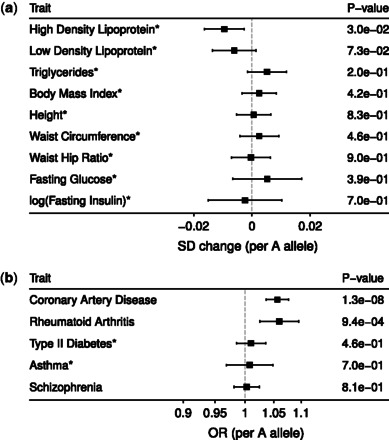
PhenoScanner is a curated database of publicly available results from large-scale genetic association studies. This tool aims to facilitate 'phenome scans', the cross-referencing of genetic variants with many phenotypes, to help aid understanding of disease pathways and biology. The database currently contains over 350 million association results and over 10 million unique genetic variants, mostly single nucleotide polymorphisms. It is accompanied by a web-based tool that queries the database for associations with user-specified variants, providing results according to the same effect and non-effect alleles for each input variant. The tool provides the option of searching for trait associations with proxies of the input variants, calculated using the European samples from 1000 Genomes and Hapmap.
Availability and implementation: PhenoScanner is available at www.phenoscanner.medschl.cam.ac.uk CONTACT: jrs95@medschl.cam.ac.ukSupplementary information: Supplementary data are available at Bioinformatics online.
© The Author 2016. Published by Oxford University Press.
Figures
References
-
- Burgess S., Thompson S.G. (2015) Mendelian Randomization: Methods for Using Genetic Variants in Causal Estimation. Chapman & Hall, Boca Raton, FL, USA.
MeSH terms
Grants and funding
LinkOut - more resources
Full Text Sources
Other Literature Sources
