


MMP-13 is one of the critical mediators of the effect of HDAC4 deletion on the skeleton
- PMID: 27320207
- PMCID: PMC4970950
- DOI: 10.1016/j.bone.2016.06.010
MMP-13 is one of the critical mediators of the effect of HDAC4 deletion on the skeleton
Abstract
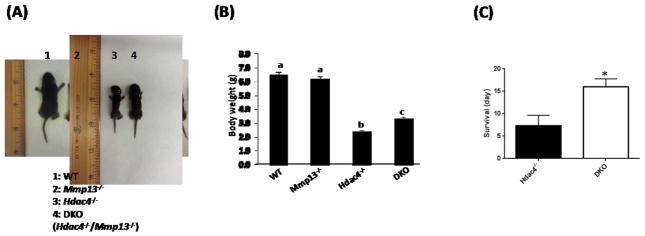
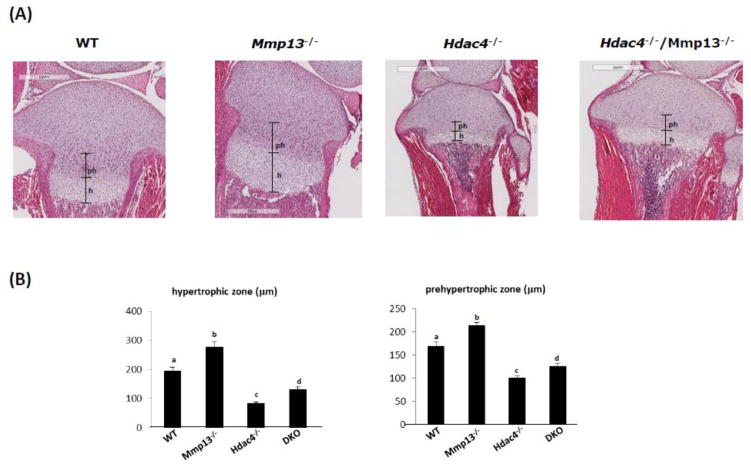
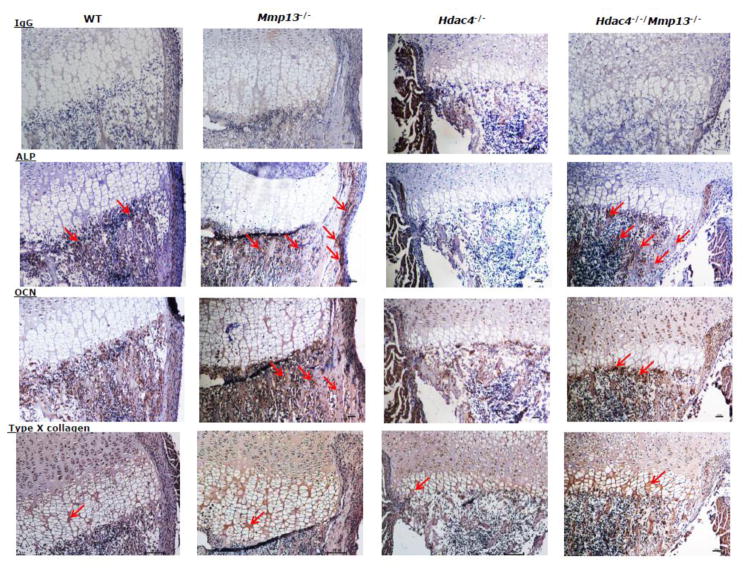
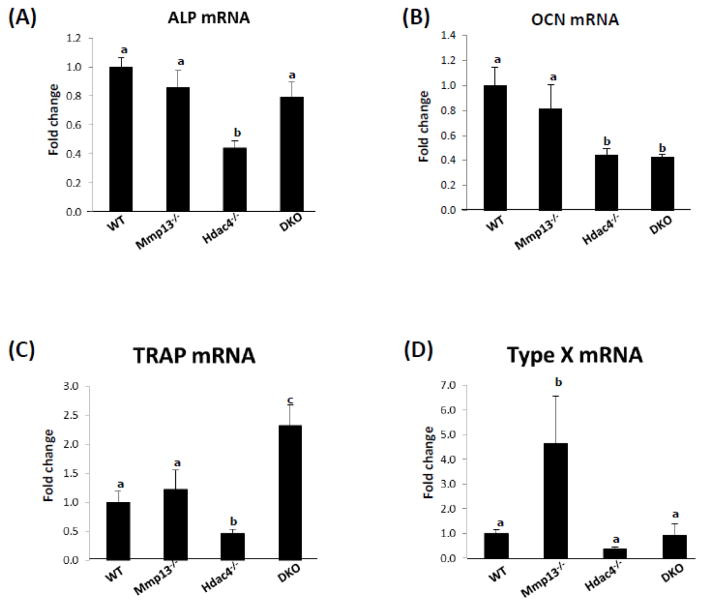
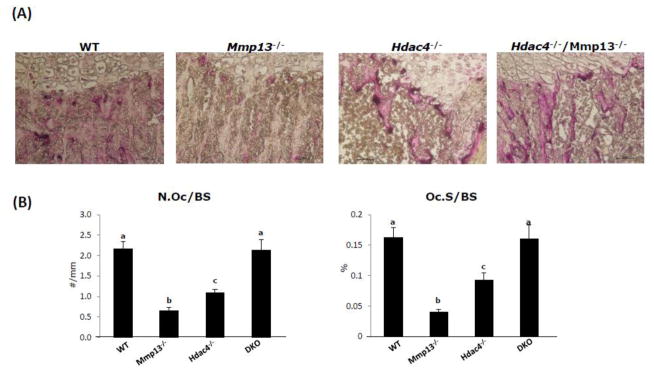
Histone deacetylase 4 (Hdac4) regulates chondrocyte hypertrophy. Hdac4(-/-) mice are runted in size and do not survive to weaning. This phenotype is primarily due to the acceleration of onset of chondrocyte hypertrophy and, as a consequence, inappropriate endochondral mineralization. Previously, we reported that Hdac4 is a repressor of matrix metalloproteinase-13 (Mmp13) transcription, and the absence of Hdac4 leads to increased expression of MMP-13 both in vitro (osteoblastic cells) and in vivo (hypertrophic chondrocytes and trabecular osteoblasts). MMP-13 is thought to be involved in endochondral ossification and bone remodeling. To identify whether the phenotype of Hdac4(-/-) mice is due to up-regulation of MMP-13, we generated Hdac4/Mmp13 double knockout mice and determined the ability of deletion of MMP-13 to rescue the Hdac4(-/-) mouse phenotype. Mmp13(-/-) mice have normal body size. Hdac4(-/-)/Mmp13(-/-) double knockout mice are significantly heavier and larger than Hdac4(-/-) mice, they survive longer, and they recover the thickness of their growth plate zones. In Hdac4(-/-)/Mmp13(-/-) double knockout mice, alkaline phosphatase (ALP) expression and TRAP-positive osteoclasts were restored (together with an increase in Mmp9 expression) but osteocalcin (OCN) was not. Micro-CT analysis of the tibiae revealed that Hdac4(-/-) mice have significantly decreased cortical bone area compared with the wild type mice. In addition, the bone architectural parameter, bone porosity, was significantly decreased in Hdac4(-/-) mice. Hdac4(-/-)/Mmp13(-/-) double knockout mice recover these cortical parameters. Likewise, Hdac4(-/-) mice exhibit significantly increased Tb.Th and bone mineral density (BMD) while the Hdac4(-/-)/Mmp13(-/-) mice significantly recovered these parameters toward normal for this age. Taken together, our findings indicate that the phenotype seen in the Hdac4(-/-) mice is partially derived from elevation in MMP-13 and may be due to a bone remodeling disorder caused by overexpression of this enzyme.
Keywords: Cortical bone; Hdac4; Hdac4(−/−)/Mmp13(−/−) double knockout; Mmp13.
Copyright © 2016 Elsevier Inc. All rights reserved.
Figures



References
-
- Vega RB, Matsuda K, Oh J, Barbosa AC, Yang X, Meadow E, McAnally J, Pomajzl C, Shelton JM, Richardson JA, Karsenty G, Olson EN. Histone deacetylase 4 controls chondrocyte hypertrophy during skeletogenesis. Cell. 2004;119:555–566. - PubMed
-
- Colnot CI, Helms JA. A molecular analysis of matrix remodeling and angiogenesis during long bone development. Mech Develop. 2001;100:245–250. - PubMed
-
- Maes C, Carmeliet P, Moermans K, Stockmans I, Smert N, Collen D, Bouillon R, Carmeliet G. Impaired angiogenesis and endochondral bone formation in mice lacking the vascular endothelial growth factor isoforms VEGF164 and VEGF188. Mech. Develop. 2002;111:61–73. - PubMed
-
- Zelzer E, Mamluck R, Ferrara N, Johnson RS, Schipani E, Olson BR. VEGFA is necessary for chondrocyte survival during bone development. Development and disease. 2004;131:2161–71. - PubMed
Publication types
MeSH terms
Substances
Grants and funding
LinkOut - more resources
Full Text Sources
Other Literature Sources
Molecular Biology Databases
Miscellaneous
