


Psychophysiological Associations with Gastrointestinal Symptomatology in Autism Spectrum Disorder
- PMID: 27321113
- PMCID: PMC5526214
- DOI: 10.1002/aur.1646
Psychophysiological Associations with Gastrointestinal Symptomatology in Autism Spectrum Disorder
Abstract
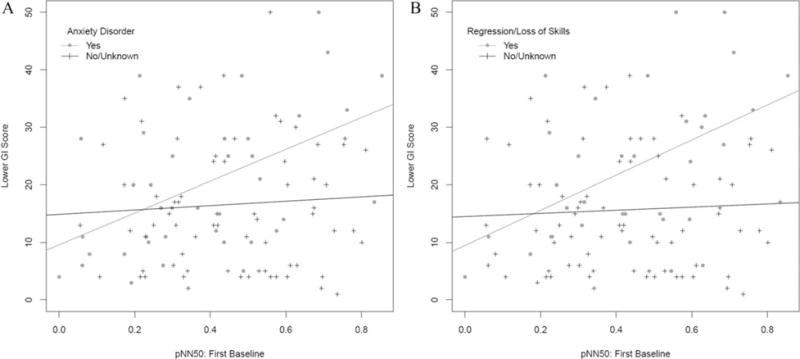
Autism spectrum disorder (ASD) is often accompanied by gastrointestinal disturbances, which also may impact behavior. Alterations in autonomic nervous system functioning are also frequently observed in ASD. The relationship between these findings in ASD is not known. We examined the relationship between gastrointestinal symptomatology, examining upper and lower gastrointestinal tract symptomatology separately, and autonomic nervous system functioning, as assessed by heart rate variability and skin conductance level, in a sample of 120 individuals with ASD. Relationships with co-occurring medical and psychiatric symptoms were also examined. While the number of participants with significant upper gastrointestinal tract problems was small in this sample, 42.5% of participants met criteria for functional constipation, a disorder of the lower gastrointestinal tract. Heart rate variability, a measure of parasympathetic modulation of cardiac activity, was found to be positively associated with lower gastrointestinal tract symptomatology at baseline. This relationship was particularly strong for participants with co-occurring diagnoses of anxiety disorder and for those with a history of regressive ASD or loss of previously acquired skills. These findings suggest that autonomic function and gastrointestinal problems are intertwined in children with ASD; although it is not possible to assess causality in this data set. Future work should examine the impact of treatment of gastrointestinal problems on autonomic function and anxiety, as well as the impact of anxiety treatment on gastrointestinal problems. Clinicians should be aware that gastrointestinal problems, anxiety, and autonomic dysfunction may cluster in children with ASD and should be addressed in a multidisciplinary treatment plan. Autism Res 2017, 10: 276-288. © 2016 International Society for Autism Research, Wiley Periodicals, Inc.
Keywords: anxiety; autism spectrum disorder; autonomic nervous system; constipation; gastrointestinal; parasympathetic; sympathetic.
© 2016 International Society for Autism Research, Wiley Periodicals, Inc.
Figures
References
-
- Aman MG, Singh NN, Stewart AW, Fields CJ. The Aberrant Behavior Checklist: A behavior rating scale for the assessment of treatment effects. American Journal of Mental Deficiency. 1985;89:485–491. - PubMed
-
- American Psychiatric Association. Diagnostic and statistical manual of mental disorders (4th edition-text revision) (DSM-IV-TR) Washington: American Psychiatric Association; 2000.
-
- American Psychiatric Association. Diagnostic and statistical manual of mental disorders: DSM-5. Washington: American Psychiatric Association; 2013.
-
- Aziz Q, Thompson DG. Brain-gut axis in health and disease. Gastroenterology. 1998;114:559–578. - PubMed
-
- Barry RJ, James AL. Coding of stimulus parameters in autistic, retarded, and normal children: evidence for a two-factor theory of autism. International Journal of Psychophysiology. 1988;6:139–149. - PubMed
MeSH terms
Grants and funding
LinkOut - more resources
Full Text Sources
Other Literature Sources
Medical
Miscellaneous
