


Cognitive Reserve and Postoperative Delirium in Older Adults
- PMID: 27321616
- PMCID: PMC4916859
- DOI: 10.1111/jgs.14130
Cognitive Reserve and Postoperative Delirium in Older Adults
Abstract
Objectives: To examine the role of cognitive reserve in reducing delirium incidence and severity in older adults undergoing surgery.
Design: Prospective cohort study.
Setting: Hospital.
Participants: Older adults (mean age 71.2, 65% women) undergoing elective orthopedic surgery (N = 142).
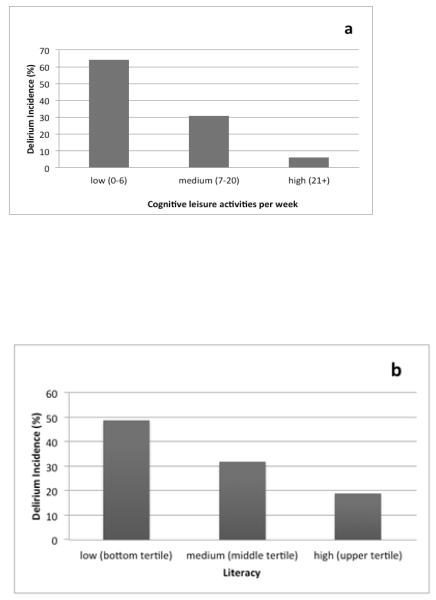
Measurements: Incidence (Confusion Assessment Method) and severity (Memorial Delirium Assessment Scale) of postoperative delirium were the primary outcomes. Predictors included early- (literacy) and late-life (cognitive activities) proxies for cognitive reserve.
Results: Forty-five participants (32%) developed delirium. Greater participation in cognitive activity was associated with lower incidence (odds ratio = 0.92 corresponding to increase of 1 activity per week, 95% confidence interval (CI) = 0.86-0.98, P = .006) and severity (B = -0.06, 95% CI = -0.11 to -0.01, P = .02) of delirium after adjustment for age, sex, medical illnesses, and baseline cognition. Greater literacy was not associated with lower delirium incidence or severity. Of individual leisure activities, reading books, using electronic mail, singing, and computer games were associated with lower dementia incidence and severity.
Conclusion: Greater late-life cognitive reserve was associated with lower delirium incidence and severity in older adults undergoing surgery. Interventions to enhance cognitive reserve by initiating or increasing participation in cognitive activities may be explored as a delirium prophylaxis strategy.
Keywords: cognitive reserve; delirium; epidemiology.
© 2016, Copyright the Authors Journal compilation © 2016, The American Geriatrics Society.
Figures
Comment in
-
Reply to Cognitive Reserve: Predictor of Onset of Postoperative Delirium in Older Adults?J Am Geriatr Soc. 2017 Mar;65(3):660-661. doi: 10.1111/jgs.14593. Epub 2016 Dec 28. J Am Geriatr Soc. 2017. PMID: 28029693 Free PMC article. No abstract available.
-
Cognitive Reserve: Predictor of Onset of Postoperative Delirium in Older Adults?J Am Geriatr Soc. 2017 Mar;65(3):659-660. doi: 10.1111/jgs.14581. Epub 2016 Dec 28. J Am Geriatr Soc. 2017. PMID: 28029707 No abstract available.
-
Re: Cognitive Reserve and Postoperative Delirium in Older Adults.J Urol. 2017 Jul;198(1):151-152. doi: 10.1016/j.juro.2017.03.111. Epub 2017 Mar 18. J Urol. 2017. PMID: 28618687 No abstract available.
References
-
- Witlox J, Eurelings LS, de Jonghe JF, et al. Delirium in elderly patients and the risk of postdischarge mortality, institutionalization, and dementia: A meta-analysis. JAMA. 2010;304:443–451. - PubMed
-
- Marcantonio E, Ta T, Duthie E, et al. Delirium severity and psychomotor types: their relationship with outcomes after hip fracture repair. J Am Geriatr Soc. 2002;50:850–857. - PubMed
Publication types
MeSH terms
Grants and funding
LinkOut - more resources
Full Text Sources
Other Literature Sources
Medical
