


Specific Metabolic Markers Are Associated with Future Waist-Gaining Phenotype in Women
- PMID: 27322650
- PMCID: PMC4920591
- DOI: 10.1371/journal.pone.0157733
Specific Metabolic Markers Are Associated with Future Waist-Gaining Phenotype in Women
Abstract
Objective: Our study aims to identify metabolic markers associated with either a gain in abdominal (measured by waist circumference) or peripheral (measured by hip circumference) body fat mass.
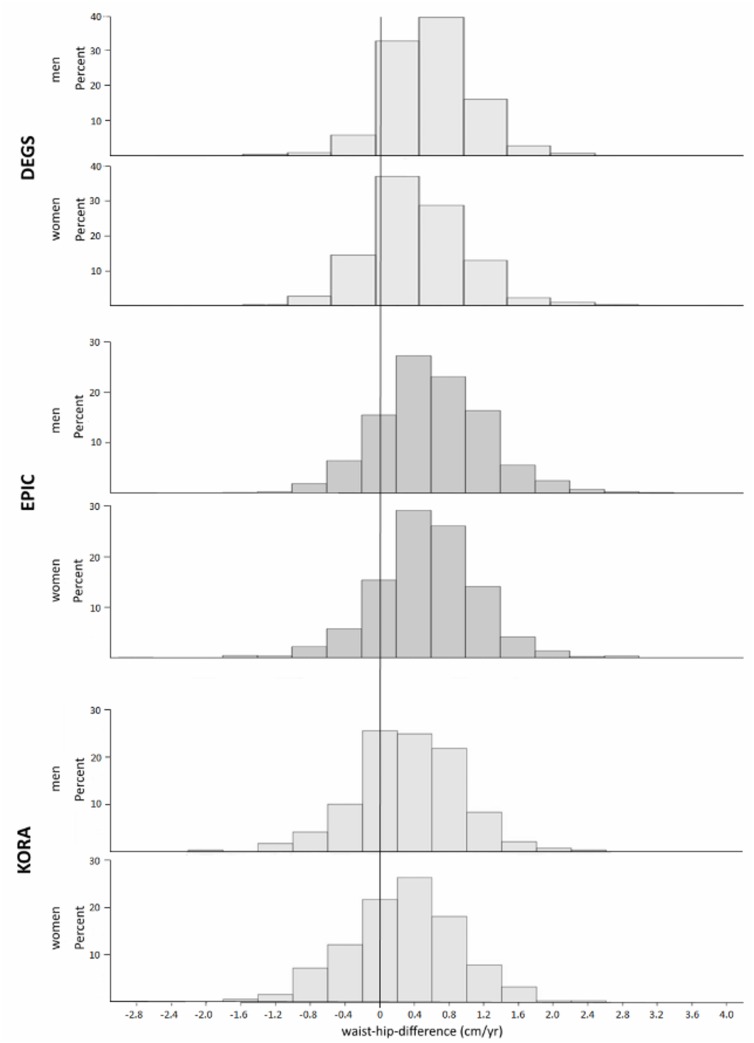
Methods: Data of 4 126 weight-gaining adults (18-75 years) from three population-based, prospective German cohort studies (EPIC, KORA, DEGS) were analysed regarding a waist-gaining (WG) or hip-gaining phenotype (HG). The phenotypes were obtained by calculating the differences of annual changes in waist minus hip circumference. The difference was displayed for all cohorts. The highest 10% of this difference were defined as WG whereas the lowest 10% were defined as HG. A total of 121 concordant metabolite measurements were conducted using Biocrates AbsoluteIDQ® kits in EPIC and KORA. Sex-specific associations with metabolite concentration as independent and phenotype as the dependent variable adjusted for confounders were calculated. The Benjamini-Hochberg method was used to correct for multiple testing.
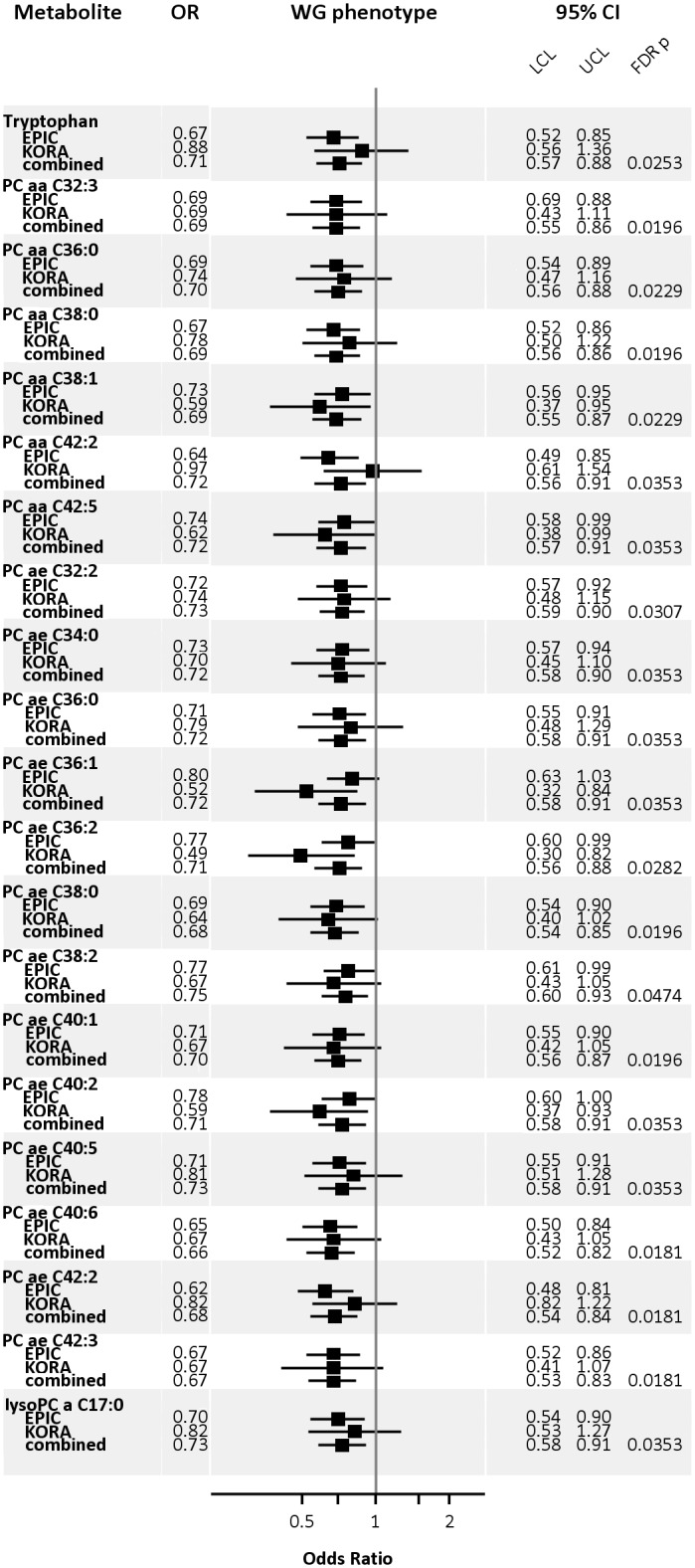
Results: Across studies both sexes gained on average more waist than hip circumference. We could identify 12 metabolites as being associated with the WG (n = 8) or HG (n = 4) in men, but none were significant after correction for multiple testing; 45 metabolites were associated with the WG (n = 41) or HG (n = 4) in women. For WG, n = 21 metabolites remained significant after correction for multiple testing. Respective odds ratios (OR) ranged from 0.66 to 0.73 for tryptophan, the diacyl-phosphatidylcholines (PC) C32:3, C36:0, C38:0, C38:1, C42:2, C42:5, the acyl-alkyl-PCs C32:2, C34:0, C36:0, C36:1, C36:2, C38:0, C38:2, C40:1, C40:2, C40:5, C40:6, 42:2, C42:3 and lyso-PC C17:0.
Conclusion: Both weight-gaining men and women showed a clear tendency to gain more abdominal than peripheral fat. Gain of abdominal fat seems to be related to an initial metabolic state reflected by low concentrations of specific metabolites, at least in women. Thus, higher levels of specific PCs may play a protective role in gaining waist circumference.
Conflict of interest statement
Figures
References
-
- Mensink GB, Schienkiewitz A, Haftenberger M, Lampert T, Ziese T, Scheidt-Nave C. [Overweight and obesity in Germany: results of the German Health Interview and Examination Survey for Adults (DEGS1)]. Bundesgesundheitsblatt, Gesundheitsforschung, Gesundheitsschutz. 2013. May;56(5–6):786–94. Ubergewicht und Adipositas in Deutschland: Ergebnisse der Studie zur Gesundheit Erwachsener in Deutschland (DEGS1). 10.1007/s00103-012-1656-3 - DOI - PubMed
-
- Chan JM, Rimm EB, Colditz GA, Stampfer MJ, Willett WC. Obesity, fat distribution, and weight gain as risk factors for clinical diabetes in men. Diabetes care. 1994. September;17(9):961–9. . - PubMed
MeSH terms
Substances
LinkOut - more resources
Full Text Sources
Other Literature Sources
