Review
. 2016 Aug:39:79-88.
doi: 10.1016/j.sbi.2016.06.003. Epub 2016 Jun 17.

Design and engineering of deimmunized biotherapeutics

Affiliations
Review

Design and engineering of deimmunized biotherapeutics

Karl E Griswold et al. Curr Opin Struct Biol. 2016 Aug.

Abstract

Therapeutic proteins are powerful next-generation drugs able to effectively treat diverse and devastating diseases, but the development and use of biotherapeutics entails unique challenges and risks. In particular, protein drugs are subject to immune surveillance in the human body, and ensuing antidrug immune responses can cause a wide range of problems including altered pharmacokinetics, loss of efficacy, and even life-threating complications. Here we review recent progress in technologies for engineering deimmunized biotherapeutics, placing particular emphasis on deletion of immunogenic antibody and T cell epitopes via experimentally or computationally guided mutagenesis.


Figures

Figure 1
Figure 1
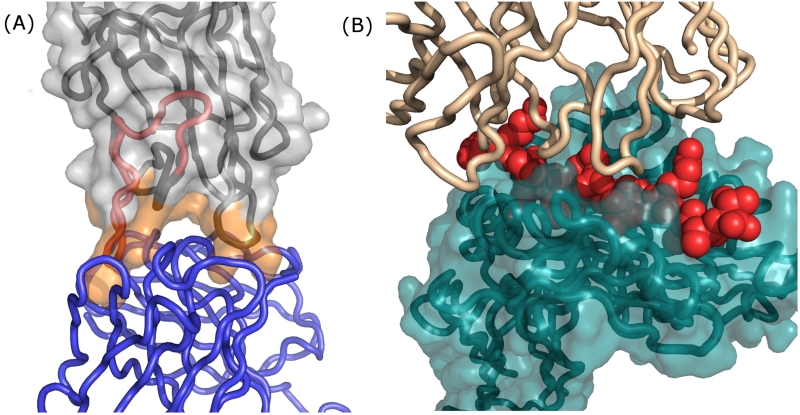
Recognition and binding of antibody versus T cell epitopes occurs via separate molecular mechanisms. (A) A co-crystal structure of the factor VIII C2 domain in complex with an inhibitory antibody; PDB id 1IQD.[85] The inhibitory antibody is rendered as a blue polypeptide backbone, and the factor VIII C2 domain is rendered as a molecular surface with the underlying polypeptide backbone shown in grey. C2 domain surface residues at the antibody binding interface are colored orange. Independent of the C2 antibody epitope, an experimentally validated C2 T cell epitope (IEDB id 131093)[62] is highlighted as a red segment on the polypeptide backbone. Note that a protein’s T cell epitopes may or may not overlap with its antibody epitopes. (B) Following proteolytic processing from internalized proteins, peptides that represent immunogenic T cell epitopes (red Van der Waals spheres) are bound in the cleft of class II MHC proteins (teal molecular surface with underlying teal peptide backbone); PDB id 1FYT.[86] The CDR regions of a cognate CD4+ T cell receptor are rendered as a tan polypeptide backbone. Formation of this ternary complex represents a key event that drives downstream development of high affinity antidrug antibodies. To reiterate, a T cell epitope need not share any amino acid residues with epitopes of resultant antidrug antibodies, though in this specific example there is at least some overlap. Images rendered with PyMOL (Schrodinger, LLC).
Figure 2
Figure 2
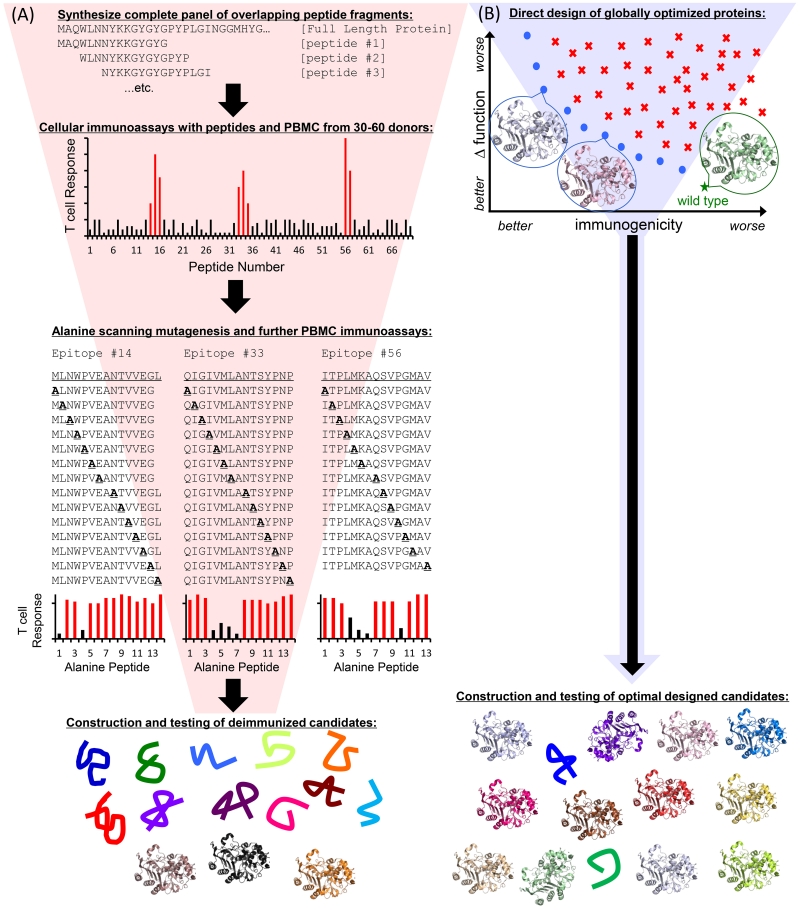
Schematic diagrams for T cell epitope deletion strategies. (A) Experimentally driven deimmunization is a multistage process, moving top to bottom. A panel of overlapping synthetic peptide fragments spanning the full sequence is synthesized. The peptides are then tested for immune recognition, typically using ex vivo cellular immunoassays with blood cells from large panels of human donors. High responses to overlapping immunogenic peptides are indicated by tall red bars. Identified immunogenic peptides are subjected to alanine scanning mutagenesis and retested with the donor human immune cells. Alanine-substituted peptides that reduce immune cell activation are highlighted as shorter black bars. Confirmed deimmunizing mutations are then engineered back into the full length protein and tested for expression, stability, and activity. Typical low hit rates are indicated by a majority of unfolded variant proteins, with only a few stable and active variants shown as cartoon structures. The process benefits from early identification of bona fide immunogenic peptides, but requires significant time and expense to funnel down to functional deimmunized candidates. (B) Computationally driven deimmunization addresses global protein design as a starting point. The protein design space is shown in two dimensions: predicted immunogenicity (x-axis) and predicted change in function (y-axis). Lower values are better in both objectives. Wild type has good molecular function but high immunogenicity. Sub-optimal designs are shown as red “x”es. The blue circles indicate Pareto optimal designs, or designs that are not simultaneously dominated on both objectives by any other single design. The Pareto frontier spans the full spectrum of optimal tradeoffs between the two objective functions. Representative protein designs are shown as cartoon structures. Individual, globally optimal designs balancing predicted reduction in immunogenicity and maintenance of function are selected for construction and analysis of expression, stability and activity. The high hit rate for folded and functional designs is indicated by a majority of cartoon protein structures. Computational optimization facilitates quick transition to validating candidates predicted to be functionally deimmunized. For both experimentally-driven and computationally-driven deimmunization projects, the final deimmunized candidates must be further tested for immunogenicity using cellular immunoassays and/or humanized murine models.

References

    1. Aggarwal S. What’s fueling the biotech engine - 2012 to 2013. Nat Biotech. 2014;32:32–39. - PubMed
    1. Baker MP, Reynolds HM, Lumicisi B, Bryson CJ. Immunogenicity of protein therapeutics: The key causes, consequences and challenges. Self Nonself. 2010;1:314–322. - PMC - PubMed
    1. Schellekens H. The Immunogenicity of Therapeutic Proteins. Discovery Medicine. 2010;49:560–564. - PubMed
    1. Sethu S, Govindappa K, Alhaidari M, Pirmohamed M, Park K, Sathish J. Immunogenicity to Biologics: Mechanisms, Prediction and Reduction. Archivum Immunologiae Et Therapiae Experimentalis. 2012;60:331–344. - PubMed
    1. Krishna M, Nadler S. Immunogenicity to Biotherapeutics – the role of Anti-drug Immune complexes. Frontiers in Immunology. 2016;7 - PMC - PubMed

Publication types